Overdose deaths in metro Atlanta increasingly involve unexpected adulterants that complicate emergency care. A new industrial chemical called BTMPS has appeared in fentanyl products across the United States at levels sometimes exceeding the fentanyl itself, and its presence in Georgia’s drug supply is highly likely.
This article explains what BTMPS is, how it affects overdose outcomes, and what Atlanta’s emergency responders and treatment providers need to know to protect lives.
What is BTMPS and Why Does it Matter?
BTMPS, or bis(2,2,6,6-tetramethyl-4-piperidyl) sebacate, is a plastic stabilizer never intended for human use. Community drug-checking programs first detected it in fentanyl samples in mid-2024, and forensic laboratories quickly confirmed its presence in at least 22 states.
Unlike fentanyl, BTMPS is not an opioid and does not respond to naloxone. Instead, laboratory studies show it blocks calcium channels in the heart, which can cause dangerously low blood pressure and slow heart rate even after naloxone reverses breathing problems.
The chemical is unscheduled and unregulated in the United States, making it easy to obtain and difficult to track. Its appearance in street drugs represents a troubling shift in how illicit supplies are manufactured or adulterated.
BTMPS Prevalence in the U.S. Drug Supply
National data paint a clear picture of rapid spread. Researchers analyzing samples from nine U.S. cities found BTMPS in 35% of fentanyl products, with an average concentration of 8.6% by mass.
In many samples, BTMPS outweighed the fentanyl itself, and some contained more than 56% BTMPS. The University of North Carolina’s Street Drug Analysis Lab confirmed over 850 BTMPS-positive samples across 14 states.
These high concentrations suggest deliberate addition rather than accidental contamination. Whether suppliers use BTMPS to stabilize fentanyl during transport, dilute potency, or for another reason remains unclear. What is certain is that BTMPS has become a structural component of the illicit opioid market.
Geographic Reach and Atlanta’s Risk
By late 2024, the DEA’s forensic database reported BTMPS in all states except Iowa, Minnesota, and Wyoming. Georgia’s proximity to Florida, where BTMPS has been detected, and Atlanta’s role as a regional distribution hub make local exposure highly probable.
Yet neither the Fulton County Medical Examiner nor the Georgia Poison Center has issued public alerts about BTMPS, suggesting a detection gap rather than absence from the market.
How BTMPS Affects Overdose Outcomes?
Cardiovascular Complications Beyond Naloxone
BTMPS acts as a potent L-type calcium channel blocker, a mechanism similar to prescription blood pressure medications. In overdose scenarios, this means:
- Naloxone can restore breathing but may not stabilize heart rate or blood pressure
- Patients may remain dangerously sedated or unstable despite adequate naloxone doses
- Cardiovascular monitoring and supportive care become essential
Animal studies cited by the Department of Homeland Security documented cardiotoxicity, ocular damage, and dose-dependent hemodynamic changes. Human toxicity data remain limited, but the pharmacology alone justifies clinical caution.
Polysubstance Mixtures Complicate Care
BTMPS rarely appears alone. Forensic analyses show frequent co-detection with:
- Fentanyl and fentanyl analogs
- Xylazine (a veterinary sedative)
- Medetomidine (another animal tranquilizer)
- Stimulants like cocaine and methamphetamine
- Local anesthetics such as lidocaine
Each adulterant adds layers of risk. Xylazine and medetomidine do not respond to naloxone and can cause profound sedation and cardiovascular depression.
Stimulants mask sedative effects initially but increase arrhythmia risk. When BTMPS joins this mix, emergency responders face overdoses that defy standard protocols.
Detection Challenges in Metro Atlanta
Laboratory Gaps
Standard toxicology panels do not include BTMPS. Detecting it requires specialized equipment like liquid chromatography with high-resolution mass spectrometry or Fourier-transform infrared spectroscopy.
The Center for Forensic Science Research & Education has published reference spectra and detection methods, but adoption by local laboratories takes time and resources.
Neither the Fulton County Medical Examiner nor the Georgia Bureau of Investigation publicly lists BTMPS in their testing protocols. This visibility gap means overdose deaths involving BTMPS may be attributed solely to fentanyl, masking the true complexity of the drug supply.
Community Drug Checking as Early Warning
Community drug-checking programs in Washington State and other regions identified BTMPS months before forensic laboratories confirmed widespread presence.
These programs allow people to test substances anonymously and provide real-time surveillance data. Atlanta currently lacks a robust drug-checking infrastructure, leaving the city blind to emerging adulterants until they appear in fatal overdoses.
Clinical Implications for Atlanta’s Emergency Response
Prehospital Care Adjustments
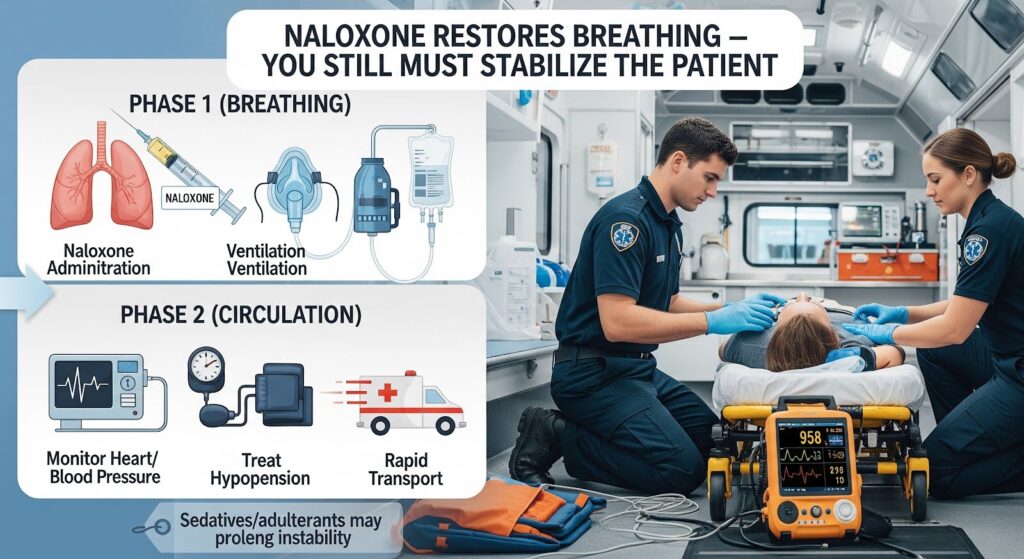
Emergency medical services should anticipate that naloxone alone may not stabilize patients. Key adaptations include:
- Administering multiple naloxone doses as needed for respiratory depression
- Prioritizing airway management and ventilatory support
- Monitoring for bradycardia and hypotension that persist after naloxone
- Transporting patients promptly even when breathing improves
Rescue breathing remains critical. When BTMPS or other sedatives are present, patients may not resume adequate breathing on their own despite naloxone.
Emergency Department Protocols
Hospital teams should prepare for prolonged sedation and cardiovascular instability. Recommended steps include:
- Continuous cardiac monitoring for all suspected polysubstance overdoses
- Avoiding medications that worsen bradycardia or hypotension without clear indication
- Extended observation periods to catch rebound sedation
- Toxicology consultation when presentations are atypical
The Georgia Poison Center can provide real-time guidance, but only if clinicians recognize and report unusual overdose patterns.
Naloxone Remains Essential
Despite BTMPS’s non-opioid effects, naloxone is still the first-line treatment for suspected opioid overdoses. The presence of adulterants does not change the need for rapid naloxone administration. It does mean that naloxone is necessary but not sufficient, and responders must be ready to provide additional support.
What Atlanta Can Do Now?
Expand Laboratory Capacity
The Georgia Bureau of Investigation and Fulton County Medical Examiner should add BTMPS to their toxicology panels. This requires:
- Acquiring reference standards and updating mass spectrometry libraries
- Training staff on detection methods and spectral interpretation
- Sharing results with public health agencies for rapid alerts
Collaboration with the Center for Forensic Science Research & Education can accelerate method development and validation.
Build Community Drug-Checking Infrastructure
Atlanta should establish drug-checking sites where people can test substances anonymously. Successful models in Washington and other states combine on-site screening with confirmatory laboratory testing. This approach:
- Provides early warning of new adulterants
- Empowers individuals to make informed decisions
- Generates real-time surveillance data for public health response
Funding through federal overdose prevention grants can support pilot programs.
Strengthen Public Communication
The Georgia Poison Center should create a standing “Emerging Adulterants” section on its website with monthly updates. Clear, accessible information helps:
- Emergency responders recognize atypical overdose presentations
- Treatment providers adjust clinical protocols
- Community members understand risks and harm reduction strategies
Transparency about what is known and unknown builds trust and encourages reporting of unusual cases.
Integrate Harm Reduction Services
Expanding naloxone access remains critical. Georgia should:
- Increase naloxone distribution through pharmacies, community organizations, and vending machines
- Provide free fentanyl and xylazine test strips
- Educate the public on rescue breathing and when to call 911
- Reinforce Good Samaritan protections that shield callers and overdose victims from certain drug possession charges
These measures save lives regardless of which adulterants are present.
The Bigger Picture: Polysubstance Overdoses in Georgia
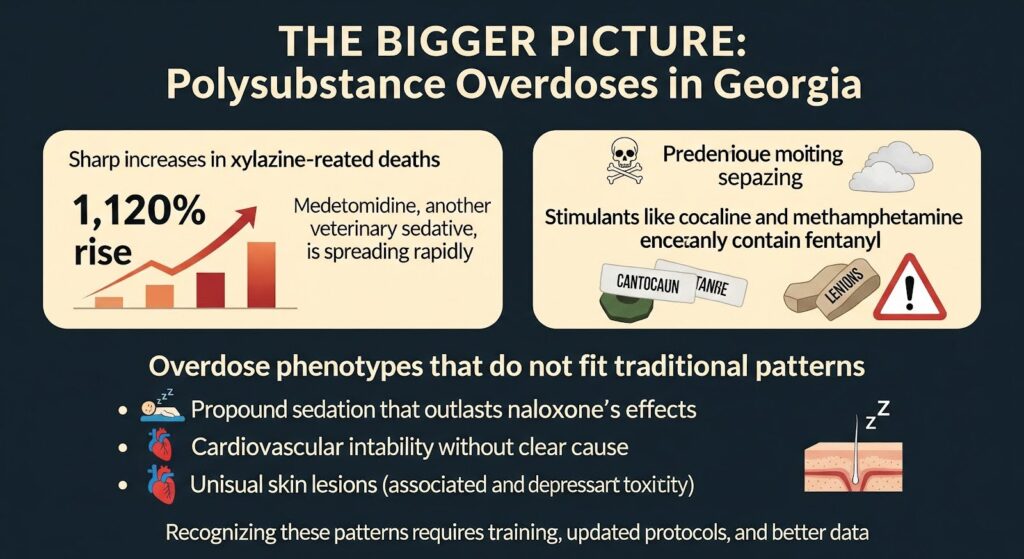
BTMPS is part of a broader trend. Georgia has seen sharp increases in xylazine-related deaths, with a 1,120% rise from 2020 to 2022. Medetomidine, another veterinary sedative, is spreading rapidly.
Stimulants like cocaine and methamphetamine increasingly contain fentanyl, exposing people with no opioid tolerance to lethal doses.
These polysubstance mixtures create overdose phenotypes that do not fit traditional patterns. Patients may present with:
- Profound sedation that outlasts naloxone’s effects
- Cardiovascular instability without clear cause
- Unusual skin lesions (associated with xylazine)
- Mixed stimulant and depressant toxicity
Recognizing these patterns requires training, updated protocols, and better data.
Research Priorities and Unanswered Questions
Much about BTMPS remains unknown. Critical research needs include:
- Human toxicology studies to define safe exposure limits and dose-response relationships
- Cardiac safety assessments using modern drug development frameworks
- Supply chain investigations to understand why BTMPS is being added
- Clinical registries to track overdose presentations and outcomes when BTMPS is detected
Atlanta’s academic medical centers and public health agencies are well positioned to lead this work.
Limitations and Cautions
This analysis relies on national data and inference. Georgia-specific BTMPS detections have not been publicly documented, and the absence of evidence is not evidence of absence. Community drug-checking data can be affected by cross-contamination, and laboratory methods continue to evolve.
Claims about BTMPS’s pharmacology should be updated as new studies emerge. Early reports of nicotinic receptor antagonism have not been reproduced in modern assays, highlighting the need for caution when interpreting preliminary findings.
Moving Forward: A Call to Action!
BTMPS represents a new challenge in an already complex overdose crisis. Its rapid spread, high concentrations in street drugs, and cardiovascular effects demand immediate attention.
Metro Atlanta has the infrastructure to respond effectively, but only if agencies act quickly to close detection gaps, strengthen surveillance, and update clinical protocols.
The path forward requires:
- Laboratory modernization to detect BTMPS and other emerging adulterants
- Community drug-checking programs for early warning
- Clinical training on polysubstance overdose management
- Public communication that is transparent, timely, and actionable
- Harm reduction services that meet people where they are
Every overdose involving BTMPS is an opportunity to learn and improve. By treating this as a solvable surveillance and care challenge rather than an invisible problem, Atlanta can protect lives and lead the Southeast in evidence-based overdose response.
If you or someone you care about is struggling with substance use, help is available. The Summit Wellness Group offers evidence-based treatment tailored to individual needs, including support for polysubstance use and dual diagnosis. Reach out today to start the path to recovery.