Brain mapping is a set of techniques that locate and measure brain activity so doctors can plan surgeries, pinpoint seizure sources, and guide treatment.
In presurgical epilepsy cases, for example, combining fMRI with white matter tract imaging produces an 81% true positive rate for identifying essential language areas when both tools agree.
This article breaks down how brain mapping is done, what it can diagnose, whether it is safe, what it costs, and when insurance will cover it.
What is Brain Mapping and Why Does It Matter?
Brain mapping is the process of identifying where specific functions live in your brain, how different regions connect, and which networks drive both healthy activity and disease. It blends structural imaging, functional scans, electrical recordings, and network analysis into a picture that guides real clinical decisions.
Doctors and surgeons use brain mapping to answer practical questions. Where exactly is the language center in this patient’s brain? Which white matter pathways sit near a tumor? Where do seizures start and spread? The answers shape whether surgery is safe, where a neurostimulation device should go, and how treatment should be adjusted over time.
The scope covers several layers:
- Structural mapping shows anatomy and white matter tracts through diffusion MRI tractography.
- Functional mapping captures task driven activations or resting network patterns through fMRI, MEG, and high density EEG.
- Invasive mapping uses direct electrical stimulation during surgery, electrocorticography, and cortico cortical evoked potentials.
- Network mapping applies lesion network analysis and connectome guided targeting to find shared brain circuits behind symptoms.
- Embedded mapping draws on chronic recordings from implanted neurostimulation devices like responsive neurostimulation (RNS) and deep brain stimulation (DBS) systems.
The American Academy of Neurology supports fMRI for specific presurgical roles in epilepsy, including language lateralization, through a practice guideline first published in 2017 and reaffirmed in 2026. That endorsement, though, comes with caveats about task design, analysis methods, and patient factors that can affect accuracy.
How is Brain Mapping Done?
Noninvasive Methods
Task based fMRI measures blood oxygen level changes while you perform specific tasks like naming pictures or tapping your fingers. It offers millimeter level spatial detail and is widely used for motor and language mapping before tumor or epilepsy surgery. Its main limits are false positives from co activated but non essential cortex and false negatives near tumors where blood flow is disrupted.
Resting state fMRI maps brain networks without any task at all. This is especially helpful for children or patients who cannot follow instructions during a scan. Society recommendations now specify at least six minutes of acquisition with eyes open and a fixation point to improve consistency across centers.
Diffusion MRI tractography traces white matter pathways like the corticospinal tract and arcuate fasciculus. Surgeons use it alongside fMRI to see which fiber bundles sit in the path of a planned resection. When fMRI and tractography both flag the same area as active, the chance of a true positive jumps to about 81% against direct cortical stimulation and 100% against cortico cortical evoked potentials. When the two disagree, the true positive rate drops below 25%.
MEG and high density EEG record electromagnetic signals from neurons with millisecond timing. A 2017 comparison found that both modalities achieve very accurate source localization when sensor counts are similar, with advanced inverse methods like cMEM producing the smallest spatial spread and least signal leakage. MEG tends to have a slight edge due to higher signal to noise ratio, but high density EEG complements it well for deeper or radially oriented sources.
Navigated transcranial magnetic stimulation (nTMS) uses magnetic pulses guided by MRI to map motor cortex before surgery. It shows high accuracy compared with direct cortical stimulation for motor areas and helps stratify surgical risk when paired with tractography.
Invasive Methods
Direct electrical stimulation (DES) remains the gold standard during surgery. For language mapping, the patient is typically awake and performs naming or counting tasks while the surgeon stimulates small cortical patches. For motor mapping, high frequency short train stimulation (the Taniguchi method) excites the corticospinal tract broadly with lower seizure risk than older low frequency approaches.
Electrocorticography (ECoG) records cortical activity in real time during surgery, monitoring for afterdischarges and providing a safety layer that guides how far a resection can go while protecting function.
Cortico cortical evoked potentials (CCEP) probe effective connectivity between brain regions. They serve as a reference standard that complements direct stimulation, especially for mapping language networks where fMRI alone may miss essential sites.
Network and Device Based Mapping
Lesion network mapping translates scattered lesion locations into shared large scale circuits using connectome data. These mapped networks have replicated established DBS targets, such as the cerebello thalamic network for essential tremor, and have identified candidate circuits for conditions like OCD and parkinsonism.
Responsive neurostimulation and DBS sensing turn implanted devices into long term mapping tools. A multicenter retrospective study of 25 patients with thalamic RNS showed a median seizure reduction of about 74% at over two years, comparable to long term cortical RNS results. Chronic recordings from these devices let clinicians track biomarkers like interictal epileptiform discharge suppression and link them to outcomes over months and years.
What Can Brain Mapping Diagnose?
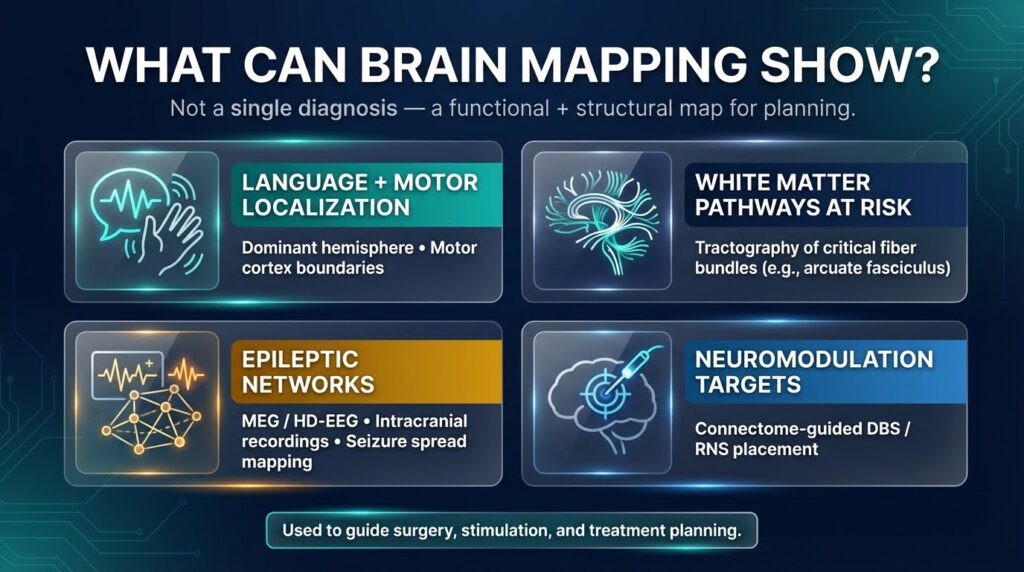
Brain mapping does not diagnose conditions the way a blood test confirms an infection. Instead, it reveals functional and structural details that inform diagnosis and treatment planning. Here is what it can show.
Language and motor localization. It identifies which hemisphere dominates for language and pinpoints motor cortex boundaries. This is critical before any surgery near eloquent brain tissue.
White matter pathways at risk. Tractography highlights fiber bundles like the arcuate fasciculus that could be damaged during resection, letting surgeons plan safer corridors.
Epileptic networks. MEG, high density EEG, and chronic intracranial recordings localize seizure generators and map how seizures propagate. Suppression of interictal discharges in RNS patients correlates with seizure reduction at the individual level, offering a measurable target for therapy tuning.
Neuromodulation targets. Lesion network mapping and connectomic analysis identify optimal electrode placement for DBS and RNS, moving beyond single site targeting toward network informed strategies.
What About ADHD and Autism?
Some clinics market quantitative EEG (qEEG) “brain mapping” as a diagnostic tool for ADHD or autism. The evidence here is much weaker. The theta/beta ratio, once promoted as an ADHD biomarker, does not reliably distinguish ADHD from controls in large, diverse samples.
A 2024 study found that the ratio correlates with attentional capacity within ADHD groups but does not serve as a diagnostic discriminator. Major insurers like Aetna and Blue Cross Blue Shield classify qEEG for ADHD and autism diagnosis as investigational and typically deny coverage.
Is Brain Mapping Safe?
Brain mapping is generally safe. Noninvasive methods like fMRI, MEG, EEG, and nTMS carry minimal physical risk. You lie in a scanner or wear a cap of sensors. There are no injections and no radiation with MRI or EEG based techniques.
Invasive mapping during surgery carries the standard risks of any neurosurgical procedure, including a small chance of seizure during direct electrical stimulation. The Taniguchi stimulation method was developed partly to lower that seizure risk compared with older approaches. ECoG monitoring adds a real time safety check.
For qEEG and neurofeedback, the physical risk is very low. The main safety concern is interpretive: a practitioner without deep EEG expertise may overinterpret a colorful brain map and assign a diagnosis that the data cannot support. The 1997 AAN/ACNS assessment explicitly warned about the substantial risk of erroneous interpretations by non experts.
Neurofeedback, when delivered by trained providers, shows few serious adverse events in controlled trials. Quality of the practitioner matters more than any inherent danger of the technique itself.
How Much Does Brain Mapping Cost?
Costs vary widely depending on the method, the clinical setting, and your insurance plan.
| Service | Typical Cost Range | Notes |
|---|---|---|
| Routine EEG (CPT 95816) | About $415 to $571 (national average negotiated rates) | Covered for standard neurologic indications |
| Digital EEG analysis / qEEG (CPT 95957) | About $330 to $462 (national average); UHC rates span roughly $174 to $504 | Covered as adjunct in epilepsy; often denied for ADHD/autism |
| Presurgical fMRI | Varies by facility; often bundled into surgical planning | Usually covered when medically necessary for epilepsy or tumor surgery |
| MEG | Higher cost; limited availability | Covered at many epilepsy centers for presurgical evaluation |
| Neurofeedback sessions | Varies; cumulative cost can be significant over 30 to 40 sessions | Coverage is inconsistent; many plans classify as investigational |
Medicare sets payment through relative value units adjusted by geographic practice cost indices. Private payer rates for the same CPT code can differ by hundreds of dollars across states and specialties. If you are considering brain mapping for a non covered indication, expect to pay out of pocket and ask for a cost estimate upfront.
Is Brain Mapping Covered by Insurance?
Coverage depends entirely on why the mapping is being done.
Typically covered: Routine and ambulatory EEG for epilepsy diagnosis and monitoring. qEEG as an adjunct to traditional EEG in presurgical epilepsy evaluation, ICU frequency trending, and long term seizure screening. fMRI and MEG for presurgical planning when medically necessary.
Typically not covered: qEEG “brain mapping” for ADHD, autism, anxiety, or other psychiatric diagnoses. Multiple major payers classify this use as experimental or investigational. Neurofeedback coverage varies by plan and often faces limits or denials.
If your doctor orders brain mapping for an established neurologic indication and documents the medical need clearly, insurance will usually pay. If a clinic offers qEEG brain mapping to diagnose ADHD or guide neurofeedback without a covered indication, you will likely bear the full cost yourself.
Is Brain Mapping Legitimate?
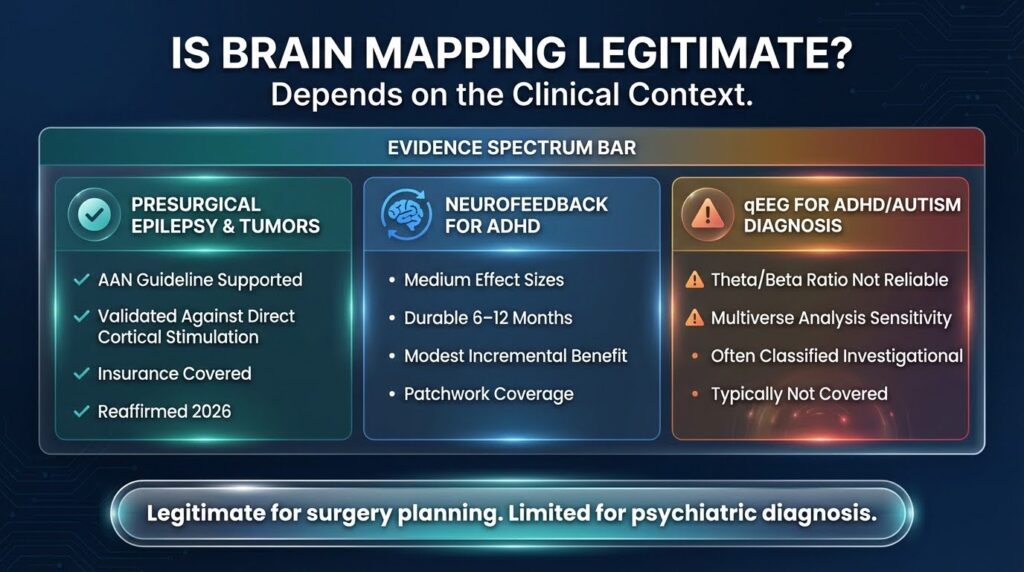
Yes, but context matters enormously.
For presurgical planning in epilepsy and brain tumors, brain mapping is backed by professional guidelines, validated against intraoperative gold standards, and recognized by insurers. The AAN guideline supporting fMRI in presurgical epilepsy evaluation was reaffirmed in 2026, reflecting continued confidence in its role.
For ADHD and autism diagnosis, the picture is different. The theta/beta ratio has not held up as a reliable diagnostic marker across real world populations. A 2026 multiverse analysis showed that the apparent ADHD association collapses or appears depending on analytic choices like referencing scheme, frequency band definitions, and inclusion criteria. Payers have followed the evidence: qEEG for psychiatric diagnosis remains non covered at most major plans.
Neurofeedback sits in between. Meta analyses show medium effect sizes for ADHD symptoms, durability at 6 to 12 months, and additive benefits when combined with medication in some randomized trials. It is a legitimate behavioral intervention, but its incremental benefit over active comparators is modest, and coverage remains a patchwork.
Brain Mapping Therapy and Ongoing Care
Brain mapping is not a one time snapshot. In modern practice, it feeds into an ongoing loop of planning, verification, and refinement.
Before surgery, a team builds a multimodal map using fMRI, tractography, MEG or high density EEG, and sometimes nTMS. During surgery, direct electrical stimulation and ECoG verify and update those maps in real time, accounting for brain shift that can throw off preoperative images. After surgery or device implantation, chronic sensing from RNS or DBS systems tracks network activity over months, linking electrophysiologic biomarkers to clinical outcomes and guiding therapy adjustments.
This integrated workflow represents the direction the field is heading: from static anatomical maps to dynamic, patient specific network control. No single modality captures everything. The strongest clinical confidence comes when multiple tools agree, and the greatest caution is warranted when they disagree.
Why Brain Mapping Matters for Your Care?
Brain mapping changes real outcomes. It helps surgeons remove more of a tumor or seizure focus while sparing the tissue you need for speech, movement, and memory. It guides where neurostimulation electrodes go and how they are programmed. And it provides measurable biomarkers that let doctors adjust treatment based on what your brain is actually doing, not just how you report feeling.
For families exploring qEEG or neurofeedback for ADHD, the honest answer is more nuanced. These tools may offer useful physiological information in the right hands, but they are not validated diagnostic tests for psychiatric conditions, and paying out of pocket for a non covered service deserves careful thought. Ask your provider what the results would change about your treatment plan. If the answer is unclear, the cost may not be justified.
If you or someone you care about is working through a mental health or substance use challenge and wants to explore evidence based treatment options, including brain mapping and biofeedback within a structured program, reach out to explore Summit’s treatment options with a team that can help you find the right path forward.