Mixing Adderall and alcohol is more dangerous than most people realize, and the reason is not what you might expect. The combination does not balance out stimulant and depressant effects.
Instead, Adderall can make you feel far less drunk than you actually are, which often leads to drinking more, taking bigger risks, and missing the warning signs of alcohol poisoning or a cardiovascular crisis.
This article walks through exactly what happens when you mix these two substances, why the interaction is risky, and who faces the greatest danger.
Adderall and Alcohol: Why the Mix is Risky?
Adderall contains mixed amphetamine salts and works as a central nervous system stimulant. Alcohol is a central nervous system depressant. Many people assume that taking a stimulant and a depressant together creates some kind of neutral middle ground. The evidence does not support that idea at all.
The CDC warns explicitly that mixing stimulants and depressants does not cancel their effects. Instead, the results are unpredictable, and one substance can mask the effects of the other, making overdose easier. That masking effect is the core of the problem.
When Adderall is active in your system, it can blunt the fatigue and sedation that normally signal you have had too much to drink. You may feel alert, social, and capable.
Your blood alcohol concentration, however, keeps rising. Your reaction time, judgment, and coordination remain impaired even though you feel functional. That gap between how you feel and how you actually are is what makes this combination so hazardous.
A systematic review published in *BMC Psychiatry* found that people using dexamphetamine with alcohol reported being able to drink more and socialize longer, and felt less perceived drunkenness or loss of control compared with alcohol alone. That finding is not reassuring. It is a direct description of the danger mechanism.
What Happens When You Mix Adderall and Alcohol?
Your Perception of Intoxication Becomes Unreliable
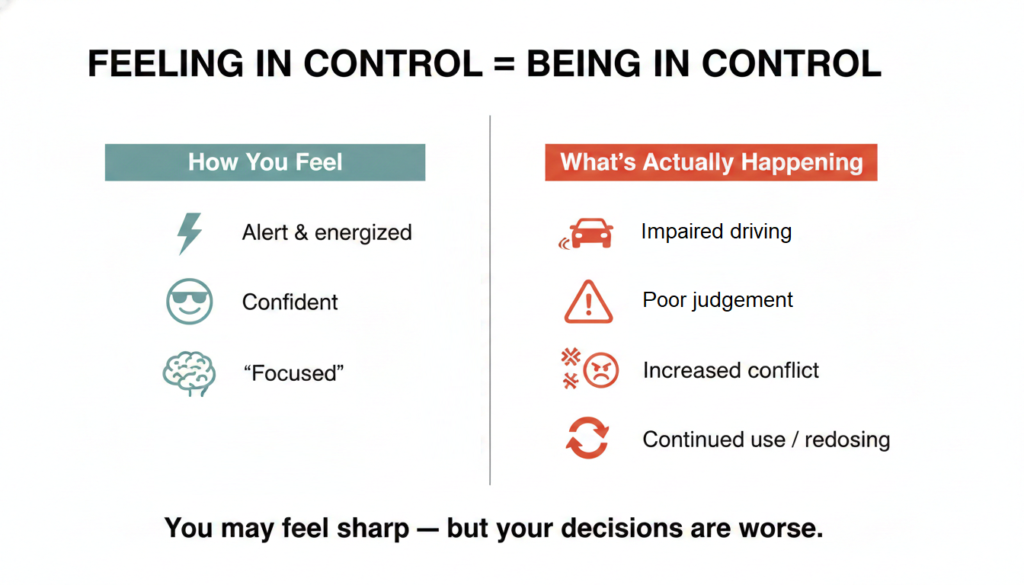
The most consistent finding across the research is that Adderall can make you feel less drunk than you are. You may keep drinking past the point where you would normally stop.
You may decide you are safe to drive when you are not. You may feel confident and in control while your blood alcohol level climbs and your actual impairment worsens.
This is not a minor inconvenience. It is a direct pathway to alcohol poisoning. When the body’s natural warning signals, such as drowsiness, dizziness, and nausea, are blunted by a stimulant, you lose the feedback loop that tells you to stop.
Your Behavior Becomes More Erratic
Alcohol lowers inhibition and impairs judgment. Adderall can increase alertness and confidence. Together, they can produce a state where you feel capable and energized while your self-monitoring and caution are significantly degraded.
Research on healthy college students taking Adderall found that the drug improved some attention-related measures but impaired working memory and did not reliably improve self-regulation.
Add alcohol to that picture and the result is someone who feels sharp but is actually making worse decisions.
This behavioral profile raises the risk of:
- Driving while impaired
- Aggression or interpersonal conflict
- Unsafe sexual decisions
- Continued drinking or stimulant redosing
- Accidents and injuries
Your Cardiovascular System Faces Added Strain
Adderall raises heart rate and blood pressure through its stimulant action on the sympathetic nervous system. Clinical review literature on adult ADHD medications explicitly highlights cardiovascular monitoring as a necessary part of stimulant prescribing.
Alcohol also affects blood pressure and heart rate in dose-related ways, as confirmed by a Cochrane-style review on alcohol’s blood pressure effects.
When both substances are active at the same time, the combined load on the cardiovascular system can be significant. This concern grows sharply if you are also dancing, overheated, dehydrated, sleep-deprived, or have any underlying heart condition or hypertension.
You May Drink Far More Than You Intended
Because the stimulant reduces the felt effects of alcohol, people often consume much more than they planned. The *BMC Psychiatry* systematic review described participants who could “drink like a trooper,” socializing longer and feeling less out of control.
That is not a benefit. It is a description of how the combination enables binge drinking by removing the body’s natural brakes.
More alcohol consumed means a higher risk of alcohol poisoning, greater dehydration, more cardiovascular strain, and a harder crash when the stimulant wears off.
Adderall and Alcohol Effects on Mental Health
The psychiatric dimension of this combination is often overlooked. Amphetamine use is associated with adverse mental health outcomes including anxiety, mood symptoms, and psychosis risk, as shown in a systematic review and meta-analysis on mental health outcomes linked to amphetamine use.
Alcohol can temporarily blunt anxiety but tends to worsen depression, emotional instability, and impulsive behavior over time.
When both substances are used together repeatedly, the cycle can look like this: stimulant use creates anxiety and insomnia, alcohol is used to come down, the crash worsens mood, and the stimulant is used again to restore function.
That pattern can accelerate the development of a substance use disorder and destabilize mental health in people who are already vulnerable.
A study of college students who misused stimulant medications found that 67% had a full or subthreshold prescription stimulant use disorder, and misusers had significantly higher rates of alcohol and drug use disorders compared with controls.
Who is at Greatest Risk?
The danger from mixing Adderall and alcohol is not evenly distributed. Some groups face substantially higher risk.
College students and young adults are the clearest high-risk group. National survey data show that nonmedical prescription stimulant use among U.S. college students is common, with past-year rates ranging from 0% to 25% across campuses, and users are significantly more likely to also use alcohol and other drugs. A separate study of undergraduates found that simultaneous use of nonmedical ADHD stimulants and alcohol was prevalent enough to warrant dedicated prevention efforts.
People using Adderall without a prescription face higher risk because they are often using it to party longer, stay awake, or enhance social experiences rather than to treat ADHD. A study found that among college students reporting stimulant use, those without prescriptions were more likely to use the drug to have a more enjoyable time and party longer.
People with cardiovascular conditions face elevated risk because the combined strain on heart rate and blood pressure from both substances can be clinically significant, especially during physical activity or in warm environments.
People with co-occurring psychiatric conditions such as anxiety, ADHD, depression, or a history of substance use disorders face a more complex risk profile because both substances can worsen underlying symptoms and reinforce maladaptive coping patterns.
Adderall and Alcohol Interactions in Real-World Settings
The research on simultaneous co-ingestion among U.S. adolescents and young adults provides some of the most important real-world evidence.
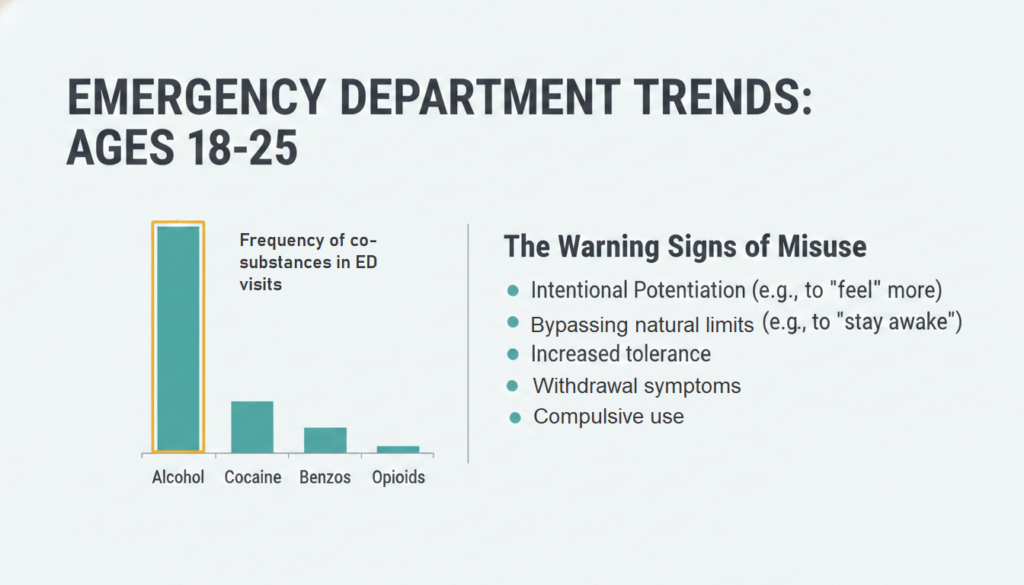
Among young adults aged 18 to 25 who appeared in emergency department visits involving nonmedical ADHD stimulant use, alcohol was the most common substance simultaneously co-ingested. That is not a theoretical risk. It is a pattern already showing up in emergency care.
A longitudinal study of college students found that by their fourth year, nearly 62% had been offered prescription stimulants for nonmedical use and 31% had used them. Alcohol and cannabis use disorders were consistently associated with nonmedical stimulant use across all four years.
A 2023 review of youth stimulant misuse noted that some college-age young adults report using prescription stimulants specifically to potentiate alcohol effects, meaning the combination is sometimes intentional.
That motivation is itself a warning sign because it reflects a deliberate attempt to bypass the body’s natural stopping signals.
Common Misconceptions About Mixing Adderall and Alcohol
“They cancel each other out.” This is false. Stimulants and depressants act on different systems and do not neutralize each other. The CDC is direct on this point: the combination is unpredictable and can mask the effects of one or both drugs.
“I can handle more alcohol when I’m on Adderall.” This belief is one of the most dangerous aspects of the combination. Feeling able to handle more is part of the mechanism that makes the interaction risky, not evidence that it is safe.
“My prescription makes it safe.” Prescription status means the medication is appropriate for treating a diagnosed condition under medical supervision. It does not make alcohol mixing safe. Even prescribed users can experience altered intoxication, greater drinking than intended, and elevated cardiovascular strain.
“If nothing bad happened last time, it’s fine.” Real harm from this combination often builds gradually through repeated overdrinking, worsening mental health, cardiovascular burden, and progression toward substance use disorder rather than through a single obvious crisis.
Why This Combination Matters Beyond the Immediate Risks?
The danger of mixing Adderall and alcohol is not limited to a single night. Repeated co-use can create a reinforcing cycle where each substance is used to manage the effects of the other.
Stimulants to stay awake and keep drinking, alcohol to come down from the stimulant, stimulants again to restore function. Over time, this pattern can produce tolerance, escalating use, and dependence on one or both substances.
The broader amphetamine literature also links regular stimulant use to mortality risk and serious psychiatric outcomes. While that research covers a wider range of amphetamine use than prescribed Adderall alone, it frames the combination within a risk landscape that extends well beyond a single social event.
The most defensible practical conclusion from the evidence is straightforward: if you take Adderall, avoid alcohol. If you are drinking, do not take Adderall. If you are struggling to follow that guidance, or if the combination has already become a pattern, that is worth taking seriously and discussing with a clinician.
If you or someone you care about is finding it hard to stop mixing prescription stimulants with alcohol, or if substance use has started to feel out of control, reaching out for support is a strong and practical next step.
The Summit Wellness Group offers individualized, evidence-based care for adults dealing with polysubstance use and co-occurring conditions. You can learn more about stimulant addiction treatment and take the first step toward getting help today.