Mixing Prozac and alcohol is something many people on fluoxetine wonder about, especially before a social event or a night out.
The short answer is no! You should not mix them, because alcohol can reduce Prozac’s benefits, worsen sedation and coordination, and destabilize the very mood symptoms the medication is meant to treat.
This article walks through exactly what happens when the two combine, what the research says, and when the situation can become genuinely dangerous.
Prozac and Alcohol: What the Interaction Actually Means?
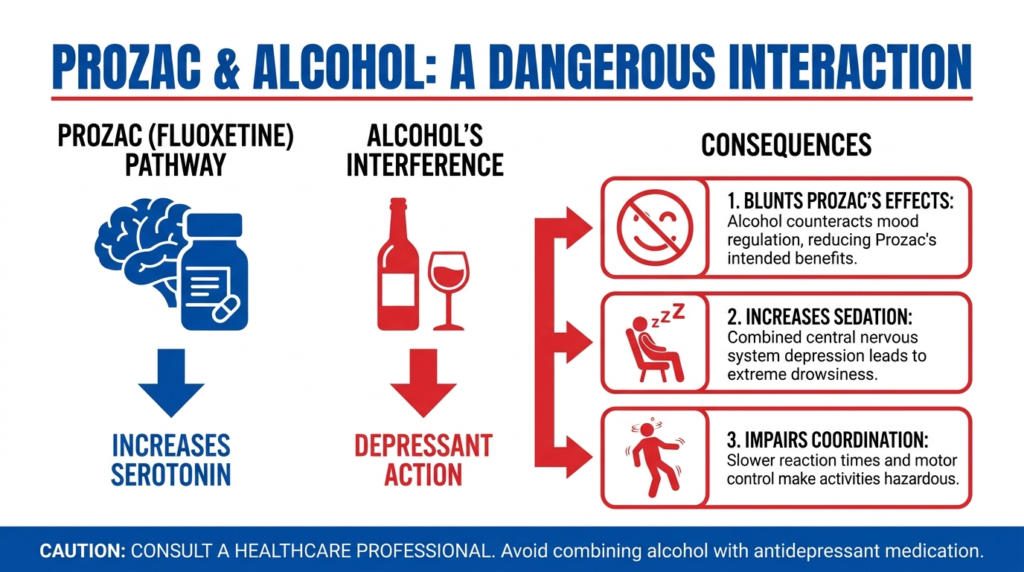
Prozac is the brand name for fluoxetine, a selective serotonin reuptake inhibitor (SSRI) prescribed for major depressive disorder, anxiety, obsessive-compulsive disorder, bulimia nervosa, and panic disorder. Alcohol is a central nervous system depressant. Put them together and you get a pairing that works against itself on almost every level.
One thing worth clearing up early: fluoxetine does not appear to dramatically raise your blood alcohol level. A controlled study found that fluoxetine did not meaningfully alter ethanol blood concentrations in healthy volunteers, and there was no significant change in blood pressure or heart rate. So the danger is not that Prozac makes you “get drunk faster” in a simple pharmacokinetic sense.
The real risks run deeper than that.
Alcohol can blunt the antidepressant benefit of fluoxetine, worsen the symptoms it is meant to treat, and add cognitive and motor impairment on top of any the medication already causes. The NAMI fluoxetine guidance is direct: avoid drinking alcohol while taking fluoxetine because alcohol may reduce the medication’s benefits and increase adverse effects such as sedation.
The FDA-linked prescribing information on DailyMed separately warns that fluoxetine may impair judgment, thinking, or motor skills, the same domains alcohol independently affects.
Side Effects of Prozac and Alcohol Together
When you mix Prozac and alcohol, several things can go wrong at once. Some effects are immediate and physical. Others build over time and affect your mental health and treatment progress.
Physical and Cognitive Effects
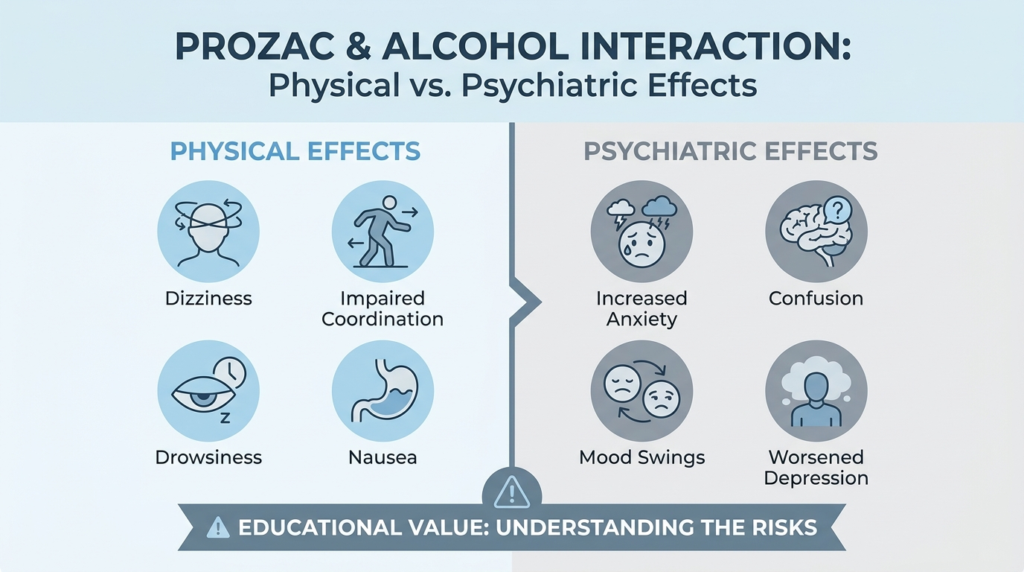
The most consistently reported short-term effects include:
- Increased drowsiness and grogginess, which raises the risk of falls, accidents, and poor decisions
- Dizziness and unsteadiness, which the NHS lists as serious enough to warrant urgent assessment if severe
- Impaired coordination and slower reaction time, making driving or operating machinery especially dangerous
- Slowed thinking, confusion, and reduced ability to focus
- Nausea, which can become dangerous if sedation is also present because of aspiration risk
- Next-day residual impairment, even after obvious intoxication has passed
Psychiatric and Emotional Effects
These are often the more consequential harms. Fluoxetine is prescribed to improve depression, anxiety, or panic, and alcohol can directly worsen all three. Drinking can fragment sleep, increase anxiety after the intoxication wears off, and leave you more irritable and emotionally volatile the following day.
NAMI specifically flags the following as warning signs to report to a prescriber promptly: new or worsening anxiety, restlessness, irritability, aggressiveness, and insomnia. Alcohol can trigger or intensify every one of those states.
There is also a suicidality concern. SSRIs carry a known monitoring requirement for children, adolescents, and young adults early in treatment. Alcohol lowers inhibition, worsens despair, and increases impulsivity, exactly the conditions under which self-harm risk rises.
The combination does not cause suicidality in a simple direct way, but it creates the circumstances where it becomes more likely in vulnerable people.
Can Alcohol Change How Prozac Works in Your Body?
Yes, and this goes beyond the psychological. Research published in a peer-reviewed journal found that alcohol consumption habit was associated with differences in fluoxetine concentration and half-life, suggesting alcohol may alter how the drug behaves in the body, not just how you feel.
That means regular drinking could affect whether fluoxetine reaches therapeutic levels at all.
Can You Take Prozac and Drink Alcohol? What About “Just One Drink”?
Many people ask whether a single drink is really a problem. The honest answer is: it depends on the person, but the risk is never zero, and the idea that one drink is always harmless does not hold up well under scrutiny.
Here is why. Fluoxetine has an unusually long half-life. According to StatPearls, fluoxetine itself has a half-life of about two to four days, and its active metabolite norfluoxetine persists for seven to nine days.
The drug can remain clinically active for weeks after the last dose. That means skipping a pill before drinking does not meaningfully reduce the interaction risk. The medication is still in your system.
Trying to time alcohol around your dose is pharmacologically unsound. It also risks breaking your treatment routine, which can worsen depression and make symptoms harder to manage.
A 2024 observational study following depressed adults on antidepressant therapy found that even moderate alcohol consumption, inferred from biomarkers, was associated with a higher risk of clinical relapse in some patient groups.
While that study focused more on SNRIs than SSRIs, it reinforces a broader point: alcohol cannot be treated as a harmless background habit during antidepressant treatment.
Prozac and Alcohol Interaction: What the Clinical Research Shows?
The research on fluoxetine and alcohol in people with alcohol use disorder (AUD) is more complicated than a simple warning label suggests. Here is what the evidence actually shows.
In adults without comorbid depression: A placebo-controlled trial found that fluoxetine had no significant effect on alcohol consumption in alcohol-dependent adults without major depression, even though both groups drank less during treatment. The authors concluded fluoxetine is probably not useful for relapse prevention in that population.
In adults with both major depression and alcohol dependence: A double-blind trial found that fluoxetine produced significantly greater improvement in depressive symptoms and significantly lower total alcohol consumption compared with placebo over 12 weeks. This suggests fluoxetine may help some patients with comorbid depression and dependence, but that is a very specific clinical context.
In adolescents with depression and AUD: A double-blind placebo-controlled trial found that fluoxetine was well tolerated but did not outperform placebo on depression or drinking outcomes when all participants also received CBT and motivational therapy. Psychosocial treatment appeared to drive most of the improvement.
At the guideline level: A 2023 Canadian clinical guideline raised concerns that SSRIs may not reliably improve depression in some AUD populations and may worsen alcohol outcomes in certain individuals, recommending caution with SSRIs in that context. That recommendation has been debated, with critics arguing it may be too broad for patients with well-diagnosed primary depression.
The takeaway from all of this is not that Prozac and alcohol are always catastrophic together, but that fluoxetine is not a reliable treatment for drinking behavior, and alcohol is not a neutral add-on to antidepressant therapy.
Can Prozac and Alcohol Kill You?
This is one of the most searched questions on this topic, and it deserves a direct answer.
The combination is not typically described as instantly fatal in a routine low-level exposure. But it can absolutely become dangerous or life-threatening under identifiable conditions. The following situations require emergency action:
- Collapse or loss of consciousness
- Seizure
- Trouble breathing
- Inability to awaken someone
- Severe dizziness or fainting
- Chest pain or pressure
- Very fast or irregular heartbeat
- High fever combined with agitation, muscle twitching, or confusion
- Suicidal thoughts or self-harm intent
If any of those occur, call 911 immediately. For non-emergency exposures in the US, Poison Control offers free, confidential help 24 hours a day at 1-800-222-1222.
The NHS also advises seeking urgent care for severe dizziness, fainting, chest pain, or shortness of breath in people taking fluoxetine.
Some sources mention serotonin syndrome as a risk. The evidence does not strongly support this as a common outcome from alcohol and Prozac alone.
However, in people taking multiple serotonergic medications, alcohol may contribute to a higher total serotonin burden, and any symptom cluster involving agitation, muscle twitching, rapid heart rate, fever, and confusion warrants emergency evaluation regardless of the final diagnosis.
Who Faces the Highest Risk?
Not everyone faces the same level of danger. Some groups need to be especially careful:
- People early in treatment or after a dose change, when side effects like grogginess and dizziness may already be present
- Young adults under 25, who have an elevated suicidality monitoring concern early in SSRI treatment
- People with alcohol use disorder or a pattern of binge drinking
- People with PTSD, trauma histories, or complex psychiatric diagnoses
- People taking multiple medications, where alcohol may amplify sedation or serotonin burden
- People with liver disease or other significant medical conditions
VA research found that about 41% of Veterans reported lifetime signs of AUD, and AUD was associated with higher rates of psychiatric disorders and suicidal behavior, with risk increasing alongside severity.
That data underscores how serious the overlap between alcohol misuse and psychiatric treatment can be in real-world populations.
What to Do If You Are Drinking While on Prozac?
If you are currently taking fluoxetine and drinking, the most important step is to tell your prescriber honestly. Do not skip doses to create a “safe window” before drinking, that approach is pharmacologically unsound and risks destabilizing your treatment.
Watch for these warning signs and contact your prescriber if you notice them:
- Worsening anxiety, irritability, or restlessness
- New or worsening insomnia
- Increased aggressiveness or emotional volatility
- Worsening depression or mood swings
- Difficulty cutting back on alcohol
- Side effects that interfere with daily life
If you have a pattern of heavy drinking or feel that alcohol is getting harder to control, that is worth addressing directly, not just as a medication safety issue, but as a health concern in its own right.
Why This Matters Beyond the Warning Label?
The standard advice to avoid alcohol on Prozac is not just a legal disclaimer. It reflects a genuine clinical reality: alcohol and fluoxetine are working at cross-purposes. One is meant to stabilize mood, reduce anxiety, and support recovery.
The other is a depressant that can worsen mood, disrupt sleep, lower inhibition, and make treatment harder to evaluate and manage.
When both are present, clinicians struggle to tell whether persistent symptoms reflect undertreated depression, alcohol effects, medication side effects, or poor adherence. That diagnostic confusion is itself a form of harm, it delays effective care and can leave people stuck in a cycle that neither medication nor willpower alone can break.
If alcohol use is a regular part of your life and you are also managing depression or anxiety, those two things are connected and both deserve attention.
If you or someone you care about is struggling with alcohol use alongside a mental health condition, reaching out to a program that treats both together is often the most effective path forward.
The Summit Wellness Group offers dual diagnosis treatment that addresses substance use and mental health at the same time, with individualized care designed to support lasting recovery.