7-Hydroxymitragynine is causing serious harm in communities across the United States.
Concentrated 7-OH products sold in gas stations and smoke shops are linked to overdoses, respiratory depression, and death.
This article explains what 7-OH does to your body, how long effects last, and why concentrated products are far more dangerous than traditional kratom leaf.
What is 7-Hydroxymitragynine?
7-Hydroxymitragynine is a potent opioid-active alkaloid associated with kratom, a tropical tree native to Southeast Asia.
While natural kratom leaf contains only trace amounts of 7-OH, modern U.S. markets increasingly feature products containing isolated, chemically enriched, or semi-synthetic 7-OH in tablets, gummies, powders, and liquid shots.
This distinction matters because concentrated 7-OH products are chemically and pharmacologically distinct from botanical kratom.
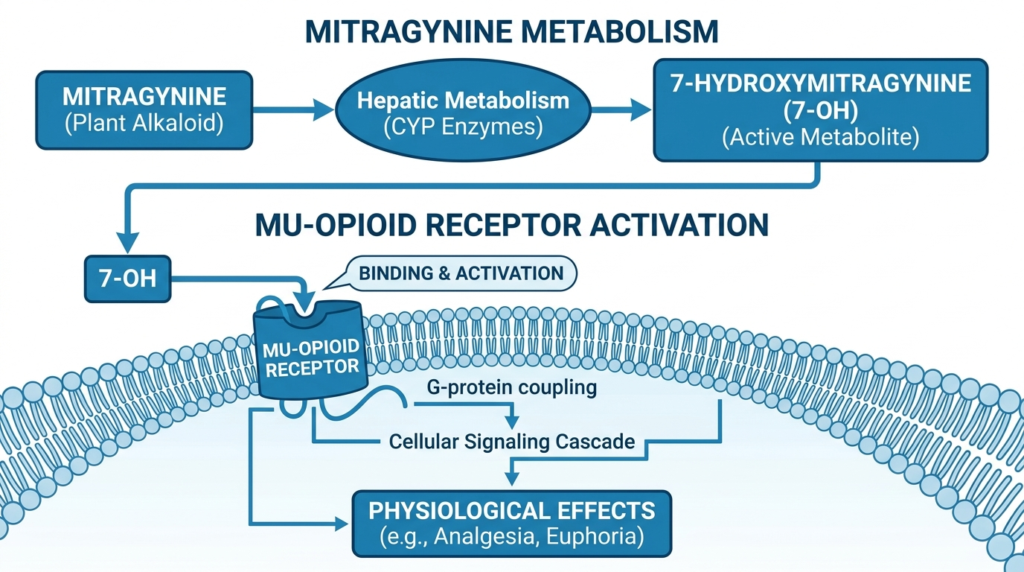
When you consume concentrated 7-OH directly, you bypass the limited metabolic formation that ordinarily constrains exposure after kratom ingestion. This explains why a product sold as “kratom” can behave much more like a potent opioid than a plant powder.
Natural Trace Constituent Versus Concentrated Retail Product
In humans using kratom leaf, some 7-OH exposure arises metabolically from mitragynine, but the amount is limited by physiology. Concentrated retail 7-OH products bypass that bottleneck and can produce markedly higher systemic exposures.
This is one of the clearest explanations for why 7-OH products may produce much more severe opioid-like effects and side effects than traditional kratom leaf.
The risk profile of 7-OH changed when it emerged as a distinct retail category in late 2023, separate from traditional kratom, and began appearing widely in gas stations, smoke shops, convenience stores, and online markets.
This commercialization combines higher concentrations, attractive consumer-ready formats, misleading labels, variable potency, lack of human safety testing, and easy nonmedical access.
How 7-OH Works in Your Body?
The most important mechanistic fact about 7-OH is that it acts primarily through the mu-opioid receptor. Research found that 7-OH produced potent antinociception mainly through activation of mu-opioid receptors.
Later pharmacology summaries describe 7-OH as a potent and selective MOR agonist with nanomolar affinity and greater efficacy than mitragynine.
This receptor-level mechanism explains most of the clinically relevant effects and side effects:
- Analgesia
- Euphoria or opioid-like subjective effects
- Sedation
- Respiratory depression
- Tolerance
- Dependence
- Withdrawal
- Overdose risk
Potency Relative to Morphine
The evidence repeatedly describes 7-OH as substantially more potent than mitragynine and, in many functional contexts, more potent than morphine.
FDA-linked summaries and state advisories have cited figures such as approximately 13-fold greater potency than morphine at opioid receptors.
The broader conclusion is secure: 7-OH is not a mild kratom-like alkaloid. It is a high-potency MOR-active compound.
Why Concentrated 7-OH Produces Stronger Effects?
The metabolic route matters. Mitragynine can act partly as a precursor to 7-OH. But when a person consumes concentrated 7-OH directly, especially via oral, sublingual, or intranasal milligram-dose retail products, they circumvent the limited metabolic formation that ordinarily constrains exposure after kratom ingestion.
This bridges basic pharmacology and public health. It explains why a product sold as “kratom” can behave much more like a potent opioid than a plant powder.
Main Effects of 7-Hydroxymitragynine
Analgesia
The clearest and best-supported direct effect of 7-OH is analgesia. Animal studies show potent antinociceptive effects mediated mainly by MOR activation. Earlier pharmacology work describes 7-OH as producing MOR-mediated analgesia with potency exceeding morphine in some models.
This analgesic effect is likely one reason products are marketed for pain relief. But no FDA-approved medical uses exist, and the compound is not legally permitted in dietary supplements or conventional foods. Therefore, the presence of opioid-like analgesia should not be mistaken for therapeutic legitimacy.
Sedation and Calming Effects
Multiple public health and treatment-oriented sources describe sedative or sleepiness-related effects. Missouri’s advisory lists sleepiness or loss of consciousness among observed effects.
Poison-center data include trouble breathing, sleepiness, and loss of consciousness. Recovery-oriented medical summaries also list drowsiness or sedation as common effects.
Sedation is better interpreted as an opioid effect with narrow separation from toxicity than as a benign calming effect.
Euphoria and Opioid-Like Subjective Effects
Some commercial and treatment discussions describe euphoria at low to moderate doses. More importantly, abuse-liability data support the idea that 7-OH can produce reinforcing opioid-like internal effects under some conditions.
In rats, 7-OH substituted for morphine self-administration and maintained self-administration on its own in dose-dependent fashion, unlike mitragynine. This finding strongly suggests that at least some users may experience 7-OH as rewarding or morphine-like.
Stronger-Than-Kratom Effects in Real-World Use
Emerging human clinical observations suggest that concentrated 7-OH may feel “stronger” than whole-leaf kratom.
In one clinical case-oriented report, a participant using 20 mg of 7-OH three times daily for four days had measurable pre-dose 7-OH levels, withdrawal symptoms, blunted or atypical effects from kratom during the study, and expressed preference for the stronger 7-OH product over a kratom rescue dose.
This is a particularly important translational finding because it bridges pharmacology, tolerance, and user preference.
How Long Do 7-OH Effects Last?
The best controlled human data come from a randomized, double-blind, placebo-controlled dose-escalation pharmacokinetic study of oral encapsulated dried kratom leaf powder.
In this study, kratom leaf powder doses ranged from 500 to 4000 mg powder, corresponding to 6.65 to 53.2 mg mitragynine, with single-dose and repeated daily dosing over 15 days studied.
Across these conditions, 7-OH showed rapid absorption with median peak concentration about 1.2 to 1.8 hours after a single dose and 1.3 to 2.0 hours after multiple doses.
The authors noted this peak timing was slightly longer than in some prior kratom tea studies, likely reflecting the capsule formulation.
What Peak Timing Means for Effect Duration?
Peak concentration is not the same as total duration of subjective effect, but it is the best controlled human indicator for timing of acute effect build-up. It strongly suggests that:
- Noticeable effects may begin within the first hour or two after oral kratom ingestion
- Peak 7-OH-related systemic exposure usually occurs by about 2 hours
- Repeated daily kratom dosing does not markedly delay absorption
For kratom-derived 7-OH exposure after oral encapsulated leaf powder, the acute opioid-like effect window appears to build quickly and peak within roughly 1 to 2 hours, with meaningful early effects concentrated in the first several hours after ingestion.
Why Concentrated 7-OH May Last Differently?
A crucial point emerges when human pharmacokinetic data are read alongside mechanistic and public health evidence. In ordinary kratom use, circulating 7-OH is constrained by mitragynine metabolism.
Concentrated 7-OH products bypass that formation-rate limitation. Therefore, onset, intensity, and duration may differ materially and may resemble direct opioid exposure more than kratom leaf exposure.
The 2025 review on the evolution from kratom to 7-OH explicitly states that human pharmacokinetic studies show systemic exposure after kratom ingestion, but concentrated 7-OH products bypass metabolic formation, producing markedly higher exposures.
This is the most important interpretive point in the entire duration question.
Side Effects of 7-Hydroxymitragynine
Gastrointestinal Effects
Nausea and vomiting are among the most consistently reported acute side effects across poison-center surveillance, state advisories, and treatment-oriented summaries.
Gastrointestinal distress is also listed in Missouri’s advisory. Constipation is a common opioid-class side effect and appears in clinical-treatment summaries of 7-OH as well.
These symptoms matter clinically because they can be part of early intoxication, part of withdrawal, or part of mixed-substance exposure.
Neurologic and Mental-Status Effects
Reported short-term adverse effects include:
- Agitation
- Confusion
- Anxiety
- Dizziness and lightheadedness
- Drowsiness
- Sleepiness
- Loss of consciousness
- Seizures
These effects appear repeatedly in poison-center data and state advisories. Missouri specifically lists agitation, confusion, anxiety, insomnia, depression, sleepiness or loss of consciousness, and seizures.
America’s Poison Centers lists agitation, confusion, sleepiness or loss of consciousness, and seizures.
The combination of sedation in some users and agitation or confusion in others is not unusual for high-potency psychoactive drugs sold in unregulated retail settings. Product variability, dose, co-ingestants, and stage of use likely shape presentation.
Autonomic and Cardiovascular Effects
Reported acute autonomic effects include sweating, rapid heart rate, and high blood pressure. These are present in poison-center surveillance and Missouri’s advisory.
These findings are important because they complicate simplistic narratives. While concentrated 7-OH is principally concerning for opioid-class toxicity, some adverse presentations still include sympathomimetic or mixed autonomic features, especially in real-world retail exposures where formulation and co-use are often unclear.
Respiratory Effects
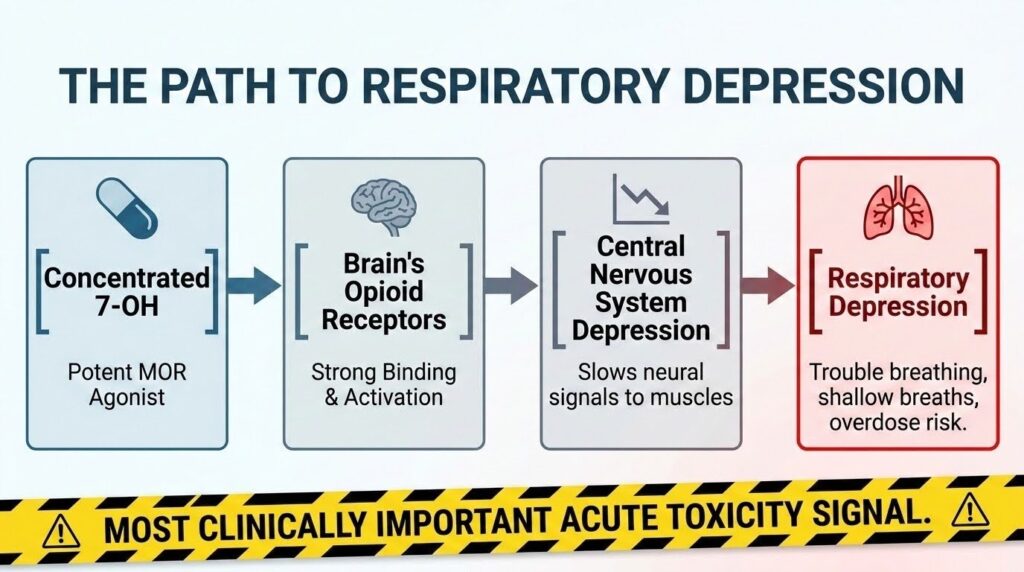
Trouble breathing and respiratory depression are among the most serious acute side effects and are central to the FDA-linked and state-level concern about 7-OH.
The 2025 toxicology review characterizes concentrated 7-OH as a potent MOR agonist with opioid-class risks including respiratory depression, and preclinical models consistently demonstrate respiratory depression.
Missouri explicitly warns that because 7-OH acts on opioid receptors, it can cause respiratory depression, overdose, and death. Poison-center advisories list trouble breathing among reported symptoms.
This is the most clinically important acute toxicity signal in the literature.
Sleepiness, Nodding, and Progression to Overdose
Because 7-OH is a potent opioid-like compound, sleepiness or heavy sedation can represent either a sought effect or the early phase of overdose. Missouri and poison-center sources both list sleepiness or loss of consciousness.
Treatment commentary has compared toxic 7-OH presentations to opioid overdose states, emphasizing respiratory depression and death.
Dependence, Tolerance, and Withdrawal Effects
Tolerance Develops With Repeated Exposure
One of the strongest pieces of evidence about repeated 7-OH use comes from mouse studies showing that tolerance develops to its antinociceptive effects similarly to morphine.
This is a classic opioid adaptation: the same dose produces less effect over time, encouraging escalation.
Tolerance has practical significance because concentrated retail products are often sold in fixed milligram strengths, which may encourage repeated use and upward titration when early effects diminish.
Cross-Tolerance With Morphine
The same animal work found cross-tolerance between 7-OH and morphine: mice tolerant to 7-OH showed reduced responsiveness to morphine and vice versa.
This suggests overlapping opioid mechanisms and supports the interpretation that 7-OH should be clinically regarded as operating within the same general dependence framework as classical opioids.
This finding also has implications for pain management and for transitions between substances.
Withdrawal Liability
Naloxone-induced withdrawal signs were elicited in mice chronically treated with 7-OH to a degree similar to morphine, indicating physical dependence.
More recent toxicology reviews and case reports reinforce that concentrated 7-OH can produce dependence and withdrawal in real-world settings. Missouri’s advisory lists withdrawal symptoms such as restlessness, body aches, fatigue, irritability, and cold sweats.
Emerging Clinical Evidence of Stronger Withdrawal
The case literature suggests that concentrated 7-OH products may produce withdrawal patterns stronger than those associated with whole-leaf kratom.
In the cited clinical report, recent 7-OH use was associated with measurable pre-dose levels and withdrawal symptoms, along with preference for the stronger 7-OH product.
Another 2025 case cited within the toxicology review involved inpatient medically managed withdrawal for 7-OH use. These are early data, but they align with the mechanistic expectation created by potency and MOR agonism.
Overdose, Severe Toxicity, and Mortality
Why Overdose Risk is Central
The most important severe side effect of 7-OH is overdose, primarily through opioid-class respiratory toxicity. Recent toxicology review authors explicitly describe concentrated 7-OH as carrying risks of respiratory depression, tolerance, dependence, withdrawal, and death, and conclude that concentrated 7-OH products pose significant morbidity and mortality risk under typical conditions of use.
Surveillance Signals
America’s Poison Centers reported that from January 1 to July 31, 2025 there were 165 reported exposures to 7-OH, and among patients reporting exposure to 7-OH alone, 35% had serious health problems and 67% were treated at a healthcare facility.
Those are high-severity numbers for an emerging retail product. Reported symptoms included trouble breathing, sleepiness or loss of consciousness, seizures, and cardiovascular or autonomic symptoms.
Missouri’s poison data also showed increasing exposure reports involving kratom or another product containing 7-OH, and the advisory noted increased reporting of adverse reactions requiring immediate clinical intervention.
Fatality Signals
The 2025 review notes forensic investigations documenting fatalities with postmortem 7-OH concentrations consistent with opioid overdose and cites state health departments reporting severe intoxications and fatalities.
Montana’s attorney general stated that the Montana Department of Health and Human Services had recorded 29 deaths in Montana involving 7-OH since 2020. These state press-release figures should be interpreted carefully because “involving” does not necessarily prove sole causation. Nevertheless, they reinforce the seriousness of the signal.
Co-Use Magnifies Risk
Missouri specifically warns that combining 7-OH with alcohol, other sedatives, illicit substances, or certain prescribed medications can amplify the risk of severe respiratory depression and death. This is entirely consistent with opioid toxicology.
Naloxone Relevance
Missouri advises that anyone who suspects overdose should call 911 immediately and administer naloxone if available. Montana’s advisory likewise notes that naloxone can stop a 7-OH overdose. This is highly informative: it further supports the practical clinical interpretation of 7-OH intoxication as opioid intoxication.
How 7-OH Differs From Traditional Kratom?
The Most Important Distinction
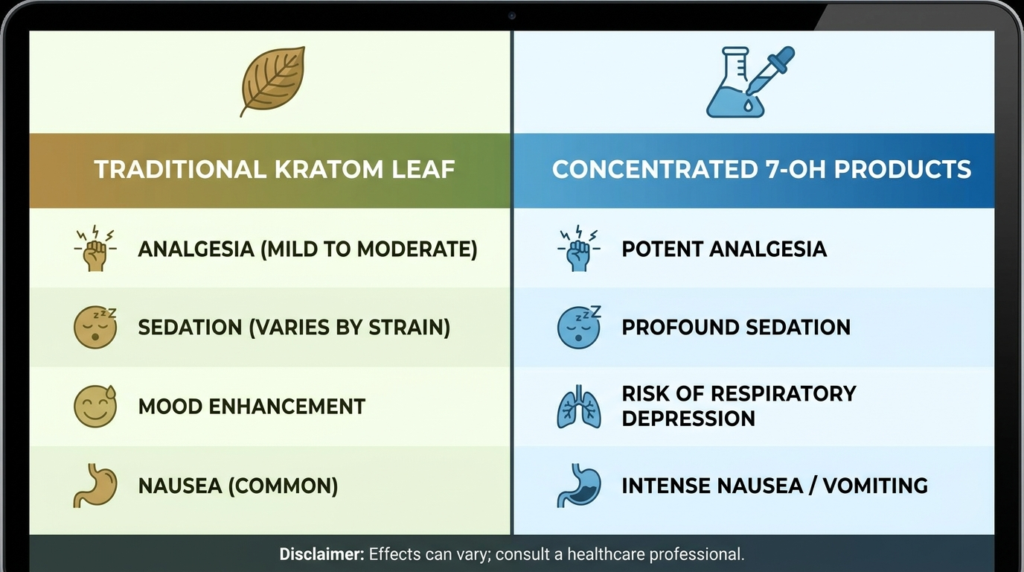
The supplied literature repeatedly insists that concentrated 7-OH products are pharmacologically and toxicologically distinct from traditional kratom leaf. This is not a minor technical point; it is the foundation for any accurate description of effects.
Traditional kratom leaf contains only trace 7-OH. Concentrated U.S. products may contain isolated or semi-synthetic 7-OH at levels far above botanical exposure, resulting in stronger opioid effects and more severe side effects.
Why Conflation Causes Harm
When concentrated 7-OH products are mislabeled as “kratom,” several harms follow. Consumers may underestimate potency. Clinicians may misclassify the exposure.
Surveillance systems may miss the true agent. Regulators may apply the wrong policy framework. And users may treat an opioid-like product as a benign herb.
This problem is explicitly recognized in recent clinical assessment commentary and FDA-related communications.
Long-Term Health Risks of 7-Hydroxymitragynine
Tolerance and Escalating Use
Animal and mechanistic reviews report development of tolerance to 7-OH with repeated administration, mirroring classic opioids. FDA-related assessments and the 2025 review note escalating dose requirements and preclinical evidence of tolerance to antinociceptive effects.
Tolerance is not just a nuisance effect. It is a central mechanism of long-term harm because it can push users toward larger doses, more frequent dosing, stronger formulations, and greater risk of overdose, especially when product concentrations are unlabeled or inconsistent.
Physical Dependence and Withdrawal
Kratom dependence literature indicates that regular use of mitragynine and 7-HMG induces dependence and withdrawal, including psychological symptoms such as anxiety, restlessness, irritability, depressed mood, and physical symptoms like myalgia, joint pain, insomnia, diarrhea, chills, tremors, and loss of appetite.
A more recent 2025 case report specifically involving concentrated 7-OH describes severe opioid-like withdrawal including insomnia, myalgia, anxiety, diaphoresis, gastrointestinal upset, and severe complications in a complex polysubstance context.
There are no FDA-approved pharmacotherapies specifically for kratom or 7-OH withdrawal, but symptomatic management with clonidine, hydroxyzine, benzodiazepines, and in some reports buprenorphine or methadone may be used.
Addiction Liability and Reinforcing Properties
Animal data summarized in recent reviews show that 7-OH has reinforcing properties, reward-related behavior, tolerance, dependence, and opioid-like abuse liability.
The review states that concentrated 7-OH products align toxicologically with classical opioids rather than botanical kratom and demonstrate reinforcing properties characteristic of opioids.
Human long-term epidemiologic addiction outcomes remain incompletely defined, but the convergence of receptor pharmacology, preclinical reward data, observed tolerance and dependence, consumer product concentration, and emerging case reports makes addiction liability highly plausible and clinically significant.
Respiratory Depression and Overdose
Preclinical work showed 7-OH causes dose-dependent respiratory depression, mitragynine’s respiratory effects appear partly mediated by conversion to 7-OH, and mitragynine shows a ceiling effect due to metabolic saturation. Therefore, concentrated 7-OH may carry greater overdose risk than ordinary kratom leaf products.
Los Angeles County reported fatal overdoses linked to 7-OH, warning that high doses or co-use with alcohol or sedatives can cause severe respiratory depression and death, and that naloxone can reverse toxicity though repeated doses may be needed.
The LA County press release reported three fatal overdoses in otherwise healthy adults aged 18 to 40, with alcohol present in all cases and no other substances identified as substantively contributing to death.
Seizures and Neurological Risk
Public health sources in 2025 included seizures in reported clinical presentations. The seizure signal is real enough to warrant caution, but the causal pathway is less certain than for respiratory depression.
Some seizure cases may reflect high dose, adulterants, co-ingestants, product contamination, or underlying predisposition.
Psychiatric Destabilization
Recent review literature on concentrated 7-OH products describes clinical cases involving psychiatric destabilization and, in some cases, severe self-harm.
A recent case report involving concentrated 7-OH and nicotine pouch withdrawal described severe agitation and psychosis in a polysubstance context.
This is an emerging risk area. The evidence is not yet strong enough to say 7-OH commonly causes psychosis by itself, but psychiatric destabilization may occur, especially with heavy chronic use, withdrawal, co-use of other substances, sleep deprivation, or preexisting vulnerability.
Product Type as the Main Risk Multiplier
Appealing Formulations
Many 7-OH products are sold in forms that likely increase uptake and reduce risk perception: gummies, candies, dessert-themed formats, liquid shots, drink mixes, tablets, and colorful packaging.
These features matter because formulation affects both dosing behavior and user expectations. Products resembling candy or supplements may encourage non-opioid framing by consumers.
Deceptive or Ambiguous Labeling
FDA-related and clinical sources repeatedly note that labels may disguise concentrated 7-OH as “kratom extract” or “natural supplements.” This raises the risk of both accidental exposure and delayed recognition of adverse effects.
Retail Access
Gas station, convenience store, smoke shop, and online sales create low-friction access to a potent opioid-like agent outside normal clinical safeguards. That retail pathway is itself a risk factor because it disconnects potency from professional oversight.
Clinical Recognition: What Healthcare Providers Should Watch For
Why 7-OH May Be Missed
Clinical recognition is difficult because patients may report “kratom” use without realizing the product contained concentrated 7-OH. Misleading marketing hampers clinical assessment and better assessment methods and real-time confirmatory testing are needed.
Exposure Patterns
Providers should suspect concentrated 7-OH when patients report “kratom” gummies, shots, tablets, or sublinguals; products bought in gas stations, smoke shops, vape shops, or online; unusually strong opioid-like effects from a supposed kratom product; rapid tolerance or pronounced withdrawal; or overdose symptoms responsive to naloxone.
Clinical Symptom Clusters
The most relevant symptom clusters are:
Opioid-intoxication cluster: drowsiness, decreased responsiveness, respiratory depression, miosis if present, overdose.
Mixed acute adverse-effect cluster: nausea and vomiting, sweating, agitation or confusion, tachycardia, hypertension, seizures.
Withdrawal cluster: restlessness, body aches, irritability, cold sweats, fatigue, dysphoria, insomnia.
Treatment Implications
Public health and evidence-to-impact sources note that evidence-based treatments used for opioid use disorder can also be effective for kratom use disorder; by extension, they are highly relevant to 7-OH dependence presentations given the shared opioid mechanism. Missouri specifically recommends naloxone in suspected overdose.
Why Does It Matter?
The best current evidence shows that 7-hydroxymitragynine produces effects and side effects that are fundamentally opioid-like, especially when delivered as concentrated, isolated, or semi-synthetic retail products. Its core direct effect is potent MOR-mediated analgesia, often described as exceeding morphine in functional potency in preclinical settings.
It can also produce sedation and opioid-like subjective effects. But those same mechanisms drive the main side effects: nausea, vomiting, constipation, confusion, agitation, sweating, rapid heart rate, high blood pressure, sleepiness, loss of consciousness, seizures, respiratory depression, overdose, tolerance, physical dependence, withdrawal, and death.
The most important interpretive point is that concentrated 7-OH should not be treated as equivalent to traditional kratom leaf. The strongest and most recent evidence repeatedly distinguishes them. Traditional kratom leaf exposes users to only trace natural 7-OH and limited metabolically generated 7-OH. Concentrated products bypass those limits and can produce much higher systemic exposure and far more dangerous opioid toxicity.
If you or someone you care about is using concentrated 7-OH products or struggling with kratom dependence, our professional help is available. The Summit Wellness Group offers evidence-based addiction treatment with medication-assisted therapy, dual-diagnosis support, and compassionate care designed to support long-term recovery.
Reach out today to speak with our specialist who understands opioid-like substance use and can help you take the next step toward safety and healing.