Yes, people can overdose on 7-hydroxymitragynine (7-OH), and the evidence shows that concentrated 7-OH products carry serious opioid-like overdose risks.
Recent federal surveillance found that kratom-related poison center reports surged 1,200% from 2015 to 2025, with 233 deaths associated with kratom products during that period, and 79% of those fatalities involved multiple substances.
This article examines what the best available data reveal about 7-OH overdose risks, symptoms, and mortality patterns.
What 7-OH is and Why Does It Differ From Traditional Kratom?
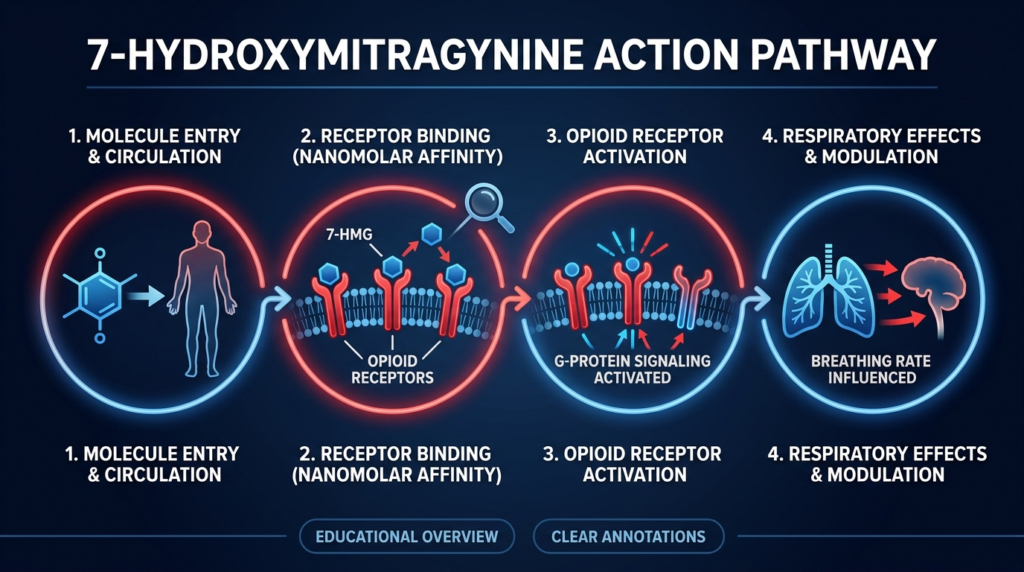
7-hydroxymitragynine is a potent alkaloid related to kratom and a metabolite of mitragynine, the main compound in *Mitragyna speciosa* leaf. Unlike mitragynine, 7-OH acts as a strong μ-opioid receptor agonist with pharmacology that more closely resembles classical opioids than traditional botanical preparations.
The distinction matters because the U.S. market has shifted dramatically. The CDC’s 2026 surveillance report explicitly identifies a transition from traditional leaf preparations to powders, tablets, gummies, concentrated shots, and products enriched with isolated alkaloids, especially 7-OH.
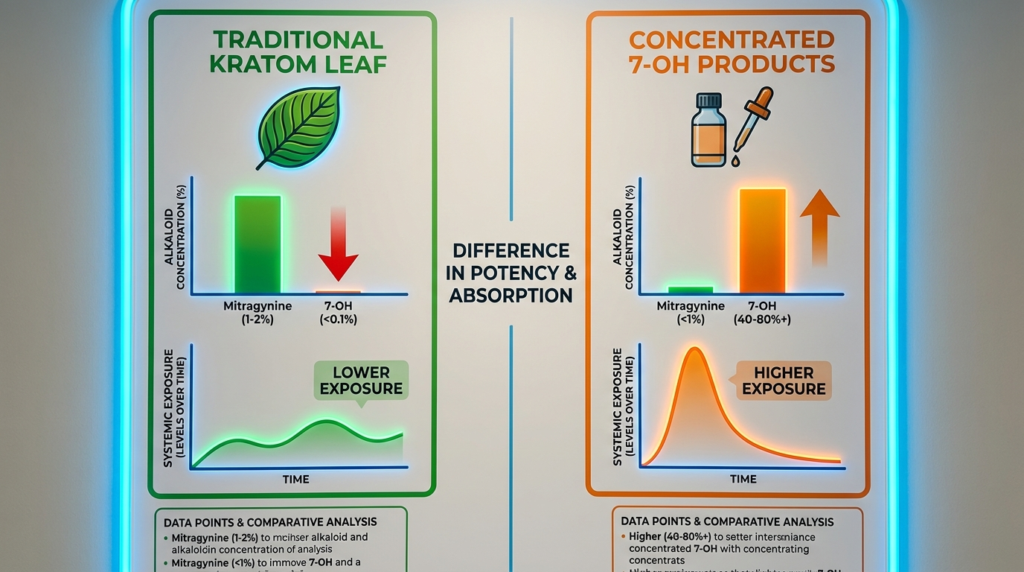
These concentrated products can deliver much higher systemic exposure than natural leaf, which contains only trace amounts of 7-OH.
A 2025 peer-reviewed analysis states that concentrated or semi-synthetic 7-OH products are pharmacologically and toxicologically distinct from kratom leaf because they bypass limited metabolic formation from mitragynine and can produce much higher blood levels.
This is not a minor regulatory detail. It changes the overdose question from “Can traditional kratom leaf cause severe toxicity?” to “Can a potent μ-opioid agonist sold under kratom-adjacent branding cause opioid overdose?”
The evidence strongly indicates yes.
How 7-OH Acts in the Body?
The strongest mechanistic reason to expect overdose from 7-OH is its potent μ-opioid receptor activity. Research shows nanomolar affinity and greater efficacy than mitragynine, with functional potency often exceeding morphine.
Direct receptor binding data demonstrate a Ki of 16 nM at the μ-opioid receptor for 7-OH versus 238 nM for mitragynine, showing much stronger receptor affinity.
In opioid toxicology, nanomolar receptor affinity combined with agonist efficacy is highly relevant because respiratory depression is mediated largely through opioid action in brainstem respiratory centers.
When a compound strongly activates these receptors, overdose potential is not incidental; it is expected unless counterbalanced by other pharmacologic constraints.
Relative Potency Compared With Other Opioids
7-OH is not simply “a little stronger” than kratom’s main alkaloid. Research reports that 7-OH’s μ-opioid receptor affinity is roughly fivefold stronger than mitragynine’s, and its antinociceptive potency is approximately 40-fold greater than mitragynine and about 10-fold greater than morphine in cited assays.
This is central to overdose interpretation. If a concentrated commercial product contains a compound with opioid potency at or above morphine-like levels, overdose is not an edge case; it is a foreseeable consequence of misdosing, co-use, or loss of tolerance.
Evidence From Respiratory Studies
The most direct preclinical evidence comes from a 2025 study on breathing effects in rats. Both morphine and 7-hydroxymitragynine induced significant respiratory depression, evidenced by reductions in breathing frequency, tidal volume, and minute volume. Investigators concluded that 7-hydroxymitragynine induced respiratory depression comparable to morphine, and naloxone fully reversed this effect.
This is highly consequential for overdose interpretation because it demonstrates a direct breathing hazard, similarity to a known opioid, opioid receptor mediation, and reversibility with naloxone. These features place 7-OH squarely within the biological framework of opioid overdose rather than within a vague category of herbal supplement adverse effects.
In the same experimental program, mitragynine increased respiratory frequency and did not produce significant respiratory depression at tested doses.
This does not imply mitragynine is harmless; it implies that its hazard profile differs. The significance statement of the paper explicitly emphasizes critical pharmacological differences between kratom-related alkaloids and highlights the risk associated with products containing high concentrations of 7-hydroxymitragynine.
National Exposure Trends: What Poison Center Data Reveal?
The most robust national trend data come from the CDC’s 2026 report on National Poison Data System reports. Poison centers received 14,449 kratom exposure reports during 2015–2025. Reports climbed from 258 in 2015 to 3,434 in 2025, a roughly 1,200% increase.
This is not a marginal increase; it is a steep acceleration consistent with rapid product diffusion and increased toxicity requiring intervention. Among patients exposed to 7-OH alone in a separate 2025 poison center advisory, 35% had serious health problems and 67% were treated at a healthcare facility.
Multiple-Substance Exposures Were More Dangerous
While single-substance reports made up most reports overall, multiple-substance exposures were more severe. They were associated with higher hospitalization rates, higher rates of serious outcomes, and accounted for 184 of 233 deaths (79%) in the CDC study period.
That pattern directly informs how one should interpret consumer risk. The biggest lethal signal is not kratom alone in a vacuum; it is kratom or 7-OH in combination with other psychoactive or respiratory-depressant substances.
Historical Mortality Data and Surveillance Gaps
The most cited early federal mortality source is the CDC’s 2019 report on unintentional drug overdose deaths with kratom detected across 27 states.
Among 27,338 overdose deaths entered into the State Unintentional Drug Overdose Reporting System, 152 (0.56%) were kratom-positive on postmortem toxicology, and 91 were determined by medical examiners or coroners to be kratom-involved causes of death.
This report is often invoked in modern discussions, but it is essential to understand its limits: it is a kratom/mitragynine report, not a 7-OH-specific report.
Only seven of the 152 kratom-positive decedents had kratom as the only substance detected on postmortem toxicology, and even then additional substances could not be ruled out because testing protocols varied.
Why Historical Numbers Probably Undercount Modern 7-OH Deaths?
A 2025 peer-reviewed review concludes that 7-OH can produce fatal opioid toxicity and that prior U.S. surveillance likely undercounted 7-OH-related poisonings and deaths because many labs tested only for mitragynine rather than 7-OH specifically. This is one of the most significant insights in the evidence base.
It resolves an apparent contradiction: older surveillance often found relatively few kratom-only deaths, yet newer toxicology and public health alerts are increasingly focused on 7-OH.
The likely explanation is not merely that 7-OH is newly dangerous; it is also that older systems were not well designed to detect it.
Los Angeles County Cases: The Strongest Documented Cluster
On September 12, 2025, Los Angeles County public health officials warned that the medical examiner had identified three fatal overdoses in county residents ages 18–40 tied to 7-OH.
The county stated that alcohol was present in all cases, that the decedents were otherwise healthy, and that no other substances were identified as substantively contributing to their deaths.
The associated clinical alert warned that high doses of 7-OH, especially with alcohol or other sedatives, can cause severe respiratory depression and death, and that naloxone can reverse 7-OH toxicity though repeated doses may be required.
By October 2025, Los Angeles County reported three additional fatal overdoses associated with 7-OH ingestion, bringing the total to six. This later notice added nuance: alcohol was present with 7-OH in many of the fatal cases, along with other medications and at times illicit substances, though descendants were otherwise generally healthy.
Later reporting by the *Los Angeles Times* stated that in the medical examiner’s reports, five of the six deceased had causes of death listed as “mixed drug effects,” while the sixth was listed as cocaine overdose, with kratom and 7-OH present alongside other substances including alcohol, sedatives, muscle relaxers, or cocaine.
A disciplined conclusion must hold two facts at once: Los Angeles County officials clearly identified a real cluster of deaths associated with 7-OH exposure, enough to trigger formal public health alerts and retail enforcement actions.
At the same time, the exact degree to which 7-OH was the sole or primary cause in each case is not uniformly clean, especially once fuller toxicology and cause-of-death reporting are considered.
What About Atlanta and Georgia?
Georgia’s Department of Public Health maintains extensive drug surveillance infrastructure, including opioid overdose surveillance, stimulant overdose surveillance, State Unintentional Drug Overdose Reporting System reporting, monthly syndromic surveillance, EMS overdose reporting, and public dashboards.
This means Georgia has the kind of surveillance architecture that could, in principle, identify emerging 7-OH or kratom-associated clusters.
However, the available evidence does not identify a specific count of 7-OH overdose deaths in Atlanta, Fulton County, DeKalb County, or Georgia statewide. That absence is itself an important finding.
In a media environment prone to extrapolation from Los Angeles and national poison center trends, the evidence does not support stating that Atlanta has documented confirmed 7-OH overdose deaths unless a separate Georgia source specifically says so.
Atlanta remains highly relevant for at least four reasons: Georgia has major overdose surveillance systems capable of detecting emerging drug patterns; national poison center and market data suggest broad U.S. availability of high-potency products, including products sold in gas stations, smoke shops, and online; Georgia faces a severe overdose environment overall, with fentanyl and polysubstance dynamics already central to state surveillance; and the CDC’s data show that multisubstance exposures are the most dangerous.
The best evidence-based statement is: As of 2026, the provided source set does not document a confirmed Atlanta-specific cluster of 7-OH overdose deaths.
However, Atlanta should be considered at real risk due to national exposure growth, widespread retail availability of concentrated products, Georgia’s broader overdose environment, and the likely under-detection of 7-OH in traditional toxicology systems.
Symptoms of 7-OH Overdose
Because concentrated 7-OH behaves like a potent opioid agonist, suspected overdose signs should be approached using opioid overdose criteria.
The CDC lists common overdose signs as small, constricted “pinpoint” pupils; falling asleep or losing consciousness; slow, weak, or no breathing; choking or gurgling sounds; limp body; cold or clammy skin; and discolored skin, especially on the lips and nails.
These are the most clinically important symptoms because they signal potential hypoxia, respiratory arrest, and imminent death.
Sources specific to 7-OH add the following commonly reported toxic effects:
- Trouble breathing
- Sleepiness and loss of consciousness
- Confusion and agitation
- Sweating
- Nausea and vomiting
- Rapid heart rate
- High blood pressure
- Seizures
The single most important symptom cluster is sedation plus slowed breathing. Nausea or agitation may appear early, but overdose becomes life-threatening when breathing slows, becomes shallow, or stops.
Major Risk Factors for 7-OH Overdose
High Dose and Product Concentration
The first and most obvious risk factor is concentrated dosing. Public health agencies repeatedly warn that unregulated products may contain unknown concentrations of 7-OH, increasing the risk of unintentional overdose.
Alcohol, Benzodiazepines, and Other Sedatives
This is one of the strongest and best-supported overdose multipliers. The Los Angeles County alert warns that co-use with alcohol or other sedatives can cause severe respiratory depression and death.
The CDC states broadly that combining opioids with alcohol, benzodiazepines, other sedatives/hypnotics, muscle relaxants, or other opioids increases overdose risk.
This is not merely theoretical. Alcohol was present in all three initially announced Los Angeles County fatalities and in many of the later reported deaths.
Loss of Tolerance and Prior Opioid Exposure
The CDC identifies several general opioid overdose risk factors that are likely relevant to 7-OH: prior overdose, substance use disorder, sleep-disordered breathing, higher opioid doses, lost tolerance, benzodiazepine co-use, kidney or liver failure, and age 65 or older.
Although direct patient-level 7-OH datasets remain limited, it is reasonable and evidence-consistent to apply these risk frameworks because 7-OH’s principal toxicology concern is opioid-class respiratory toxicity.
Polysubstance Context
A narrow focus on 7-OH alone can miss the real-world risk landscape. Federal data note that overdose deaths involving fentanyl, methamphetamine, and cocaine rose sharply from 2016 to 2021, underscoring the importance of polysubstance dynamics.
The CDC similarly notes that polysubstance overdose deaths have increased and often involve combinations of opioids with stimulants, benzodiazepines, or counterfeit pills.
7-OH enters this environment as another opioid-like compound that may be mixed, co-used, or mistakenly perceived as a safer natural alternative.
Can Naloxone Reverse a 7-OH Overdose?
Yes. The best available evidence indicates that naloxone can reverse 7-OH toxicity, but repeated doses may be needed.
The Los Angeles County health alert explicitly states that naloxone can reverse 7-OH toxicity, though repeated doses may be required. The 2025 rat breathing study showed that naloxone reversed 7-hydroxymitragynine-induced respiratory depression.
This aligns with general CDC guidance that naloxone can reverse opioid overdose and should be administered if opioid overdose is suspected, even if the exact drug is uncertain.
For stronger opioids or high exposures, more than one naloxone dose may be required. The CDC notes this specifically in the context of fentanyl.
While 7-OH is not fentanyl, the same clinical principle applies when a potent opioid agonist has produced significant respiratory suppression. Re-dosing does not mean naloxone failed; it means continued opioid effect is outlasting the initial reversal.
Naloxone does not replace emergency care. The World Health Organization, CDC, and federal substance use authorities all emphasize that bystander naloxone is a life-saving interim measure, not a replacement for emergency medical care. Someone revived after naloxone can re-sedate or stop breathing again.
What to Do in a Suspected 7-OH Overdose?
The CDC advises the following for suspected overdose:
1. Treat it like an overdose if you are unsure.
2. Administer naloxone if available.
3. Call 911 immediately.
4. Try to keep the person awake and breathing.
5. Lay the person on their side to prevent choking.
6. Stay with the person until emergency assistance arrives.
The CDC’s guidance adds that one should not leave the person alone and that more than one naloxone dose may be needed for stronger opioids.
When to Use Naloxone if You Are Unsure?
The CDC states clearly that naloxone will not harm someone if they are overdosing on non-opioids, so if opioid overdose is possible, it is best to use it. Because 7-OH is opioid-active and overdose may be difficult to distinguish from other sedative states, the threshold for naloxone use should be low.
Comparing Traditional Kratom Leaf and Concentrated 7-OH Products
Traditional kratom leaf and concentrated 7-OH products should not be treated as interchangeable. Traditional kratom leaf contains only trace amounts of 7-OH compared with mitragynine.
One analyzed sample contained 11.45 mg/g mitragynine and only 0.056 mg/g 7-OH; broader literature places leaf mitragynine at approximately 1–6% and 7-OH at only 0.01–0.04% of leaf content.
Traditional leaf exposure therefore occurs in a low-7-OH context. Concentrated commercial 7-OH products do not.
The 2025 review explicitly states that concentrated or semi-synthetic 7-OH products are pharmacologically and toxicologically distinct from kratom leaf because they bypass limited metabolic formation from mitragynine and can produce much higher systemic 7-OH exposure. That conclusion is reinforced by composition data showing that natural kratom leaf contains very little 7-OH.
Recent federal and public health notices show that the U.S. market has moved beyond botanical kratom powders and teas toward gummies, tablets, shots, liquids, and enhanced extracts containing unnaturally high concentrations of 7-OH.
This shift in product formulation is not a minor regulatory detail. It changes the overdose question fundamentally.
Forensic and Toxicological Interpretation
The most advanced toxicological conclusion in the provided research is that a 2025 peer-reviewed review found that 7-OH can produce fatal opioid toxicity.
This directly rebuts any categorical claim that 7-OH cannot itself be lethal. The review further notes that attribution is often complicated by polysubstance use, but it does not rule out a central causal role for 7-OH where the clinical picture and quantitative toxicology are consistent with opioid toxicity.
That matters because some public commentary frames the issue as if every 7-OH death is either definitely caused by 7-OH or definitely caused by something else.
The scientific position supported by the best evidence is more precise: 7-OH is capable of causing fatal opioid-type respiratory toxicity, and in mixed-drug deaths it may still be a major causal component even when not the only substance present.
Forensic commentary has long emphasized that mitragynine was often used as the primary exposure marker in kratom investigations. Commentary notes that 7-OH is more theoretically informative than mitragynine for causality given its potency, but also that 7-OH is unstable in biological samples, complicating interpretation.
This leads to a critical surveillance problem: If many labs only tested for mitragynine, they would miss some 7-OH-specific events.
If 7-OH is unstable postmortem, even labs that attempt detection may face degradation-related uncertainty. If product formulations contain both compounds in variable or adulterated amounts, interpreting blood levels becomes even harder.
These three facts explain why the mortality picture is so contested.
Regulatory and Policy Context
In July 2025, the FDA issued warning letters to seven companies and stated that 7-OH cannot lawfully be sold as a dietary supplement or added to food; there are no FDA-approved drug products containing 7-OH.
This is an unusually direct regulatory statement and strongly suggests that, at least from the federal perspective, isolated or concentrated 7-OH should not be treated as a lawful supplement ingredient akin to a conventional herb.
The CDC surveillance report cites FDA regulatory concern focused on these high-potency alkaloid products. This regulatory posture reinforces the toxicology signal: agencies are not merely cautioning against “too much kratom,” but specifically against a new class of concentrated 7-OH products marketed under the kratom umbrella.
Some states have restricted semisynthetic 7-OH or otherwise moved against it, and Los Angeles County moved aggressively to red-tag kratom and 7-OH products from retail shelves following its fatality cluster.
What the Numbers Reveal: A Synthesis
The public health problem is real. The poison-center trend is too large to dismiss, the product-market shift is too clear to ignore, and the toxicological literature is too convergent to treat 7-OH as a media invention.
The strongest concern is concentrated 7-OH products, not traditional leaf per se. This is one of the most consistent findings across newer, higher-priority sources. Discussions that fail to distinguish these products are analytically outdated.
Most deaths are not clean single-substance events. Nationally and locally, mixed-drug cases dominate. That means claims of simple causation should be made carefully.
Polysubstance use does not negate 7-OH’s causal role. Rather, it often defines it. 7-OH is best understood as an opioid-like toxicity amplifier in a real-world environment full of alcohol, sedatives, opioids, stimulants, and psychiatric medications.
Historical surveillance likely undercounted 7-OH deaths. This is a deep-research insight with major implications. Older kratom mortality numbers are not a reliable ceiling for modern 7-OH risk.
Los Angeles has the clearest documented local cluster. The six Los Angeles County deaths are the strongest public cluster in the supplied evidence, though individual-case causation remains partly contested.
Atlanta risk is plausible and serious, but the provided evidence does not prove confirmed local deaths. This is the most important Atlanta-specific conclusion. Any stronger claim would outrun the evidence.
Conclusion
The clearest answer is this: 7-OH overdose deaths are real, but the numbers are both significant and incomplete. The strongest current evidence shows a rapidly escalating national burden of kratom-related adverse events, an important market shift toward concentrated and isolated alkaloid products, and a credible toxicological basis for fatal opioid-like toxicity from 7-OH itself.
The Los Angeles County cluster provides the clearest public example of deaths tied to 7-OH, yet even there the case-by-case causal story is more complex than early headlines implied. Most severe outcomes involve multiple substances, especially alcohol and other depressants, and this mixed-drug pattern is not a reason to dismiss 7-OH; it is the main reason to take it seriously.
The U.S. public health system is currently undercounting and underclassifying the 7-OH problem, even as some local communications occasionally overstate certainty in individual death cases. Of those two errors, undercounting is the more dangerous one.
The correct response is not rhetorical exaggeration, but sharper surveillance, product differentiation, toxicology modernization, and aggressive regulation of concentrated 7-OH products sold in ordinary retail settings. The evidence already justifies that approach.
If you or someone you know is struggling with substance use or experiencing concerning symptoms after using kratom or 7-OH products, our help is available. Reach out to The Summit Wellness Group’s addiction counseling for confidential support and evidence-based care.