Mixing Xanax and marijuana is often framed as a way to relax or manage anxiety, but that perception is misleading.
The strongest medical evidence indicates that combining alprazolam, a high-risk benzodiazepine, with cannabis creates clinically meaningful safety problems characterized by additive impairment, worsening psychomotor slowing, impaired judgment, elevated driving risk, and greater complexity of dependence and withdrawal management.
This article explains what happens when you mix these substances, why doctors advise against it, and what safer alternatives exist.
What Xanax and Marijuana Do Separately?
Xanax is the brand name for alprazolam, a fast-acting benzodiazepine prescribed for anxiety and panic disorders. It enhances inhibitory signaling in the central nervous system, producing calming and sedative effects.
Common adverse effects include sleepiness, decreased alertness, impaired judgment, decreased memory formation, reduced motor skills, dizziness, fatigue, concentration problems, and anterograde amnesia. These effects already compromise attention, balance, reaction time, memory, and judgment before any other substance is added.
Marijuana, especially THC-containing products, is not one uniform substance. Effects vary by product form, THC concentration, CBD content, dose, route of administration, user tolerance, psychiatric vulnerability, and timing of onset.
Modern cannabis products can be potent, with concentrates or dabs containing more than 80% THC, far exceeding concentrations typical of older marijuana products. Cannabis can impair cognition, coordination, and alertness, and in some users it can trigger anxiety, panic, paranoia, disorientation, or dysphoria.
Can You Mix Xanax and Weed? The Medical Answer
The most important high-reliability evidence directly relevant to this interaction comes from FDA labeling for dronabinol, an oral THC product. That labeling warns that combining dronabinol with central nervous system depressants, including benzodiazepines, can produce additive CNS depression such as dizziness, confusion, sedation, and somnolence.
FDA patient counseling also specifically advises patients about additive CNS depression when dronabinol is used with alcohol or other CNS depressants such as benzodiazepines and barbiturates.
Alprazolam interaction guidance emphasizes that sedating or metabolism-altering substances can increase serious side effects and that patients should disclose all prescription, nonprescription, and herbal products and not change doses without medical approval.
The interaction logic is clear: one sedating substance on top of another raises the ceiling for impairment and lowers the threshold for harm.
What Happens If You Mix Xanax and Weed?
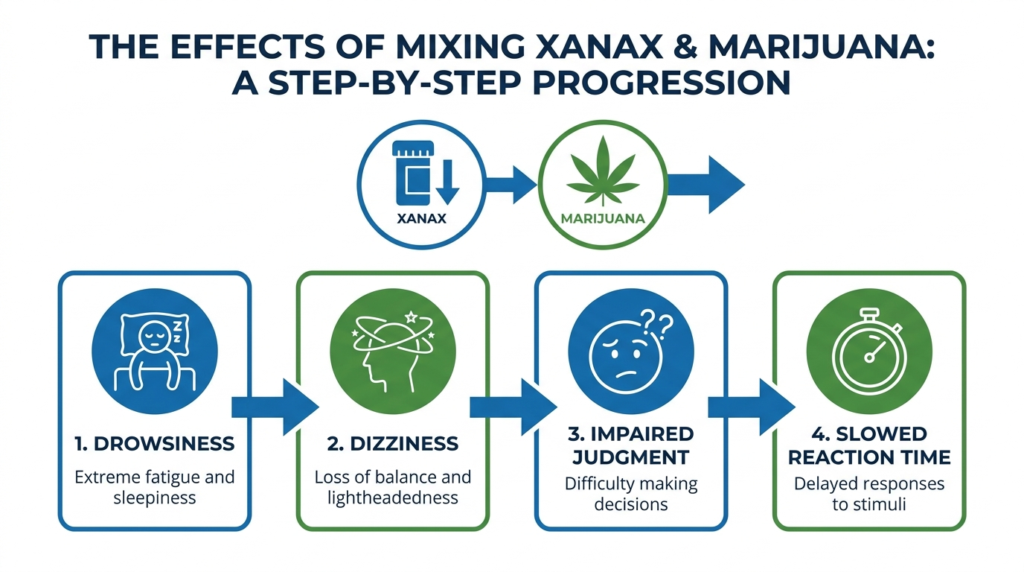
The most evidence-supported short answer is that mixing Xanax and weed most commonly produces more sedation, more cognitive impairment, worse psychomotor function, and poorer judgment than either substance alone, with unpredictable emotional responses in some users.
Likely Acute Effects
- Drowsiness
- Dizziness
- Slowed reaction time
- Impaired concentration
- Short-term memory problems
- Poor judgment
- Decreased motor coordination
- Slurred speech
- Disorientation
- Increased risk of falls or accidents
These effects are highly plausible from a mechanistic and clinical standpoint because both agents can impair alertness, attention, and coordination. Alprazolam alone causes sleepiness, impaired judgment, and reduced motor skills. THC labeling warns of dizziness, confusion, sedation, and somnolence with benzodiazepines.
Less Predictable Acute Effects
Some users may instead experience increased anxiety, panic, paranoia, emotional dysregulation, agitation, confusion, or dissociation-like experiences.
Cannabis can acutely worsen anxiety or cause paranoia in some individuals. Benzodiazepines can rarely produce paradoxical reactions, including excitement, increased talkativeness, excessive movement, and emotional release, in fewer than 1% of patients, with alcohol abuse history and psychological disturbance listed as risk factors.
The combination should not be conceptualized as two calming drugs producing guaranteed calm. In some individuals, especially those with psychiatric vulnerability or polysubstance exposure, the result may be destabilizing rather than soothing.
Mental Health Effects and the Self-Medication Trap
Cannabis is commonly used to self-treat anxiety and sleep problems, but evidence remains unclear on whether it truly helps or worsens those problems, and THC and CBD may have different effects.
This is one of the most clinically important findings because it explains the real-world motivation for mixing: people are often not seeking intoxication alone; they are trying to manage distress.
Why Xanax Plus Weed for Anxiety is a Bad Clinical Strategy?
At first glance, combining two calming agents may sound logical. In practice, it is unstable for several reasons. THC can worsen anxiety or trigger panic in some users, especially at higher doses or in high-THC products.
Alprazolam can reinforce reliance on rapid relief, reducing the chance that longer-term evidence-based treatment is used. Combined sedation can feel like anxiety relief while actually impairing cognition and function.
Rebound phenomena may follow, including rebound anxiety after benzodiazepine effects wear off. Missed diagnosis becomes more likely; for example, panic disorder, trauma-related symptoms, insomnia, depression, medication side effects, or sleep apnea may all be obscured.
Evidence reviewed in anxiety pharmacotherapy literature suggests THC and dronabinol are likely not safe for many anxiety patients because they can induce anxiety and panic attacks depending on dose and individual predisposition, whereas CBD appears more promising but remains supported by relatively low-quality evidence.
Dependence, Withdrawal, and the Two-Drug Coping System
Alprazolam is the most widely prescribed and misused benzodiazepine in the United States, with more than 48 million prescriptions dispensed in 2013 alone.
All benzodiazepines carry risk of misuse, diversion, tolerance, and physical dependence. Misuse is more common among people with personal or family history of alcohol or drug misuse.
Do Not Stop Xanax Abruptly After Regular Use
Patients taking benzodiazepines for longer than a month should not abruptly discontinue them but should gradually taper under clinical supervision. Alprazolam’s withdrawal syndrome is often described as more severe than that of some other benzodiazepines, even when tapered according to manufacturer guidance.
Reported features include rebound anxiety, panic, sleep disturbance, irritability, hyperalertness, rage reactions, dissociative symptoms, suicidal ideation in some reports, and delirium or psychosis in case reports.
Cannabis withdrawal is generally not medically dangerous in the same way benzodiazepine withdrawal can be, but it can still produce irritability, anxiety, sleep disturbance, appetite change, and cravings. These symptoms can complicate benzodiazepine tapering because they may mimic or worsen withdrawal-related distress.
If someone uses both Xanax and cannabis regularly, stopping both at once may produce severe rebound anxiety, insomnia, agitation, tremor, panic, diagnostic confusion about which withdrawal is dominant, and increased relapse risk.
For that reason, the most evidence-consistent clinical position is that benzodiazepines should never be stopped abruptly after sustained regular use, combined use warrants careful taper planning, and co-occurring psychiatric disorders or substance use disorders should be assessed and addressed.
Can Cannabis Reduce Xanax Use? The Evidence Says No!
A common public claim is that cannabis can replace or substantially reduce benzodiazepine use. The most relevant and higher-weight source is a 2024 Alberta study of 9,690 medically authorized cannabis patients matched to controls, using interrupted time series analysis over 12 months before and after cannabis authorization.
It found that medical cannabis authorization was associated with little to no short-term change in benzodiazepine use among adults already prescribed regular benzodiazepine treatment.
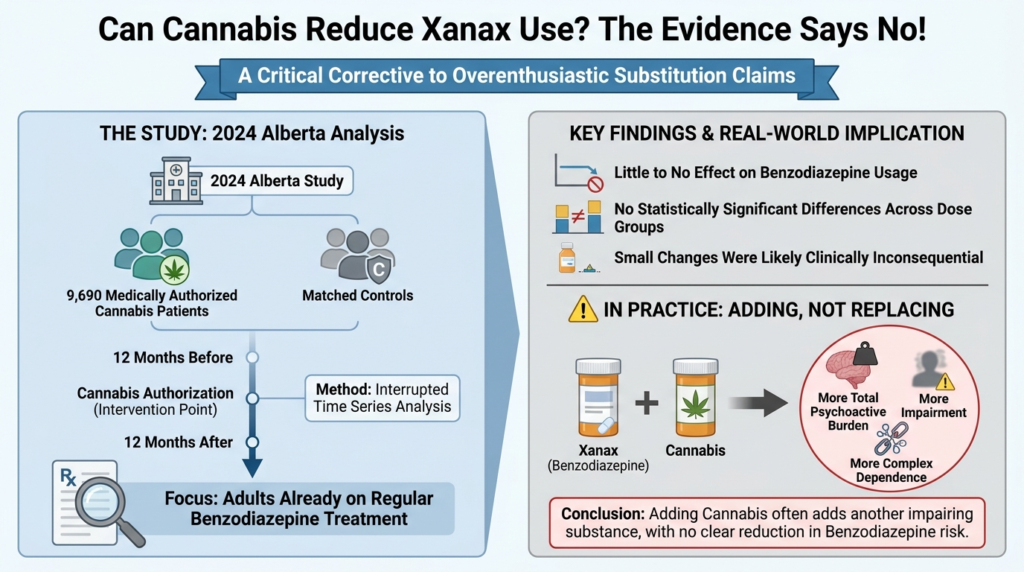
Key findings included little to no effect on benzodiazepine usage, no statistically significant differences across baseline benzodiazepine dose-equivalent groups, and small observed changes that were likely clinically inconsequential.
This is a critical corrective to overenthusiastic substitution claims. If a person is already on regular benzodiazepine therapy, the best available recent population evidence does not support assuming that cannabis will meaningfully reduce their benzodiazepine exposure. This means many real-world users who add cannabis to Xanax are probably adding another impairing substance rather than replacing one with another.
In practice, that often means more total psychoactive burden, more impairment, more complex dependence, and no clear reduction in benzodiazepine risk.
What We Can Learn From Simultaneous Alcohol-Cannabis Research?
There is more high-quality research on simultaneous alcohol and marijuana use than on Xanax-cannabis use. This branch is highly relevant because it studies what happens when cannabis is used at the same time as another intoxicating or sedating drug. While alcohol and alprazolam are pharmacologically distinct, they share an important clinical characteristic: both can worsen CNS impairment when combined with cannabis.
In a longitudinal young-adult sample, 41% reported simultaneous alcohol and marijuana use at baseline, compared with 13% concurrent but non-simultaneous co-use. Higher frequency of simultaneous use predicted heavier later substance use, more substance-related harms, greater symptoms of psychosis, and more externalizing problems two years later.
Concurrent but non-simultaneous co-use was still associated with conduct symptoms, illicit drug use, and alcohol use disorder risk relative to alcohol-only use, but was less harmful than simultaneous use across several domains.
Simultaneous alcohol-cannabis use is commonly associated with stronger acute subjective intoxication than alcohol alone, including feeling more drunk, intoxicated, clumsy, confused, and dizzy. Laboratory studies found alcohol increased THC blood levels and was linked to greater euphoria and longer-lasting impairment, suggesting pharmacologic interaction that can intensify acute effects.
The alcohol-cannabis literature does not prove identical magnitudes of risk for alprazolam-cannabis. But it strongly supports a higher-order inference: simultaneous co-use of cannabis with another CNS-acting intoxicant is not neutral; it tends to intensify impairment and is associated with worse downstream outcomes.
Given that alprazolam is itself a sedative with well-known impairment risks, the clinical extrapolation is conservative and reasonable.
Dangers of Mixing Weed and Xanax
Driving and Accident Risk
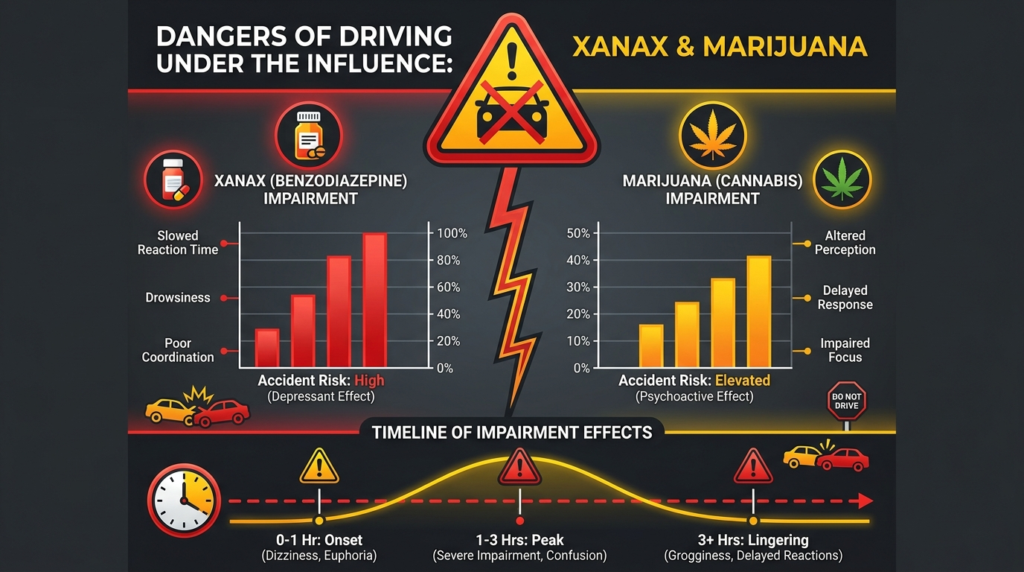
The clearest and most immediate danger is functional impairment. Benzodiazepine use is associated with increased risk of falls, motor vehicle accidents, cognitive impairment, and overdose. Cannabis also impairs driving-related performance and cognition.
A 2025 narrative review on cannabis-impaired driving concluded that newer controlled studies since 2020 have expanded evidence across longer impairment windows, different routes of use, and joint effects of cannabis and alcohol.
When used together, it is reasonable and evidence-based to conclude that users are at significantly elevated risk of motor vehicle crashes, work accidents, falls, domestic injuries, and injury while caring for children or dependents.
The combination is particularly dangerous because users may feel less anxious while simultaneously becoming less capable.
Overdose and Severe Toxicity
A common misconception is that benzodiazepine overdose is usually benign. An alprazolam toxicity review notes published case reports of fatalities involving alprazolam, including deaths reported with alprazolam alone.
Further, alprazolam appears to be intrinsically more toxic in overdose than other benzodiazepines, and this higher toxicity persisted after adjustment for dose, age, and co-ingested drugs. In the overdose cohort summarized, 22% were admitted to ICU, 12% had coma, 16% required mechanical ventilation, and 14% received flumazenil.
Cannabis is not classically understood as a major respiratory depressant in the same way as opioids, but it can still worsen the overall risk picture by increasing confusion and delayed help-seeking, deepening sedation in some users, increasing accident risk leading to trauma, co-occurring with alcohol or other sedatives, and masking early signs of dangerous impairment.
Polysubstance Amplification
Polysubstance research consistently shows that multiple drugs often interact in ways more hazardous than single-drug models predict. Cannabis-related toxic episodes commonly involve other substances.
In a multi-center European cannabis toxicity case series, most cannabis-related toxic episodes involved co-ingestants, including alcohol in 59% and benzodiazepines in 23%.
The practical implication is direct: Xanax plus weed is already risky, Xanax plus weed plus alcohol is substantially worse, and Xanax plus weed plus opioids or other sedatives can become life-threatening.
Product Type, Timing, and Dose Matter
Cannabis effects vary widely by product form. Flower or inhaled products tend to have faster onset and may promote repeated redosing. Edibles have delayed onset and longer duration, which can lead to stacking doses or taking Xanax before the cannabis has fully taken effect. Public-health and clinician resources increasingly advise attention to THC potency and CBD to THC ratio.
An especially risky pattern is edible cannabis taken, no immediate effect felt, Xanax taken to help it along or because anxiety persists, edible effect peaks later, and severe combined sedation or confusion follows. This scenario aligns closely with current public-health warnings about delayed edible impairment.
Special Safety Issues Doctors Worry About
Driving and Operating Machinery
With either Xanax or cannabis alone, driving is already unsafe. Together, the risk is higher. Public-health advice to avoid impaired driving with cannabis becomes even more urgent when benzodiazepines are added.
Falls, Aspiration, and Positional Risk
Severe sedation, nausea, and vomiting create hazards beyond feeling too high. Remaining seated rather than lying down is sometimes advised because choking risk may rise if vomiting occurs during deep sedation. The exact risk magnitude is uncertain, but the principle is sound: reduced alertness plus emesis is dangerous.
Hidden Third Substances
In actual clinical practice, the most dangerous cases often involve more than two drugs: alcohol, opioids, sleep medications, antihistamines, antipsychotics, or contaminated illicit products. The additive-sedation model becomes much more dangerous as more depressant or impairing drugs are added.
Patients With Substance Use Disorder
Caution is especially warranted in patients with current or past substance use disorder. Anxiety-treatment literature specifically highlights caution with benzodiazepines in individuals using alcohol, opioids, or other CNS depressants and in those with substance use disorders.
Clinical Guidance for Risk Mitigation
International guidance over more than 30 years has generally not recommended benzodiazepines as first-line treatment for anxiety, depression, or insomnia. Most guidance limits their use to short-term treatment, typically under 4 weeks.
This matters because many nonmedical users implicitly treat Xanax as a controllable symptom-management tool. Clinically, however, alprazolam is already considered a medication requiring caution because of rapid onset, short half-life, misuse potential, withdrawal liability, and CNS depressive effects.
Benzodiazepine risk mitigation should include structured deprescribing and withdrawal planning, not only acute prescribing limits. When risks outweigh benefits, structured taper plans and evidence-based withdrawal management are central to safer care.
Practical Harm-Reduction Guidance
Although the best recommendation is not to combine Xanax and cannabis, real-world safety guidance is still necessary.
If a Person is Prescribed Xanax
They should tell the prescriber about all cannabis use, including edibles, vapes, CBD products, and high-THC products; not adjust Xanax dose based on cannabis effects without medical guidance; avoid alcohol and other sedatives; not drive after using either substance; and seek non-benzodiazepine strategies for long-term anxiety management where appropriate.
If a Person Uses Cannabis for Anxiety or Sleep
They should recognize evidence is mixed and product-dependent, THC may worsen anxiety in some users, delayed edible onset can mislead dosing, and relying on Xanax to smooth out cannabis is a high-risk coping pattern.
Red Flags That Need Urgent Medical Attention
Seek urgent care if mixed use is followed by unresponsiveness, inability to stay awake, slow or difficult breathing, repeated vomiting, chest pain, fainting, seizure, severe confusion, or psychosis-like symptoms.
The Bottom Line: What Doctors Say?
Based on the evidence, a careful physician would likely say something close to this: Mixing Xanax and cannabis is generally not considered safe. Both can impair alertness, judgment, coordination, and reaction time.
THC products and benzodiazepines can produce additive CNS depression, and effects are more unpredictable with high-THC products and edibles. If you are using both for anxiety or sleep, that suggests the underlying problem needs proper assessment rather than layered self-medication.
My evidence-based opinion is clear: people should not mix Xanax and weed except in rare, explicitly clinician-managed situations where all substances are disclosed, dosing is controlled, and the patient is not driving or using other sedatives. In ordinary real-world use, the combination is unsafe enough that not doing it is the correct default recommendation.
That opinion is not based on sensational claims. It follows directly from the strongest available evidence: alprazolam is already a high-risk sedating drug, THC products can add sedation and unpredictability, simultaneous co-use tends to worsen impairment, and self-medicating anxiety or insomnia with layered sedatives is more likely to entrench the problem than solve it.
If you or someone you care about is mixing Xanax and marijuana to manage anxiety, panic, or sleep problems, that pattern deserves clinical attention, not casual acceptance. Safer, evidence-based treatment exists, and structured support can help you taper off benzodiazepines without abrupt withdrawal. Reach out today to The Summit Wellness Group and explore dual diagnosis treatment that addresses both substance use and mental health in a compassionate, individualized setting.