Many people with bipolar disorder wonder whether marijuana might help manage their symptoms or if it poses serious risks.
Recent research shows that cannabis use is associated with substantially increased risk of developing bipolar disorder, especially when exposure begins in adolescence, and may worsen illness of those already diagnosed.
This article examines the latest evidence on how marijuana affects bipolar disorder onset, symptoms, and long-term outcomes.
Cannabis Use is Common in Bipolar Disorder
Cannabis exposure appears far more frequently among people with bipolar disorder than in the general population. One large study found that individuals with bipolar disorder were 6.8 times more likely to report lifetime cannabis use compared with controls.
Separate research indicates that over 70% of people with bipolar disorder reported a lifetime history of regular cannabis use versus 26% in the general population.
This high prevalence raises an important clinical question. Is cannabis simply more common because people with bipolar disorder use it to self-medicate symptoms, or does cannabis exposure actually contribute to the development and worsening of bipolar illness?
The answer appears to be both, with the strongest evidence pointing toward cannabis as a meaningful risk factor rather than a harmless coping strategy.
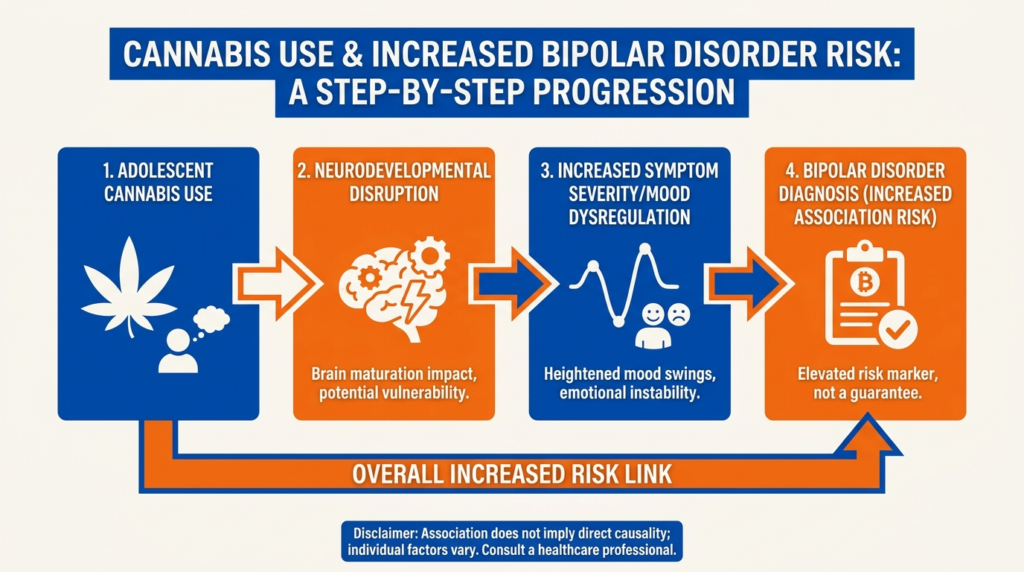
Adolescent Cannabis Use Doubles Later Bipolar Risk
The most compelling evidence comes from a 2026 study that followed 463,396 adolescents aged 13 to 17 years who were universally screened for past-year cannabis use during routine pediatric care.
Researchers tracked these young people through age 25 and found that any past-year cannabis use during adolescence was associated with approximately doubled risk of later bipolar disorder.
The findings were especially strong for psychotic and bipolar disorders. Adolescents who reported cannabis use showed about 2.19 times higher risk of later psychotic disorder and 2.0 times higher risk of bipolar disorder by age 26.
These associations remained significant even after adjusting for sociodemographic factors, prior psychiatric conditions, and other substance use.
What makes this study particularly important is that elevated risk appeared even with broad past-year use, not just heavy or daily consumption. This suggests that the risk signal is detectable below the threshold of cannabis use disorder.
The study authors concluded that the overall pattern is more consistent with cannabis acting as a risk factor for psychiatric disorders rather than merely reflecting preexisting symptoms.
Cannabis Use Disorder Predicts Later Bipolar Disorder
A Danish nationwide prospective study provided additional strong evidence by following 6,651,765 individuals from 1995 to 2021. This massive cohort showed that cannabis use disorder was associated with substantially increased risk of subsequent bipolar disorder, with adjusted hazard ratios of 2.96 in men and 2.54 in women.
The association was especially pronounced for psychotic bipolar disorder, with a hazard ratio of 4.05. This means people with cannabis use disorder were about four times more likely to develop bipolar disorder with psychotic features compared with those without cannabis use disorder.
The elevated risk persisted up to ten years after cannabis use disorder registration, making short-term self-medication a less sufficient explanation for the entire association.
These findings strengthen the case that cannabis use disorder is an independent, temporally prior, clinically significant predictor of later bipolar disorder. The study adjusted for multiple confounders including alcohol use disorder, other substance use disorders, parental substance disorders, and parental affective disorders.
How Cannabis Affects Bipolar Symptoms and Course?
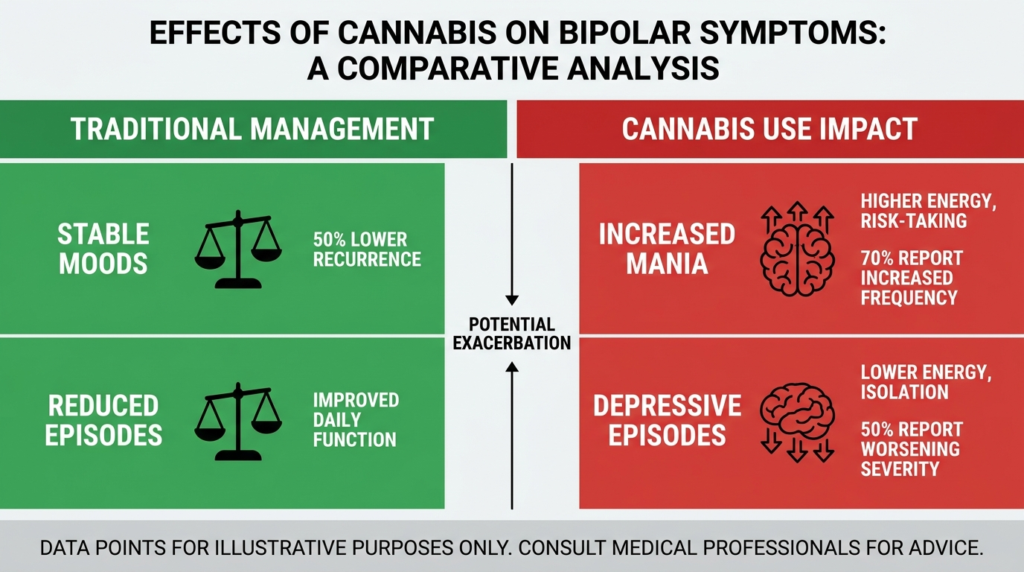
Beyond increasing the risk of developing bipolar disorder, cannabis use appears to worsen the course of illness in those already diagnosed. Research consistently shows that cannabis is associated with increased manic symptoms, more frequent episodes, and poorer long-term outcomes.
A systematic review found that cannabis use in mood disorders is generally associated with worse clinical outcomes, including elevated depressive symptoms, elevated mania, suicidality, and poorer bipolar disorder.
Another meta-analysis reported that cannabis use may worsen manic symptoms in individuals with diagnosed bipolar disorder and is associated with approximately threefold increased risk for new-onset manic symptoms.
A 24-month prospective study in bipolar I disorder and schizoaffective disorder concluded that regular cannabis use negatively affects long-term clinical outcome and was associated with decreased likelihood of long-term remission. The study found lower remission rates for depressive symptoms in females and for manic symptoms in males among cannabis users.
Cannabis use disorders in bipolar disorder have also been linked to suicide attempts and disability. One meta-analysis found a weak but statistically significant cross-sectional association between cannabis use disorder and suicide attempts in bipolar disorder, with an odds ratio of 1.35 based on 6,375 subjects from eleven studies.
Why Adolescence is a Critical Window?
The brain undergoes substantial development during adolescence, making this period especially vulnerable to cannabis exposure. THC, the main psychoactive compound in cannabis, acts on CB1 receptors that are highly expressed in the adolescent brain and involved in emotional regulation, motivation, cognition, and reward processing.
The Kaiser Permanente study found that cannabis use preceded diagnoses by an average of 1.7 to 2.3 years, supporting the idea that exposure occurs during a developmentally sensitive window before illness onset. Depressive and anxiety associations were strongest with earlier adolescent exposure, further supporting the concept of developmental vulnerability.
This developmental context matters because bipolar disorder typically emerges in late adolescence or early adulthood, the same window during which cannabis use commonly begins and intensifies.
The overlap creates both scientific difficulty and clinical urgency. While reverse causation remains plausible because early subthreshold mood symptoms may prompt self-medication, the temporal ordering in large prospective studies makes pure reverse causation insufficient to explain the entire association.
Cannabis and Psychotic Bipolar Disorder
One of the most important patterns in the research is that cannabis appears especially linked to bipolar presentations with psychotic features. The Danish cohort found that the association was stronger for psychotic than nonpsychotic bipolar subtypes, with a relative hazard ratio of 1.48.
This concentration of risk in psychotic bipolar disorder aligns with broader evidence linking cannabis to psychosis and schizophrenia-spectrum outcomes.
It suggests that cannabis may preferentially interact with pathways linked to salience dysregulation, psychotic symptom emergence, or severe mania rather than evenly affecting all mood pathology.
The adolescent cohort also found the strongest associations for psychotic and bipolar disorders, not for depression or anxiety. This contrast sharpens the argument that cannabis may be especially linked to more severe psychiatric outcomes rather than producing a broad nonspecific effect.
Mixed Evidence on Cognition in Adults With Bipolar Disorder
While the evidence on illness onset and mood course points toward harm, research on cognitive function in adults already diagnosed with bipolar disorder shows a more complex picture.
A 2020 systematic review identified six observational studies examining cannabis use and cognition in bipolar disorder. Two studies reported better performance in some cognitive domains among cannabis users with bipolar disorder, three found no association, and one found worse overall cognition.
A 2025 study provided more targeted evidence by testing 87 participants with or without bipolar disorder and with either regular cannabis use or no cannabis use.
The study found that adults with bipolar disorder who used cannabis performed better than bipolar non-users on decision-making tasks and had functional capacity comparable to healthy non-users. By contrast, healthy cannabis users showed impaired decision-making relative to healthy non-users.
These findings suggest that cannabis may have different associations with specific cognitive functions in adults with established bipolar disorder compared with healthy populations.
However, the studies remain observational and cross-sectional, meaning they cannot establish that cannabis caused better or worse cognition. People who choose to use cannabis may differ systematically from non-users in premorbid function, illness subtype, or other characteristics.
Cannabis is Not a Treatment for Bipolar Disorder
Despite some patient reports of subjective benefit and mixed cognitive findings in adults, the evidence does not support cannabis as a treatment for bipolar disorder.
A 2024 systematic review found no compelling evidence that cannabinoids are effective treatments for mood disorders. The only randomized trial of CBD in bipolar disorder was clinically inconclusive, though CBD appeared potentially safe.
The key distinction is that a cross-sectional association with preserved performance on one cognitive task is not equivalent to therapeutic benefit. A person may show relatively better performance on a laboratory measure while still having worse overall illness trajectory, more frequent episodes, poorer medication adherence, and greater psychosocial difficulties.
The broader evidence indicates that cannabis is more likely to worsen mood course than to stabilize it. Even if some adults with bipolar disorder experience perceived cognitive benefits or calming effects, current evidence does not establish safety or efficacy for cannabis as a mood or cognitive treatment.
Screening and Clinical Implications
Given the high prevalence of cannabis use in bipolar disorder and the evidence of associated risks, routine screening should be standard in bipolar care and adolescent mental health settings. Several validated tools exist for identifying cannabis use and cannabis use disorder in clinical practice.
The CRAFFT screening tool has demonstrated excellent sensitivity and specificity for identifying adolescents who need further assessment for substance use.
A large Illinois statewide study specifically evaluated the CRAFFT for identifying heavy cannabis use, defined as cannabis use 10 or more times in the past 30 days. Other brief screening tools including S2BI, BSTAD, and TAPS have shown adequate psychometric properties for identifying adolescent substance use disorders in general primary care settings.
For adults with bipolar disorder, clinicians should ask specifically about cannabis frequency, potency, route of administration, and purpose of use. Monitoring for mania, psychosis, cycling, adherence problems, and functional decline is essential.
Clinicians should differentiate subjective symptom relief from objective clinical benefit and avoid presenting cannabis as a validated cognitive or mood treatment.
Harm Reduction for Those Who Continue Use
For adolescents and adults who continue to use cannabis despite counseling, harm reduction strategies can help minimize risk. Research-backed approaches include delaying initiation, reducing frequency, choosing lower-THC products, and avoiding driving after use.
Moderate cannabis use, defined as about 4 to 24 times per week, was associated with better decision-making and function in one study of adults with bipolar disorder, whereas heavy use of 25 or more times per week was associated with worse performance.
This suggests a nonlinear relationship where more cannabis is not more benefit, and heavy use is especially concerning.
Integrated management approaches such as motivational interviewing and cognitive behavioral therapy for co-occurring bipolar disorder and cannabis problems are explicitly recommended in the clinical literature. These approaches acknowledge the complexity of dual diagnosis while working toward reduced use or abstinence.
What the Evidence Means for Families and Patients?
The research carries several practical implications for people with bipolar disorder and their families. First, adolescent cannabis exposure is a serious psychiatric risk factor that should be actively discouraged.
The evidence that any past-year use in adolescence is associated with doubled later bipolar risk is strong enough to justify firm prevention efforts.
Second, for adults already diagnosed with bipolar disorder, cannabis should generally be treated as a destabilizing exposure unless careful longitudinal observation in an individual case strongly suggests otherwise. Subjective benefit does not equal proven treatment effect, and cannabis may feel helpful in the short term yet worsen long-term mood course.
Third, heavy or frequent use is especially concerning. The dose-response evidence, while limited by measurement inconsistencies, suggests that risk increases with frequency and that very heavy use is associated with worse outcomes even in populations where moderate use shows mixed associations.
Fourth, evidence-based alternatives for cognition and mood should be prioritized. Cognitive remediation, targeted psychosocial interventions, and careful pharmacologic management offer clearer therapeutic pathways than relying on observational associations with recreational cannabis.
Alternative Approaches to Cognitive and Mood Symptoms
For people seeking help with cognitive symptoms or mood instability in bipolar disorder, several evidence-based alternatives exist. Computerized cognitive training has shown promise in mood disorders.
A pilot randomized controlled trial in older adults with late-life depression found that six weeks of computerized cognitive training improved depressive symptoms, global cognition, and serum brain-derived neurotrophic factor compared with computer-based health education.
Cognitive remediation protocols specifically designed for bipolar disorder aim to improve cognition, global functioning, and mood symptoms through structured, non-intoxicating interventions. These approaches reflect a cleaner therapeutic pathway than relying on observational associations with recreational cannabis.
Medication-assisted therapy, evidence-based psychotherapies including cognitive behavioral therapy and dialectical behavior therapy, family therapy, and holistic approaches such as yoga, meditation, and therapeutic fitness all offer validated pathways for managing bipolar symptoms and improving quality of life.
The Bottom Line on Marijuana and Bipolar Disorder
The evidence base on marijuana and bipolar disorder has matured substantially in recent years. The strongest conclusion is that cannabis exposure, especially adolescent use, regular use, and cannabis use disorder, is a meaningful psychiatric risk factor for bipolar-spectrum illness. The clearest signal appears at the severe psychotic-manic end of the spectrum.
Cannabis is not a benign correlate of bipolar disorder. It is best understood as a clinically meaningful risk exposure that likely contributes to the onset and worsening of bipolar illness in a susceptible subset of individuals.
The causal case is not absolute, but it is now strong enough to justify firm clinical caution, routine screening, prevention in youth, and active treatment of co-occurring cannabis problems in bipolar populations.
For adults already living with bipolar disorder, cannabis may show selective, context-dependent associations with certain cognitive outcomes, but it is not an evidence-based therapy for bipolar mood or cognitive symptoms.
The most defensible position is that public health messaging should continue to discourage adolescent exposure, and cautious clinical monitoring should continue for adults with bipolar disorder who use cannabis.
If you or someone you care about is struggling with bipolar disorder and substance use, The Summit Wellness Group’s professional support can make a real difference. So, reach out to explore our dual diagnosis treatment options that address both conditions together.