People with obsessive-compulsive disorder often turn to alcohol to quiet intrusive thoughts or reduce the distress that comes with compulsions.
Research shows that about 13% of adults with OCD develop alcohol dependence, and those who do are less likely to respond well to standard OCD medications. This article explains how drinking affects OCD symptoms, why it undermines recovery, and what treatment options work best when both conditions are present.
How Alcohol Affects OCD Symptoms?
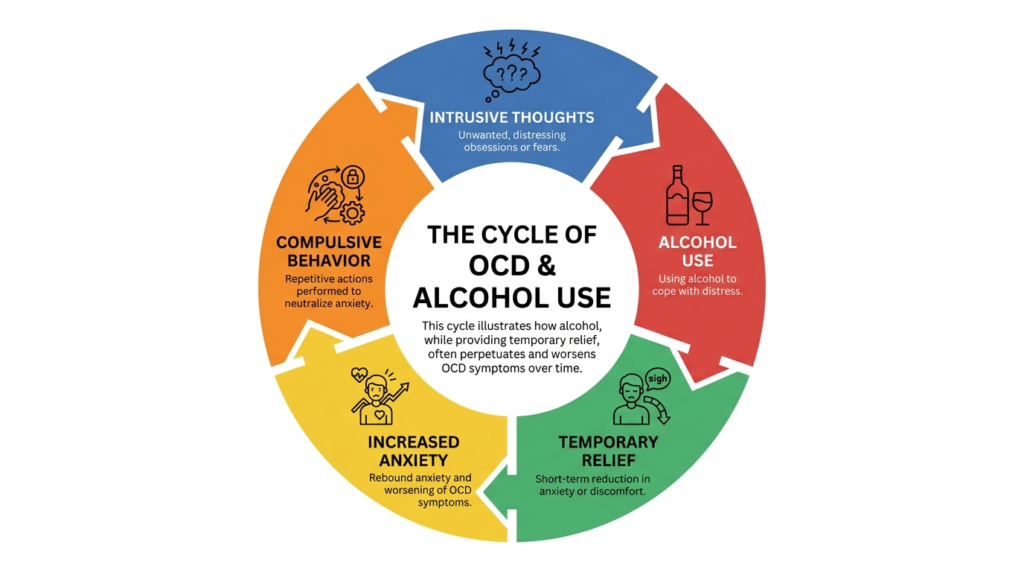
Alcohol creates a short-term illusion of relief for people struggling with obsessive-compulsive symptoms. When intrusive thoughts spike or compulsive urges feel overwhelming, a drink can temporarily numb the anxiety, guilt, or disgust that drives the OCD cycle. That momentary escape is exactly what makes alcohol dangerous in OCD.
The problem is what happens next. If someone repeatedly uses alcohol to reduce obsessional distress, they never learn that the distress can rise and fall on its own without rituals or substances. This directly conflicts with exposure and response prevention, the gold-standard therapy for OCD, which teaches people to tolerate anxiety without neutralizing it.
Recent research found that risky alcohol use is associated with higher overall OCD symptom severity and with multiple symptom dimensions, including checking, obsessing, ordering, and washing. The strongest link appeared with the obsessing dimension, especially unacceptable or taboo thoughts and mental compulsions.
This matters because alcohol may function as a hidden ritual. Instead of washing hands or checking locks, someone might drink to escape intrusive thoughts. The behavior looks different, but the function is the same: temporary relief that reinforces the OCD cycle.
Why Thought-Based OCD is Especially Vulnerable?
People with intrusive sexual, religious, or aggressive thoughts often experience intense shame and fear of what those thoughts might mean. Alcohol can temporarily reduce self-monitoring, social anxiety, and the urgency to neutralize disturbing thoughts.
A study of young adults found that coping drinking motives significantly explained the link between obsessive-compulsive symptoms and problematic alcohol outcomes, even after controlling for anxiety, depression, smoking, and cannabis use. This suggests that people with OCD drink specifically to manage emotional tension, not just because they feel generally distressed.
When someone with taboo obsessions drinks before social events or after particularly difficult intrusive thoughts, alcohol becomes a covert safety behavior. It prevents the person from learning that they can handle distress without chemical escape.
OCD Often Comes Before Alcohol Problems
One of the most important findings in the research is the temporal sequence. In a clinical OCD sample, 70% of those with comorbid substance use disorder reported that OCD began at least one year before the substance problem. This supports the idea that untreated or undertreated OCD distress may increase vulnerability to alcohol misuse later.
Early-onset OCD appears to carry even higher risk. When OCD begins at age 15 or younger, the odds of developing alcohol use disorder increase. This makes sense developmentally: more years of living with obsessional distress means more time for maladaptive coping patterns to take root.
Population-level data challenges the outdated notion that OCD protects against addiction. A Swedish study of more than 6.3 million individuals found that OCD diagnosis was associated with a 3.68-fold elevated risk of any substance misuse outcome. In a twin cohort, obsessive-compulsive symptoms predicted increased alcohol and drug dependence symptoms both concurrently and over time.
Why People With OCD Self-Medicate With Alcohol?
OCD produces repeated, intense, aversive internal states: intrusive thoughts, fear of catastrophe, disgust, shame, guilt, uncertainty, and perceived loss of mental control. These are exactly the kinds of experiences that drive self-medication.
The self-medication pathway in OCD is not vague. Research has identified a specific mechanism: obsessive-compulsive symptoms lead to coping motives for drinking, which in turn lead to risky alcohol use and problematic outcomes. This relationship held even after controlling for overlapping emotional and behavioral variables.
Alcohol as a Substitute Ritual
One of the most clinically important insights from recent research is that alcohol may serve as a maladaptive substitute for compulsive rituals. This means drinking occupies the same functional role as checking, washing, praying, or mental reviewing: it is used to neutralize internal distress.
This reframes the clinical picture. Rather than seeing OCD and alcohol misuse as parallel problems that happen to co-occur, clinicians should sometimes conceptualize alcohol use as an extension of the compulsive system.
Shame Drives Hidden Drinking
The strongest symptom-level link to risky drinking involves the obsessing dimension, especially taboo or unacceptable thoughts. These symptoms often bring extreme shame and fear of disclosure. Alcohol may be used because it reduces acute distress, dampens self-criticism, decreases social inhibition, and provides a rapid mental off switch.
Supporting evidence indicates that unacceptable or taboo thoughts are associated with greater obsessional distress and past non-alcohol substance dependence. Shame is one of the most underappreciated drivers of alcohol misuse in OCD. Fear-based OCD may invite visible rituals; shame-based OCD may invite hidden chemical neutralization.
Dangerous Interactions With OCD Medications
SSRIs: The Standard First-Line Treatment
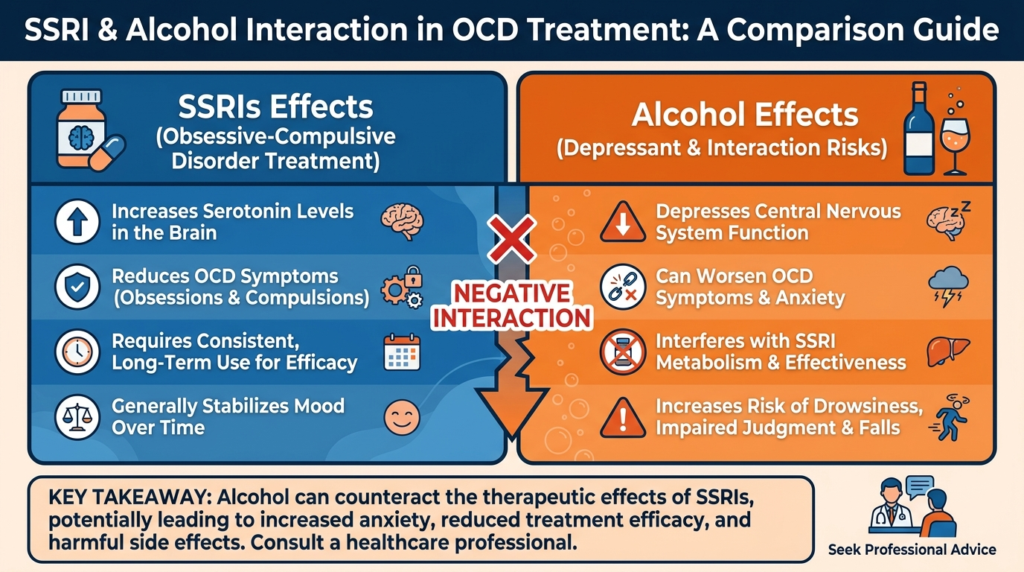
Selective serotonin reuptake inhibitors are the standard first-line medication treatment for OCD. Commonly used agents include fluoxetine, sertraline, paroxetine, and fluvoxamine. OCD often requires longer SSRI trials and sometimes higher dosing than other psychiatric conditions.
A common oversimplification is that SSRIs and alcohol do not have major dangerous interactions, so moderate drinking is acceptable. The evidence does not justify such broad reassurance.
While the most dramatic classic interaction warnings are stronger for tricyclics and MAOIs than for SSRIs, several reasons support caution even with SSRIs. Alcohol can impair adherence to the prolonged and dose-sensitive SSRI trials needed in OCD. Comorbid alcohol dependence is associated with poorer SSRI response in OCD. Alcohol worsens mood and disinhibition, which can increase suicidality risk in a population already vulnerable to depression and intrusive self-harm obsessions.
In a study of 1,222 adults with OCD, 13% had lifetime alcohol dependence, and those individuals were less likely to have received SRI or SSRI treatment. If they had received treatment, they were less likely to report a good response.
This finding is critical. The poorer response could reflect reduced adherence, interrupted treatment duration, lower tolerated doses, greater psychiatric comorbidity, psychosocial instability, sleep disturbance, or possible neurobiological overlap. But from a clinical standpoint, the mechanism does not reduce the importance.
If alcohol dependence is associated with lower probability of benefiting from an SSRI, then ignoring alcohol undermines rational OCD care.
Clomipramine: Effective but Higher Risk
Clomipramine is a tricyclic antidepressant with particularly potent serotonin reuptake inhibition. It was the first medication shown effective and the first FDA-approved medication for OCD. However, modern guidance generally does not prefer clomipramine as first-line because head-to-head trials found efficacy comparable to SSRIs while clomipramine has a worse side-effect burden.
Clomipramine’s adverse effect profile makes alcohol considerably more problematic than it is with many SSRIs. Documented concerns include anticholinergic effects such as dry mouth, constipation, and urinary hesitancy; weight gain and sexual dysfunction; cardiac conduction delay or arrhythmia risk; lowering of seizure threshold; and a reported 0.4% seizure incidence.
Alcohol adds concern in multiple ways. Tricyclics can cause drowsiness and impaired coordination, and alcohol can worsen these effects substantially. Clomipramine lowers seizure threshold; alcohol intoxication and especially withdrawal can also alter seizure risk. This is particularly relevant in heavy or episodic binge drinkers.
TCAs are more cardiotoxic and more lethal in overdose than SSRIs. Alcohol-related disinhibition can worsen overdose risk in suicidal crises or impulsive states. Clomipramine often requires drug level monitoring and regular EKGs, meaning that unstable alcohol use adds further unpredictability to safe prescribing.
Clomipramine should be treated as a high-caution medication in any patient with ongoing alcohol use, especially binge drinking, heavy use, blackouts, withdrawal history, seizure history, suicidality, or poor adherence.
How Alcohol Undermines OCD Recovery?
Exposure and Response Prevention Requires Sobriety
Exposure and response prevention is the gold-standard psychotherapy for OCD. It works by helping patients intentionally face feared stimuli, thoughts, images, or situations while refraining from compulsive rituals or avoidance. Improvement depends on repeated learning that feared outcomes are tolerable, less likely than assumed, or manageable without rituals.
This learning process is highly vulnerable to alcohol. Alcohol promotes avoidance rather than exposure. It is often used to reduce anxiety quickly, but ERP works by reducing reliance on safety behaviors and avoidance. If a patient drinks to blunt intrusive thoughts or exposure-related distress, alcohol functionally becomes a competing ritual or safety behavior. That directly undermines ERP’s mechanism.
Research shows that patient adherence is closely linked to who improves and which treatment components are most effective. If drinking reduces homework completion, appointment attendance, willingness to tolerate distress, memory for therapeutic learning, or next-day functioning, then ERP efficacy falls.
ERP gains accumulate over repeated practice. A patient who does exposures consistently four to six days per week may improve, while a patient who avoids them after drinking, skips them due to hangovers, or performs them only inconsistently may appear treatment resistant when the actual problem is process failure rather than true nonresponse.
Alcohol Disrupts Treatment Consistency
OCD pharmacotherapy often requires higher doses and longer treatment trials than clinicians and patients may expect from depression treatment. Likewise, ERP requires repeated participation, distress tolerance, memory consolidation of exposure learning, and completion of homework assignments.
These characteristics make OCD treatment unusually sensitive to any factor that disrupts consistency or persistence. Alcohol can interfere not just with one part of care, but with all parts simultaneously. It can reduce medication adherence, increase side effects, worsen sleep and mood, reduce participation in therapy, and promote avoidance, the opposite of ERP’s active mechanism.
A patient who takes sertraline reliably Monday through Thursday, then binge drinks Friday and Saturday, misses doses, sleeps poorly, and arrives at Monday therapy ashamed and unprepared may look like a partial SSRI responder with low ERP motivation. In reality it is a repeating alcohol-related destabilization cycle.
Screening for Alcohol Problems in OCD
The U.S. Preventive Services Task Force recommends that all adults age 18 years and older be screened for unhealthy alcohol use in primary care and that those engaged in risky or hazardous drinking receive brief behavioral counseling.
Brief tools with acceptable accuracy include the AUDIT-C and the Single Alcohol Screening Question. The older but still clinically useful binge-drinking screening question asks how many times in the past year the person had five or more drinks in a day for men, or four or more drinks in a day for women and adults older than 65.
This is especially relevant because many patients who say they only drink socially still meet risky-use thresholds. Screening matters in OCD for three evidence-based reasons: alcohol dependence is not rare in OCD, OCD is associated with elevated substance misuse risk, and alcohol comorbidity predicts treatment complications.
Alcohol screening should be routine in OCD treatment, not reserved for patients who look addicted. A person who says they only drink on weekends or only drink socially may still have repeated binge episodes, hangovers that impair ERP homework, missed medication doses after nights out, or episodic disinhibition that worsens shame and obsessive rumination.
Treatment for Co-Occurring OCD and Alcohol Use Disorder
Why Concurrent Care Works Best?
Expert commentary from the International OCD Foundation on co-occurring OCD and substance use disorder notes a familiar pattern: patients enter treatment for whichever condition seems worse, then symptoms of the untreated disorder interfere, leading to dropout or failure, and the patient bounces between silos.
Broader co-occurring disorder literature supports combining pharmacologic and psychotherapeutic treatments rather than treating disorders in isolation.
For OCD specifically, the logic of integration is especially strong because SSRIs and ERP are core OCD treatments, alcohol misuse can reduce adherence and response to both, and substance-focused behavioral work can target triggers, craving patterns, and coping deficits that otherwise sabotage OCD treatment.
An evidence-aligned integrated plan may involve comprehensive dual assessment of OCD symptoms, alcohol quantity and frequency, withdrawal history, suicidality, medication side effects, and prior treatment response. Simultaneous treatment planning continues or initiates evidence-based OCD treatment while directly treating unhealthy alcohol use or alcohol use disorder.
Behavioral Interventions for Alcohol Use
Behavioral interventions for alcohol use include brief counseling for risky drinking, CBT-based relapse prevention, motivational interviewing, and peer or mutual-help support as appropriate.
Medication planning should choose OCD medication with attention to alcohol pattern and safety, consider AUD medications when indicated, and watch for liver disease, renal disease, opioid use, withdrawal risk, and adherence feasibility.
A systematic review and meta-analysis found that combined pharmacotherapy plus CBT was superior to usual care plus pharmacotherapy for adults with alcohol or substance use disorders. However, CBT did not outperform other evidence-based behavioral therapies when paired with medication.
This finding is valuable because it argues against over-attachment to one psychotherapy brand name on the alcohol side. For concurrent AUD treatment, what matters most is evidence-based behavioral treatment, medication when appropriate, and fidelity and engagement.
Medication Options for Alcohol Use Disorder
Common AUD medications include acamprosate, which may reduce cravings and is often more effective after drinking has stopped, with major contraindication being severe kidney disease.
Naltrexone is available orally and as long-acting injectable, contraindicated in severe liver disease and requiring caution with opioid use. Disulfiram deters drinking by causing an aversive reaction with alcohol and requires abstinence, education, and caution in severe heart disease, psychosis, liver disease, and pregnancy.
These are not OCD treatments, but in an integrated plan they may improve the odds that OCD treatment can work. When alcohol use disorder is present, treating it directly, including with evidence-based medication when indicated, is often necessary to create conditions in which OCD treatment can succeed.
When Withdrawal Risk is Present?
If a patient has heavy daily drinking, morning drinking, prior withdrawal symptoms, seizures, or delirium tremens, the issue is no longer simply whether alcohol undermines OCD treatment. It becomes a medical safety question.
The American Society of Addiction Medicine emphasizes that withdrawal management alone is not treatment for alcohol use disorder, but it may be a necessary first step in engaging patients in treatment.
A patient with active alcohol withdrawal risk may be unable to engage effectively in ERP or safely continue or adjust psychiatric medications without coordinated medical oversight.
Symptoms such as tremor, panic, insomnia, autonomic arousal, and perceptual disturbances can masquerade as worsening anxiety or OCD-related distress. Heavy daily drinkers or those with withdrawal history may need medical management before standard outpatient OCD treatment can proceed safely.
Practical Recommendations
Clinicians should screen all adults with OCD for unhealthy alcohol use using AUDIT-C or the Single Alcohol Screening Question routinely, not only when addiction is suspected. Include alcohol in the initial OCD formulation alongside symptom subtype, insight, comorbidities, suicidality, and treatment history.
Reassess alcohol use whenever treatment is not working. Before labeling a patient resistant to SSRIs or ERP, ask whether alcohol is interfering with dosing consistency, session attendance, homework, sleep, distress tolerance, or side-effect burden.
Use extra caution with clomipramine in drinkers. Given seizure threshold, sedation, cardiotoxicity, and overdose concerns, unresolved unhealthy drinking should materially influence prescribing and monitoring decisions.
Treat alcohol misuse in parallel. For risky drinking, provide brief counseling. For alcohol use disorder, coordinate or refer for integrated treatment including behavioral therapy and, when appropriate, AUD medications.
Treat drinking during ERP as a treatment-interfering behavior, especially if alcohol is used before exposures, after exposures to recover, or in place of ritual prevention. Escalate care when withdrawal risk is present.
Why Social Drinking Still Matters?
Many patients with OCD and clinicians alike reserve concern for obvious alcohol dependence. But risky drinking can be present well before alcohol use disorder is diagnosed.
A person who says they only drink on weekends or only drink socially may still have repeated binge episodes, hangovers that impair ERP homework, missed medication doses after nights out, or episodic disinhibition that worsens shame and obsessive rumination.
OCD recovery is unusually sensitive to consistency, sleep quality, anxiety regulation, and completion of structured work between sessions. Even non-dependent heavy episodic drinking can disrupt all four.
The point is not moralism. The point is that OCD treatment is process-dependent, and alcohol commonly disrupts the treatment process before it produces obvious addiction.
Get Real Recovery With Summit Wellness Today!
Alcohol use in patients being treated for OCD should generally be regarded as clinically countertherapeutic, and in many cases clinically unsafe, especially when treatment involves clomipramine, complex pharmacotherapy, suicidality risk, or active ERP.
OCD treatment depends on consistency. SSRIs often require sustained high-dose trials, and ERP requires repeated sober practice. Alcohol undermines both. Alcohol dependence is common enough in OCD to matter routinely. A 13% lifetime alcohol dependence rate in a large OCD sample is not a niche issue.
Alcohol comorbidity predicts poorer SSRI outcomes. This is one of the most direct and clinically meaningful findings in the evidence. Alcohol worsens the exact psychological processes ERP tries to reverse. It is often an avoidance tool or safety behavior in disguise. Medication safety concerns become substantially more serious with clomipramine and other higher-risk regimens.
The most rational clinical stance is not merely to warn patients about hypothetical interactions, but to actively incorporate alcohol assessment and intervention into standard OCD care. For many patients, reducing or stopping alcohol use is not an optional wellness upgrade; it is part of making OCD treatment work.
If you or someone you care about is struggling with OCD and alcohol use, our coordinated treatment can make a real difference. Reach out to Summit Wellness and Recovery today and learn more about our dual diagnosis treatment that addresses both conditions at the same time.