Wondering what dual diagnosis treatment actually costs before you sign an admission form? Dual diagnosis treatment cost typically runs from about $10,400 for a month of intensive outpatient care up to roughly $27,500 for 30 days of residential care, though your real bill depends far more on your insurance plan and how many days get approved than on the price a facility advertises. This guide walks through what drives that price, what your plan actually covers, and how to avoid a surprise bill after admission.
What Shapes Dual Diagnosis Treatment Cost in 2026
A facility might quote you a flat price for a program that treats both a mental health condition and a substance use disorder together. That number is a starting point, not a prediction of what you will pay.
Your insurer looks at the claim differently. It applies its own allowed amount, which is often lower than the billed charge, and then your deductible, copay, and coinsurance apply to that lower number. A worked example from insurance research shows how this plays out. Say a residential stay generates $24,000 in allowed charges. With a $1,500 deductible left for the year and 20 percent coinsurance after that, a patient owes $1,500 plus 20 percent of the remaining $22,500, which comes to $6,000 total, well under an annual out of pocket maximum of $6,000. The allowed amount drives the math, not the sticker price.
That is a clean scenario. It assumes every day of care stays authorized. As you will see below, that assumption often breaks down partway through treatment.
Average Cost by Level of Care
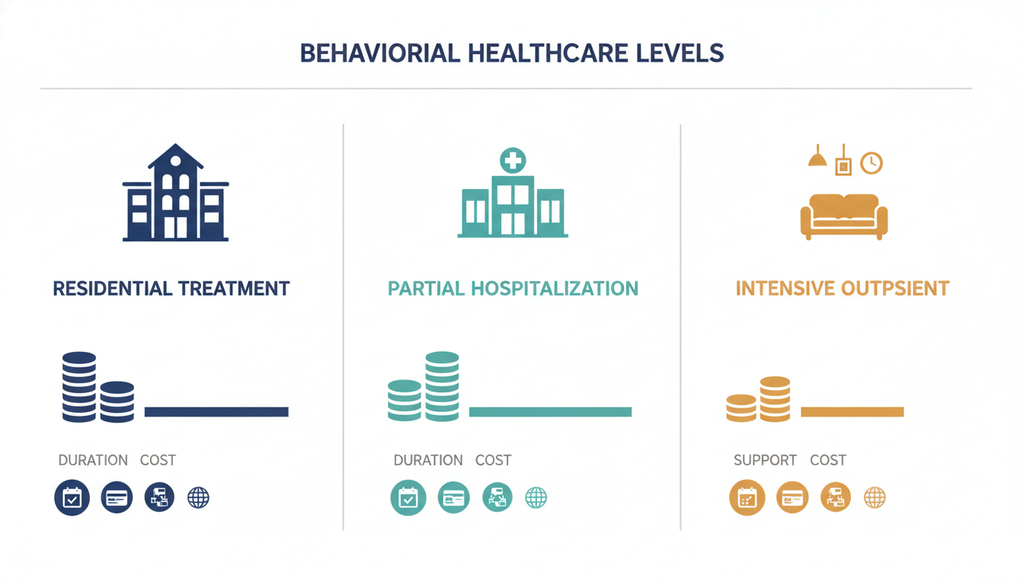
Dual diagnosis cost varies a lot depending on how intense the setting is. Residential care costs more than partial hospitalization, which costs more than intensive outpatient care. Published estimates for a 30 day stay cluster around $27,500 for residential care, roughly $15,000 for partial hospitalization, and roughly $10,400 for a month of intensive outpatient sessions. Ranges vary widely between sources, so treat these as order of magnitude rather than a quote.
| Level of care | Typical total cost for 30 days | Typical patient share when in network |
| Residential treatment | About $27,500 | Roughly 20 percent |
| Partial hospitalization | About $15,000 | Varies by plan |
| Intensive outpatient | About $10,400 | Varies by plan |
These figures give you a rough map, not a quote. Your plan design, your deductible status for the year, and whether the facility is in your network will move the actual number quite a bit in either direction.
Why Advertised Prices Differ From What You Pay
Here is the part that trips up most families. In network care and out of network care produce wildly different bills for the same clinical services. In network care and out of network care produce wildly different bills for the same clinical services. In network, your share is typically a coinsurance percentage of a negotiated allowed amount. Out of network, the facility can bill you for the difference between its full charge and what your plan allows, and that balance does not count toward your out of pocket maximum. Add uncovered services on top and total liability can exceed what the care would have cost an in network patient outright.
Commercial claims data tell a similar story from a different angle. Health System Tracker reported average inpatient costs of about $15,900 for a mental health admission and $15,500 for a substance use admission in 2023, with average patient out of pocket spending near $1,300 and $1,400. Those averages sound manageable, but they hide real spread. Roughly one quarter of admissions cost the patient more than $1,900 out of pocket, which shows that a meaningful share of insured patients still face real financial strain even with coverage in place.
Millions of people need this kind of care. The government’s own data put the number of adults living with both a mental illness and a substance use disorder at 21 million adults as of 2024. That scale is a big part of why insurers apply such careful review to residential and inpatient claims. It also means the cost questions in this article affect a huge number of families every year, not a small edge case.
Insurance, Parity Rules, and Your Coverage
The law does give you some real protection here, though not as much as most people assume. Federal parity law generally stops health plans that offer mental health and addiction benefits from applying stricter limits to those benefits than they apply to medical and surgical care. This parity law covers things like prior authorization, ongoing utilization review, and how medical necessity gets defined, not just deductibles and copays.
What it does not do is force every plan to cover every residential program at every length of stay you want. Whether residential treatment is a covered setting, and for how long, depends on your specific plan document and, for many individual and small group plans, the benefit rules set by your state.
Insurers also lean on clinical placement criteria to decide whether a level of care is medically necessary right now, not just whether you carry a diagnosis. Many plans use the ASAM criteria, which look at withdrawal risk, medical conditions, psychiatric symptoms, readiness to change, relapse risk, and how safe your home environment is. A patient can still meet residential criteria even without an active medical crisis, if relapse risk and an unsafe living situation remain high. That distinction matters a lot once your stay is underway, which brings us to the biggest cost surprise families run into.
Dual Diagnosis Treatment Cost and Mid Stay Denials
Here is the single biggest reason an advertised price and an actual bill drift apart. Insurers rarely approve a full 30 day stay up front. Instead, they often authorize a shorter block of days, then review the case again before extending coverage. When that review ends coverage early, the days that follow can shift from an insured benefit to a bill you owe directly to the facility.
Go back to the earlier example: $24,000 in allowed charges, $1,500 deductible, 20 percent coinsurance, and a $6,000 yearly cap. Now assume the insurer approves only the first 12 days, worth $9,600 in allowed charges, and denies the remaining 18 days, which the facility bills at a private pay rate of $14,400. The approved portion still follows the deductible and coinsurance math from before, but the denied portion may not count toward your out of pocket maximum at all, since it was never treated as a covered benefit. A bill that looked like $6,000 on paper can grow far past that once part of the stay gets treated as uncovered care.
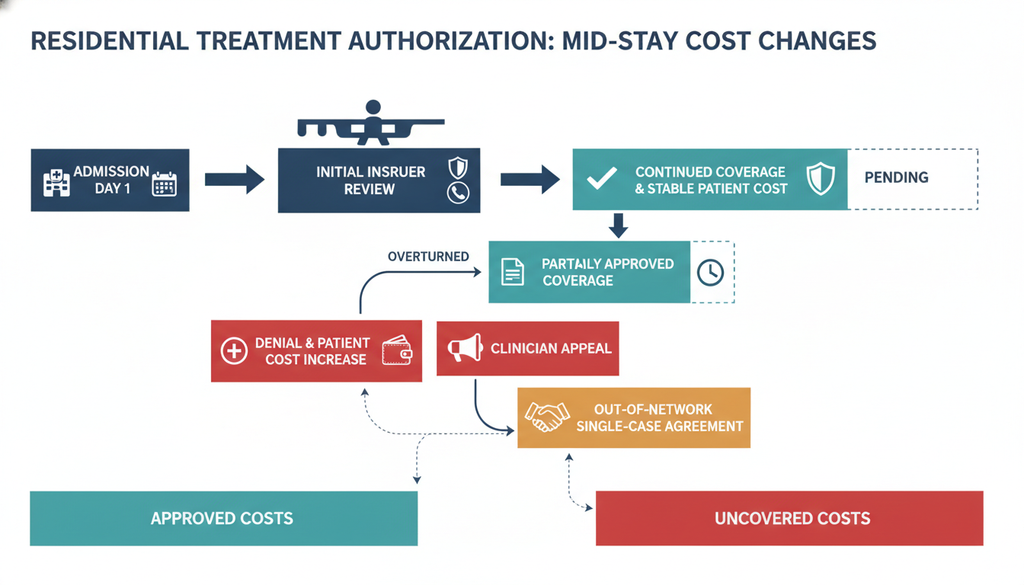
This is why the real dual diagnosis cost story is not the number on a brochure. It is what happens to authorization once you are already admitted. If you compare the cost of dual diagnosis treatment programs 2025 against the cost of dual diagnosis treatment programs 2026, the base prices probably look similar, since facility pricing tends to move slowly year over year. What actually swings your final bill is whether your insurer keeps approving days, not which year you happen to be admitted in.
If your coverage ends earlier than expected, act fast. Ask for a peer to peer review between your treatment team and the insurer’s medical director, and file an appeal before the approved period runs out rather than waiting until after discharge. Concurrent care appeals generally have to be decided before the previously approved treatment ends, so timing matters more than almost anything else in this process.
Single Case Agreements and Out of Network Care
If the facility you need is not in your network, you are not automatically stuck with the full out of network rate. Insurers sometimes agree to a single case agreement, which is a one time contract covering a specific patient, a specific facility, and a defined stretch of care, often at a rate closer to what an in network patient would pay.
This option tends to work best when no in network facility can actually treat both conditions in time, or when moving you to a different program would create real clinical risk. Parity rules do not force an insurer to sign one of these agreements just because you prefer a particular facility, but they do require network adequacy standards and comparable review processes between medical and behavioral health claims. If your plan’s in network options genuinely cannot meet your needs, that gap is exactly the kind of evidence that supports a single case agreement request.
Before you rely on one, get the terms in writing. Confirm the exact dates covered, the negotiated rate, what your share of the cost will be, and whether the agreement protects you from being billed for the difference between that rate and the facility’s normal charge.
How to Get an Accurate Estimate Before You Commit
Skip the question, what does this program cost, and ask a sharper set of questions instead. Find out the allowed amount your specific plan recognizes for this facility, not the advertised price. Ask how many days are currently authorized and what happens the moment that authorization runs out. Ask whether the facility will hold your account and keep appealing on your behalf if a denial happens, or whether you will owe the private pay rate immediately.
Also confirm whether the program is billed as residential treatment, inpatient psychiatric care, or something else entirely, since that classification affects which benefit rules apply. If the facility is out of network, ask directly whether staff will pursue a single case agreement or a network gap exception, and get that answer in writing rather than as a verbal promise from an admissions coordinator.
None of these questions guarantee a painless bill. They do turn a vague price conversation into something closer to a real risk assessment, which is the only way to protect your finances going into treatment.
Why It Matters
The advertised price on a dual diagnosis program tells you almost nothing about what you will actually owe. Your real cost depends on whether your plan treats the stay as covered, whether the facility sits in your network, and whether your insurer keeps approving days as treatment continues. A patient with strong in network coverage and a smooth authorization process might pay a few thousand dollars for care that costs tens of thousands on paper. A patient whose authorization gets cut short partway through, or who ends up out of network without an agreement in place, can face a bill that dwarfs the original quote.
Getting ahead of this means asking about allowed amounts, authorization periods, and network status before admission, then staying alert to concurrent review once treatment starts. That is the difference between a manageable bill and a financial crisis layered on top of a health crisis.
If you or someone you love needs coordinated care for a mental health condition alongside substance use, reach out to The Summit Wellness Group to ask about their dual diagnosis program and get clear answers about coverage before you commit to care.