Can Xanax cause anxiety instead of relieving it? Sometimes. Anxiety can intensify as alprazolam wears off, during withdrawal, or when the underlying anxiety disorder remains active. Learn how interdose symptoms, tolerance, rebound anxiety, and recurrence differ and also when to seek medical advice.
Can Xanax Cause Anxiety? Here’s the Quick Answer
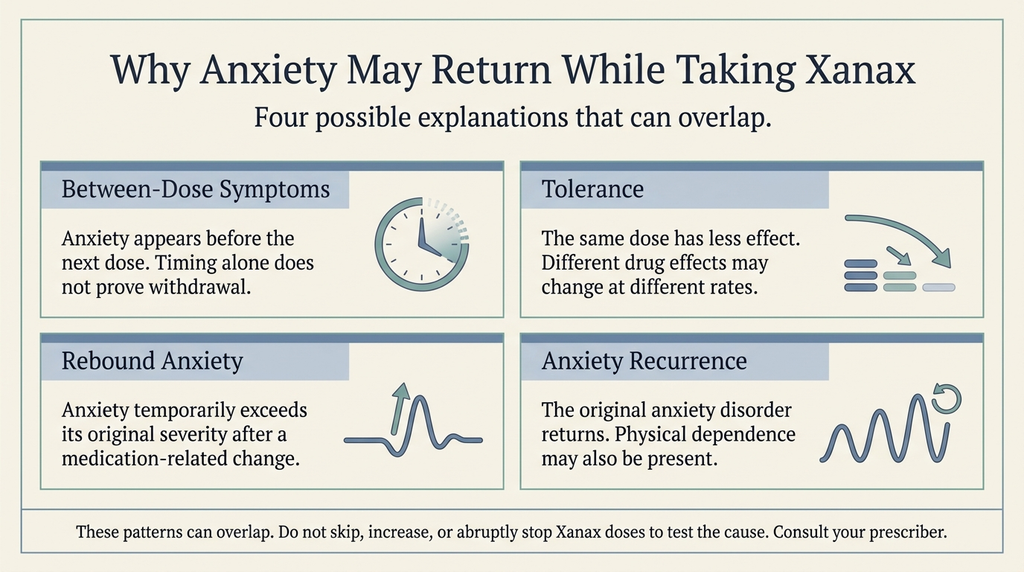
If Xanax (alprazolam) seems to be making your anxiety worse, there are several possible explanations. Some people experience anxiety as medication levels fall between doses, while others have a return of the condition the medication was prescribed to treat. The pattern deserves assessment rather than an automatic dose increase.
Your body can adapt to regular alprazolam use. Some effects may become less noticeable, and a physically dependent person can develop withdrawal-like symptoms as drug exposure falls. Meanwhile, the original anxiety disorder may still be active. These explanations can overlap, which makes the cause difficult to identify from anxiety alone.
Official alprazolam prescribing information acknowledges this uncertainty. In one controlled discontinuation trial, investigators could not determine whether anxiety and insomnia reflected the return of the original disorder, rebound symptoms, or withdrawal. Even structured research does not always distinguish them clearly.
Why Xanax Can Make Anxiety Worse Between Doses
Alprazolam levels rise after a dose and later fall, but the timing and intensity of symptoms differ between people. Immediate-release and extended-release formulations also produce different exposure patterns. A dosing schedule alone cannot establish why a particular episode of anxiety occurs.
What Interdose Withdrawal Feels Like
As blood levels drop, some people notice anxiety creeping back before the next scheduled dose. You might wake up shaky, sweaty, or suddenly on edge, even though nothing in your day has changed yet.
This pattern is sometimes described as interdose withdrawal. Product information recognizes early-morning and between-dose anxiety during prescribed alprazolam treatment, but it also notes that these symptoms may reflect tolerance or a dosing interval that exceeds the medication’s useful effect. They are a clue, not a diagnosis.
Feeling better after the next prescribed dose does not prove withdrawal caused the symptoms. Xanax can relieve both the underlying anxiety disorder and anxiety associated with falling medication levels. Look at the broader symptom pattern with your prescriber rather than deliberately skipping, delaying, or adding doses to test a theory.
Tolerance: When the Same Dose Stops Working
Tolerance means that the same dose produces less of a particular drug effect after repeated exposure. But tolerance is not an all-or-nothing switch. A review of benzodiazepine tolerance research found that sedation and sleep-promoting effects may diminish faster than anxiety relief, which does not necessarily fade at the same rate.
This explains a confusing situation some people run into. You might stop feeling sleepy on your usual dose, yet still get real anxiety relief from it. Neither pattern proves addiction or failure on your part. It just means different brain effects wear off at different speeds.
If your usual dose seems to control anxiety less effectively, tolerance is one possibility. But a return of the original disorder, reduced duration of benefit, sleep disruption, and interdose symptoms are also possible. Feeling worse does not, by itself, establish that your body needs a higher dose.
Rebound Anxiety vs Your Anxiety Simply Returning
Recurrence means the original anxiety disorder returns, often resembling its pretreatment pattern. Rebound anxiety refers to a temporary worsening above the pretreatment level in a medication-related context, such as after a reduction or as an effect wears off. Symptom intensity alone cannot reliably distinguish the two.
A Canadian alprazolam product monograph distinguishes rebound from recurrence using the person’s pretreatment baseline. More frequent or intense panic after a dose change can raise suspicion of rebound, but new life stressors or worsening of the original condition can also increase symptoms. Dose timing, symptom history, and other factors all matter.
Either way, dependence can still be present underneath. A person can have genuine recurring anxiety and physical dependence on Xanax at the same time. These are not competing explanations, they can both be true.
So Can Xanax Cause Anxiety Over Months or Years?
With longer use, the picture gets more layered. Dependence becomes more likely the longer you take a benzodiazepine regularly, and the joint tapering guideline from a group of ten medical organizations makes a point of separating dependence from addiction. Dependence is a physical adaptation. It can happen to someone taking Xanax exactly as prescribed, with no misuse at all.
ASAM’s patient guide on benzodiazepine tapering estimates that fewer than 2% of people taking benzodiazepines develop a benzodiazepine use disorder. This is a broad educational estimate, not an individual risk prediction; physical dependence is much more common and does not, by itself, mean addiction.
Dose creep is worth watching here too. If you find yourself taking the next dose earlier, adding extra doses, or needing more just to feel steady, that’s a signal worth bringing to your prescriber. It doesn’t automatically mean addiction, but it does mean the current plan may not be working the way it should.
Warning Signs Your Xanax Use Needs a Closer Look
Not every symptom carries equal weight. Some patterns deserve a prompt conversation with your prescriber. Watch for:
- Anxiety that reliably shows up before your next scheduled dose, especially after the longest overnight gap
- New symptoms that weren’t part of your original anxiety, such as tingling, muscle twitching, unusual sound sensitivity, or blurred vision
- Needing to take doses earlier, closer together, or in larger amounts just to feel normal
- Anxiety or panic that now feels clearly worse than it ever was before you started treatment
- Trouble functioning, sleeping, or concentrating that keeps getting worse despite steady dosing
Even one new, severe, or worsening symptom may justify assessment; you do not need several signs at once. Repeated symptoms that track dose timing are especially useful to discuss with a prescriber.
When to Seek Urgent Medical Care
A seizure, severe confusion, hallucinations, pronounced disorientation, or difficulty breathing requires emergency medical attention. Severe sedation or an inability to wake someone is also an emergency. These problems should not be managed by waiting for the next dose. See MedlinePlus alprazolam safety guidance for warning signs.
Xanax can cause dangerous sedation and breathing problems when combined with opioids, alcohol, or other central nervous system depressants. Do not drink alcohol while taking Xanax, and tell your prescriber about opioid pain medicines, sleep medications, and other sedating substances. The FDA warns that these combinations can cause overdose or death.
What To Do If Xanax Seems to Be Backfiring
First, do not stop Xanax or reduce the dose abruptly on your own after regular use. Abrupt discontinuation or rapid reduction can trigger serious withdrawal, including seizures. FDA labeling for Xanax XR describes seizure events reported in discontinuation or dose-reduction settings, but those historical trial findings do not give a personalized seizure probability. Any change should be planned and supervised by the prescribing clinician.
Second, bring a clear history to your prescriber: prescribed and actual dose times, recent changes, the symptoms you notice, sleep and stress patterns, and how your anxiety compares with before treatment. A brief symptom record can help identify possible patterns, but it is not a diagnostic test. Do not change the dosing schedule to see whether symptoms get better or worse.

If the risks of continued treatment outweigh its benefits and a taper is appropriate, the plan should be gradual and individualized. NICE withdrawal guidance recommends stepwise, proportionate reductions rather than the same fixed amount at each step, with adjustments when symptoms become difficult to tolerate. The 2025 joint benzodiazepine-tapering guideline likewise emphasizes reassessment, flexible pacing, and clinical supervision. Dependence alone does not mean everyone must discontinue immediately.
Treatment for the underlying anxiety disorder should continue alongside any medication changes. Cognitive behavioral therapy and other evidence-based treatments can help people manage anxiety while medication decisions are reviewed. The goal is safer treatment and better functioning—not simply a lower medication dose.
Why This Matters For Your Recovery
If Xanax seems to worsen your anxiety, recognizing the possible roles of withdrawal, tolerance, and recurring symptoms can help you respond more safely. More medication is not automatically the answer when anxiety returns, and a flare-up does not by itself prove that your original diagnosis was wrong.
It also means safety has to come first. Physical dependence can build quietly, even in people who have never misused their prescription. Respecting that reality, rather than ignoring it or panicking over it, is what makes a safe path forward possible.
If Xanax seems to be feeding your anxiety instead of calming it, you don’t have to sort this out by yourself. The team at The Summit Wellness Group can help you build a safer plan through evidence based treatment designed around your history, your symptoms, and your goals.