There’s no single right number of days for rehab because the length that works depends on your level of care and how your insurance reviews progress, not a fixed calendar. Most centers offer 30, 60 or 90 day tracks, but continued care is approved only when your needs still require that level of support. This article breaks down what each length offers, answers how long should rehab last for different needs, and covers what matters after you leave.
How Long Should Rehab Last? The Real Answer
The honest answer is that it depends on what level of care you actually need, not which package a facility happens to advertise. If you are asking how long should rehab be for your specific situation, start with this: length follows medical necessity, and medical necessity gets checked again and again while you are in treatment, not decided once at intake.
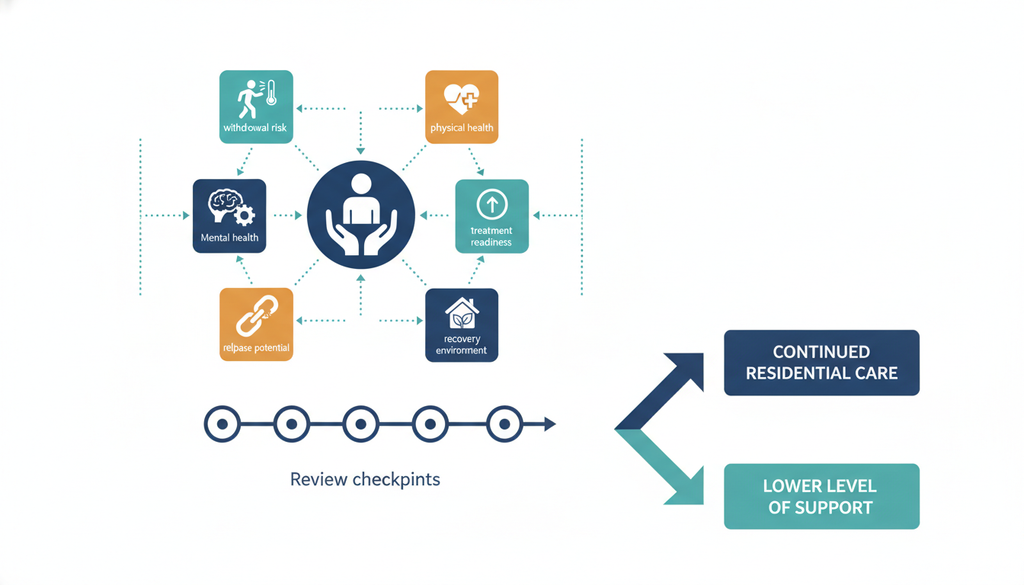
Clinicians and insurance reviewers commonly lean on a framework called the ASAM criteria to make that call. It looks at six areas of health, including withdrawal risk, medical conditions, mental health, readiness, relapse risk, and how safe your living situation is, to figure out the least intensive setting that can still keep you safe. That framework gets applied at admission, and it gets applied again during treatment to decide whether you still need that same level of intensity.
That is the part most people do not expect. A 30 day plan on paper does not guarantee 30 days of coverage. Insurance reviewers check in on a schedule set by your specific plan, sometimes weekly, to ask whether the reasons you were admitted still apply today. A program can be completely appropriate at admission and still get flagged three weeks later if progress looks good on paper, because the question being asked has quietly shifted from whether this person needed residential care when they arrived to whether they still need it now.
A Quick Comparison
| Length | Best fit when | What the evidence says |
| 30 days | First treatment episode, stabilization after withdrawal management, insurance often authorizes in short blocks | Early weeks carry the highest risk for medication gaps and return to use, so tight follow up matters most |
| 60 days | A previous short stay did not hold, or a co occurring mental health condition needs more time to stabilize | Medication discontinuation climbs fastest in the first month, so extra weeks can support steadier use |
| 90 days | Repeated relapse, significant trauma, or an unsafe home environment | Reviews of residential treatment found stays ranging from a few weeks to well over a year, with outcomes tied to what happens after discharge |
The 30 Day Rehab Program: What It Covers
A 30 day rehab program is often the first structured stay after withdrawal management ends. It is built for stabilization: starting or adjusting medication, practicing early coping skills, and getting a first honest look at what triggers substance use.
Training materials used by one major insurer describe minimum weekly treatment hours tied to the level of care being billed, roughly five hours a week at a lower intensity residential level and closer to fifteen hours a week at higher intensity levels. Those numbers matter because a program that claims a high level of care but delivers far less actual treatment time can run into trouble at the next review.
Thirty days is rarely enough time to fully carry new skills into daily life outside a structured setting. It can be enough to get someone medically stable, connected to medication if needed, and pointed toward the right next step, whether that is a longer residential stay, a partial hospitalization program, or intensive outpatient care.
The 60 Day Rehab Program: A Middle Ground
A 60 day rehab program buys more room during the exact window when things tend to fall apart. In a large Medicaid claims study of people starting buprenorphine, 10.4 percent stopped the medication within the first week and 28.4 percent stopped within the first month. By 60 days, someone who has stayed engaged has already cleared some of the steepest drop off points seen in that data.
This length also gives more time to address whatever sits alongside the substance use, depression, anxiety, trauma, or an unstable living situation, without rushing straight from detox into a discharge plan. It tends to fit someone who tried a shorter stay before and did not hold onto the gains once they got home, or someone managing a substance use disorder together with another mental health condition that needs more than a few weeks to settle.
The 90 Day Rehab Program: More Time to Rebuild
A 90 day rehab program is usually reserved for people with repeated relapse, significant trauma, or a home environment that is not safe yet. There is no single number that proves 90 days works better than 60 for everyone. A relapse review of studies on residential treatment for opioid use disorder, published between 2018 and 2022, found relapse rates ranging from zero percent to 95 percent depending on the study, with follow up periods running from one month to six months.
That wide range is not a flaw in the research, it is a warning against trusting any single relapse statistic as a universal benchmark. What the evidence does support is simpler: more time tends to help people whose needs are more complicated, but the extra weeks only pay off when they are paired with an actual plan for what happens after discharge, not just more days inside the same routine.
How Long Is Inpatient Rehab, Really?
People often use the word inpatient to mean any stay away from home, but medically monitored inpatient care is a distinct level from clinically managed residential care. The inpatient version involves closer medical monitoring, usually reserved for people with more serious health complications or higher withdrawal risk. Most people asking how long is inpatient rehab are actually picturing a residential stay rather than a hospital level program.
A 2020 national survey of treatment facilities found that 82 percent offered outpatient services, while only 24 percent offered residential care outside a hospital and just 5 percent offered hospital inpatient treatment. On the day that survey was taken, 94 percent of clients in care nationwide were receiving outpatient treatment, compared with 5 percent in residential care and 1 percent in hospital inpatient settings. That does not mean residential care is unnecessary. It means it is a smaller, more intensive slice of a much bigger system, typically reserved for people who need more than outpatient care can offer right now.
Within residential care itself, intensity varies too. Some programs sit at a lower intensity, closer to structured supportive housing with clinical services attached, while others run at a higher intensity, with daily programming and closer psychiatric or medical involvement. The word residential on a brochure does not tell you which end of that range you are looking at, so it is worth asking directly what level a program is licensed to provide and how many hours of actual treatment happen each week.
Why Insurance Doesn’t Just Approve a Number of Days
Insurance companies do not authorize a length of stay the way a hotel books a reservation. They approve a period, then review the case again before it ends. One major plan’s own policy library separates initial admission rules from concurrent review rules for residential levels of care, a clear sign that the paperwork that got you admitted is not the same paperwork that keeps you covered.
Plans are also shifting which clinical criteria they use, which affects how those reviews get decided. One insurer announced it would begin applying the newer ASAM Fourth Edition criteria to adult admissions in 2026 while keeping its existing authorization and review procedures in place unless it says otherwise. If a request for more days gets denied, that is a real, appealable decision, not the final word. Federal guidance for marketplace plans lays out an external review process for asking an outside, independent reviewer to look at a denial, generally within four months of the final denial letter.
You can typically ask, in writing, what criteria a reviewer used and why a lower level of care was judged sufficient in your case. Asking your treating clinician to talk directly with the plan’s reviewer can sometimes resolve a denial faster than a formal written appeal, especially when the disagreement comes down to a detail that got missed rather than a real dispute about your care.
What Happens After Rehab Matters as Much as Length
However long a stay lasts, the days right after discharge carry outsized risk, especially for opioid use disorder. Tolerance drops during a residential stay, so returning to a previous dose after leaving can be far more dangerous than it was before treatment started. A Massachusetts study that followed more than 30,000 people through inpatient opioid withdrawal management found that medication for opioid use disorder was linked to sharply lower death rates in the year after discharge, and the combination of medication plus residential treatment showed the lowest death rates of any group studied.
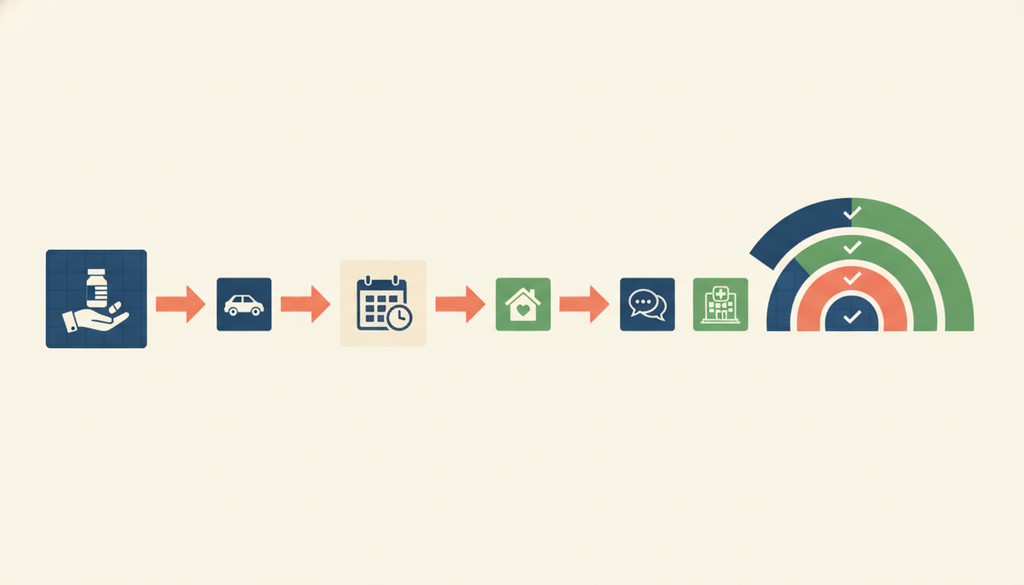
That risk is not spread evenly across the following weeks. The first three days tend to be the most fragile for medication and transportation logistics. The first week is when many people either connect with follow up care or quietly drift away from it. The first month is where medication gaps and early relapse most often show up. None of that is a reason to panic. It is a reason to want specific answers, not vague reassurance, about what the first week after discharge actually looks like.
None of this means a longer program guarantees a safer outcome on its own. It means the plan for the day someone leaves, medication in hand, a scheduled follow up appointment, a safe place to live, and someone checking in if an appointment gets missed, matters just as much as whether the stay was 30, 60, or 90 days. One continuing care resource built for families frames a return to use as a signal to adjust support rather than proof that treatment failed.
How Long Should Rehab Last for You
There is no universal number that fits every person walking through the door. Someone stabilizing after a first, relatively contained episode might do well with a 30 day program paired with a strong outpatient plan. Someone who has relapsed multiple times, carries a serious mental health condition alongside their substance use, or does not have a safe place to return to may need 60 or 90 days, sometimes longer, with the length reassessed along the way rather than fixed in advance.
The most useful question is not how many days. It is what this specific situation still needs in order to be safe at a lower level of care. That is the same question your treatment team and your insurance reviewer are quietly asking, even if they phrase it differently. Answering it honestly, and building a real plan for the days right after discharge before the last day ever arrives, tends to matter more than hitting a round number on the calendar.
If you are trying to work out what level of care actually fits your situation, or you need a plan that holds once treatment ends, we are glad to talk it through with you. Reach out to our team at The Summit Wellness Group and explore our outpatient programs and figure out the right next step together.