Overdose patients in Atlanta face a critical window after leaving the emergency department.
Without proper follow-up care, many return to the ER within days or weeks, signaling gaps in treatment and support.
While Georgia does not publish patient-linked 30-day revisit rates for overdose cases, strong data systems exist to measure this metric using hospital discharge records with privacy-preserving patient tracking.
This article explains what we know about repeat ER overdose visits in Atlanta, the tools available to measure them accurately, and the clinical and social factors that drive recurrence.
What We Know About Atlanta’s 30-Day ER Overdose Revisit Landscape?
No public dashboard currently reports Atlanta’s exact 30-day ER revisit rate for overdose patients. However, multiple data streams provide strong context.
The CDC’s Drug Overdose Surveillance and Epidemiology system (DOSE-SYS) tracks suspected nonfatal overdose ED visits monthly across 46 states and DC, offering near real-time trend intelligence.
Georgia’s Online Analytical Statistical Information System (OASIS) provides county-level overdose ED visit rates with historical depth. Yet neither system directly links individual patients across visits to calculate 30-day recurrence.
The most accurate method to compute Atlanta’s revisit rate uses the Healthcare Cost and Utilization Project (HCUP) state databases.
HCUP’s Georgia emergency department and inpatient discharge files include VisitLink and DaysToEvent variables, which enable privacy-preserving patient tracking within the state and precise measurement of days between encounters.
These tools are specifically engineered for revisit analysis and widely adopted in peer-reviewed research.
National evidence suggests revisits are common and predominantly local. Across a large state sample, roughly 22.6% of all ED visits resulted in a 30-day return, with 70% of patients returning to the same hospital and county-level capture reaching approximately 92%.
While this statistic spans all causes, it frames expectations for overdose-specific revisits and underscores that most recurrence happens close to home.
Why Measuring 30-Day Revisits Matters for Atlanta?
Repeat ER visits after an overdose are more than a utilization metric. They signal missed opportunities to initiate addiction treatment, distribute naloxone, and connect patients to housing and mental health services.
Overdose survivors face elevated short-term mortality and morbidity. Quantifying 30-day revisit rates enables hospitals and public health agencies to evaluate whether ED-based interventions—such as buprenorphine initiation, addiction consult services, and peer navigation—are reducing recurrence and improving outcomes.
Atlanta’s flagship safety-net hospital, Grady Health System, operates the region’s only Level 1 trauma center within 100 miles of downtown and serves as the anchor for emergency medicine in Fulton and DeKalb counties.
With approximately 80% of Grady physicians as Emory faculty, the system has the clinical, academic, and data infrastructure to implement rigorous revisit measurement and evidence-informed care pathways.
Data Systems That Support Overdose Surveillance and Revisit Measurement
Data systems that support overdose surveillance and revisit measurement help Georgia track who returns to care after an overdose and how often. Together, these tools show patterns over time and guide targeted prevention:
HCUP State Databases: The Gold Standard for Revisit Metrics
The HCUP state emergency department (SEDD) and inpatient (SID) databases provide comprehensive all-payer discharge data with person-level linkage variables.
VisitLink creates a synthetic patient identifier that tracks individuals across hospitals within Georgia, while DaysToEvent calculates the interval between encounters.
These variables support reproducible 30-day revisit computations and are used in national readmission studies, including the Nationwide Readmissions Database.
HCUP’s strength lies in completeness and specificity. Discharge data include ICD-10-CM diagnosis codes that identify opioid-involved, stimulant-involved, and polysubstance overdoses with high accuracy.
The main limitation is state-bounded tracking: revisits occurring outside Georgia are not captured, which may slightly underestimate true recurrence. However, given that most ED returns are local, this bias is likely minimal for Atlanta-focused analyses.
CDC DOSE-SYS: Near Real-Time Syndromic Surveillance
DOSE-SYS aggregates suspected nonfatal overdose ED visits using electronic health record text queries and standardized syndrome definitions.
The system updates monthly with a one- to two-month lag and covers more than 90% of ED facilities in participating states.
By September 2023, the underlying National Syndromic Surveillance Program (NSSP) platform received data from over 6,500 facilities, with 78% of U.S. EDs sending information within 24 hours.
DOSE-SYS excels at timeliness and trend detection, making it essential for operational monitoring and rapid response to emerging substances like fentanyl and xylazine.
However, it does not provide patient-level revisit metrics. The syndromic definitions are nested and not mutually exclusive, meaning a single visit can be flagged for both opioid and stimulant involvement.
This design supports comprehensive trend analysis but differs from the diagnosis-coded approach used in HCUP.
Georgia DPH OASIS and Monthly Reports
Georgia’s OASIS system offers county-level overdose ED visit and mortality rates with historical baselines.
The Georgia Department of Public Health publishes monthly and quarterly surveillance reports that include syndromic ED overdose trends, case definitions, and documented limitations.
These resources are vital for local context and public-facing dashboards but do not link individual patients across visits.

Clinical and Social Factors That Drive 30-Day Revisits
Clinical and social factors that drive 30-day revisits shape who returns to the emergency department after an overdose and why. Understanding hospital-based addiction supports, ED-initiated buprenorphine, and social determinants like homelessness and mental illness is essential for designing effective, equitable follow-up care:
Hospital-Based Addiction Supports
Observational evidence from a Canadian cohort study found that hospital-based addiction medicine consult services and specialized addiction units were associated with statistically significant differences in 30-day ED revisits among substance use disorder patients.
The study used Kaplan-Meier survival analysis and logistic regression—methods suitable for replication in Atlanta—to demonstrate that structured inpatient and ED addiction care can influence short-term utilization.
ED-Initiated Buprenorphine
A landmark randomized controlled trial showed that ED-initiated buprenorphine with facilitated follow-up roughly doubled 30-day addiction treatment engagement compared to standard referral (78% versus 35%).
While only 9% of participants were enrolled post-overdose, the findings highlight a mechanism by which revisits may be reduced through improved continuity and stabilization.
Separately, research indicates that higher buprenorphine doses during the first 30 days of treatment are associated with significantly reduced opioid-involved overdose mortality over the subsequent year, supporting aggressive stabilization strategies post-ED.
Social Determinants of Health
Homelessness and mental illness are robust predictors of repeat ED visits. A retrospective cohort study found that homelessness increased the odds of 30-day ED revisits by 40% (OR 1.40, 95% CI 1.20–1.65).
Mental health diagnoses also correlate with revisit patterns. These findings underscore the need for risk adjustment in benchmarking and for integrating housing navigation, medical respite, and psychiatric stabilization into ED overdose pathways.
A scoping review of social determinants and substance use disorders identified unstable housing, unemployment, and prior incarceration as factors linked to overdose and mortality.
While these variables may indirectly influence revisit risk, they are not always captured in administrative data, highlighting the importance of supplemental data collection and community partnerships.
How Atlanta Can Measure and Reduce 30-Day Revisits?
Atlanta can measure and reduce 30-day revisits depending on pairing rigorous data methods with targeted clinical and social interventions. By tracking who returns after an overdose and why, the city can focus resources on high-risk patients and build systems that prevent avoidable repeat emergencies:
A Two-Track Measurement Strategy
Atlanta should implement a dual approach: annual benchmark-quality revisit rates using HCUP Georgia SEDD/SID with VisitLink and DaysToEvent, paired with a near real-time operational dashboard integrating DOSE-SYS, OASIS, EMS data, and fatal overdose surveillance.
The HCUP-based metric provides the rigor needed for quality management and intervention evaluation. The DOSE-SYS dashboard offers the timeliness required for responsive public health action.
To compute the 30-day revisit rate, analysts should identify the first qualifying ED overdose encounter per patient per study year as the index visit, using ICD-10-CM poisoning codes for opioid-involved and all-drug overdoses.
VisitLink enables tracking of all subsequent encounters for the same individual, and DaysToEvent calculates the interval from the index ED discharge to any ED return within 30 days.
Outcomes should include both all-cause and overdose-specific revisits, with stratifications by county, facility, homelessness status, mental health comorbidity, and polysubstance involvement.
Risk Adjustment and Subgroup Analysis
Recommended covariates for risk adjustment include demographics (age, sex, race/ethnicity), clinical factors (triage acuity, mental health diagnoses, comorbidity burden), social determinants (homelessness indicator, payer type), and utilization history (prior ED visits, prior overdose episodes).
Kaplan-Meier curves can illustrate time to first revisit, while logistic regression models with facility random effects support adjusted comparisons across hospitals and patient subgroups.
Separate analyses for opioid-involved versus stimulant-involved overdoses, and for polysubstance presentations, will align with DOSE-SYS syndromic categories and reflect the complexity of Atlanta’s overdose landscape.
Stratifying by homelessness and mental health comorbidity will identify high-risk cohorts that may benefit most from integrated clinical and social interventions.
Validation and Transparency
Cross-validating HCUP-based revisit trends with DOSE-SYS monthly suspected overdose rates and Georgia DPH syndromic reports will corroborate directional consistency and build stakeholder confidence.
Publishing annual technical reports with codebooks, sensitivity analyses, and documented handling of HCUP linkage variables will ensure reproducibility and support peer review.
Interventions to Reduce Repeat ER Overdose Visits
Interventions to reduce repeat ER overdose visits focus on closing the gaps that send people back to the hospital after a crisis. Standardized discharge bundles, integrated addiction medicine and peer navigation, and supports for homelessness and mental health can work together to prevent avoidable 30-day revisits:
Standardized ED Discharge Bundles
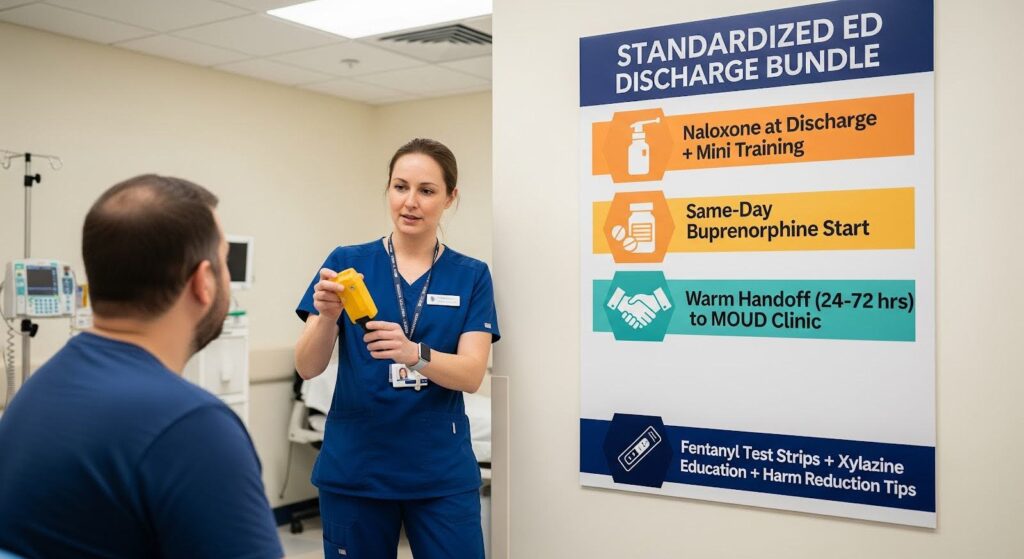
Every suspected overdose patient should receive naloxone at discharge with brief training, same-day buprenorphine initiation for patients with opioid use disorder, and warm handoffs to outpatient medication for opioid use disorder within 24 to 72 hours.
Fentanyl test strips, xylazine education, and clear harm reduction messaging should be standard components. These bundles address the modifiable gaps that drive preventable recurrence.
Integrated Addiction Medicine and Peer Navigation
Expanding ED-based addiction consult services and peer navigation programs, paired with housing and mental health supports, can target the social complexity that elevates revisit risk.
Evidence suggests that combined models—rather than any single intervention—are necessary to achieve meaningful reductions in 30-day revisits.
Addressing Homelessness and Mental Health
Integrating housing navigation, medical respite, and psychiatric stabilization into ED care pathways is critical.
Medicaid waivers and managed care partnerships can fund nonmedical supports that reduce avoidable utilization.
Atlanta should embed these services into the ED overdose pathway and measure differential effects across subgroups.
Building a Metro Atlanta Overdose Dashboard
A public-facing dashboard should integrate annual HCUP-based 30-day revisit rates, monthly DOSE-SYS suspected overdose trends, EMS overdose-related activations from the National EMS Information System, and fatal overdose counts from the State Unintentional Drug Overdose Reporting System.
The dashboard should include transparent methods documentation, data quality indicators, and intervention overlays (such as ED buprenorphine adoption dates) to support evaluation.
Design principles should emphasize transparency, equity, and actionability. Stratifications by race/ethnicity, age, and geography will enable monitoring of disparities.
Flagging thresholds and trend alerts will support responsive public health action. Examples from CDC NSSP partner dashboards, such as Virginia’s unintentional drug overdose ED visits, illustrate integration best practices that Atlanta can customize to local needs.
Limitations and Considerations
HCUP’s state-bounded linkage will undercount revisits occurring outside Georgia. However, for Atlanta, county-level capture is expected to be high based on national patterns, reducing this limitation’s practical impact on local benchmarking.
DOSE-SYS syndromic definitions are not diagnosis-confirmed and facility participation may vary, so month-to-month comparisons are valid for trend assessment but not directly translatable to coded revisits.
The lack of randomized trials demonstrating revisit reduction specifically in post-overdose ED cohorts for medication-assisted treatment suggests Atlanta needs to generate local evidence through stepped-wedge or quasi-experimental designs.
Social determinants require multi-sector investments; without housing and behavioral health supports, revisit reductions may stall even with optimal ED pharmacotherapy.
The Path Forward for Atlanta
Measuring Atlanta’s 30-day ED revisit rate for overdose patients is feasible, valid, and overdue. HCUP’s Georgia SEDD/SID with VisitLink and DaysToEvent provide the necessary linkage to compute this metric with benchmark quality.
DOSE-SYS offers the most up-to-date nonfatal overdose ED trends for near real-time operational management. Together, these systems enable both annual benchmarking and responsive public health action.
Clinical interventions with promising associations to reduced 30-day revisits include hospital-based addiction medicine support and ED-initiated buprenorphine with facilitated follow-up.
Strong local evaluation is needed, given mixed evidence in overdose-specific cohorts. Social determinants, especially homelessness and mental health comorbidity, must be integrated into both care models and revisit risk adjustment.
Grady and Emory are uniquely positioned to lead this work, producing both improved outcomes and peer-reviewed evidence that advances national practice.
The decisive, feasible path for Atlanta is to pair a gold-standard HCUP-based 30-day revisit benchmark with a DOSE-SYS-enabled operational dashboard and to embed evidence-informed ED care that addresses medical, behavioral, and social needs.
If you or someone you know is struggling with substance use after an overdose, compassionate, evidence-based support is available.
Reach out to explore Summit’s addiction treatment options that can help break the cycle of repeat ER visits and build a path to lasting recovery.