Atlanta faces a troubling cocaine trend, but pinpointing exactly which neighborhoods are hit hardest remains a challenge.
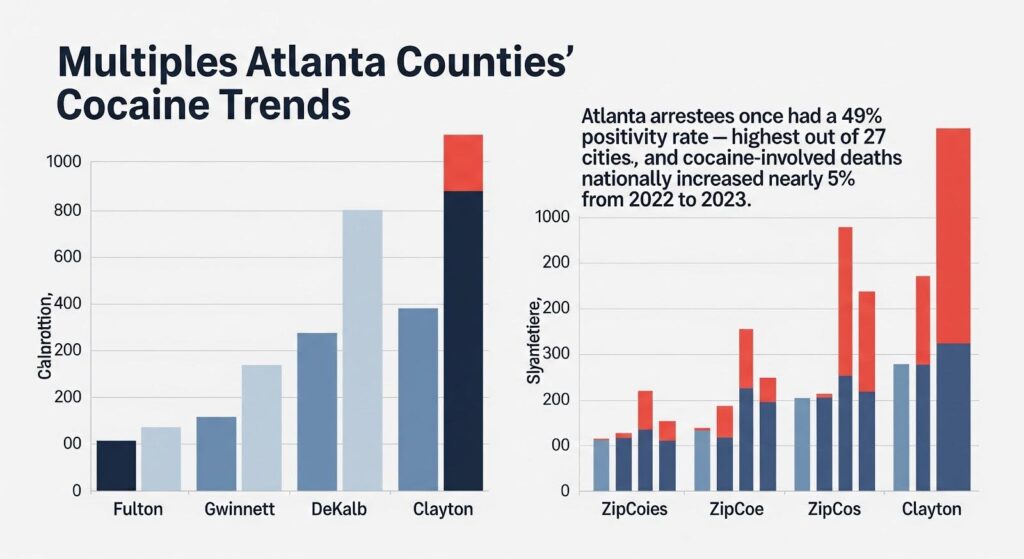
Around 2000, Atlanta arrestees showed the highest cocaine positivity rate among 27 U.S. cities at 49 percent, and national data confirm that cocaine-involved deaths rose by nearly 5 percent from 2022 to 2023.
This article explains what we know about cocaine use by county in Atlanta, what data gaps exist, and how public health systems can fill those gaps to guide treatment and prevention.
What We Know About Cocaine Trends in Metro Atlanta?
The most reliable evidence comes from three streams: historical arrestee testing, modern overdose surveillance, and supply-side intelligence. Each tells part of the story, but none currently provides the ZIP-level detail needed for precise local action.
Historical Baseline: Atlanta’s 49 Percent Cocaine Rate
At the turn of the millennium, the federal Arrestee Drug Abuse Monitoring program tested adult male arrestees in 27 cities. Atlanta topped the list. Nearly half tested positive for cocaine by urinalysis in 2000, far above the range seen in smaller cities. The program also separated crack from powder cocaine and mapped where arrestees lived and where they last bought drugs, creating a geographic snapshot of cocaine markets by ZIP code.
That data is two decades old, but it establishes Atlanta as a long-standing cocaine hub. The question is whether the geography of harm has shifted since then.
Contemporary Overdose Data: Cocaine Deaths Climb Nationally
National vital statistics show that cocaine-involved overdose mortality reached 8.6 deaths per 100,000 people in 2023, up from 8.2 the year before. Urban counties consistently report higher rates than rural areas, with 2020 data showing urban cocaine mortality more than double rural rates. These national patterns suggest that core Atlanta neighborhoods likely bear heavier burdens than outlying counties.
Georgia’s public health system tracks overdose deaths through its OASIS portal, which reports drug overdose mortality by residence down to the census tract level. However, the public interface groups cocaine with other stimulants or under a broader “all drugs” category, rather than isolating cocaine-specific deaths by ZIP code.
Emergency department visits offer another window. Georgia participates in the CDC’s syndromic surveillance system, which flags suspected cocaine-involved overdoses in near real time. But again, ZIP-level breakdowns are not publicly released, leaving a critical gap for neighborhood-level strategy.
Why ZIP-Level Data Matters for Cocaine Intervention?
Countywide statistics mask enormous variation within cities. A single county can contain wealthy suburbs with minimal overdose risk alongside urban cores where harm is concentrated. Without ZIP-level data, resources get spread too thin or deployed in the wrong places.
Consider how this plays out in practice. If a harm reduction organization has 500 naloxone kits to distribute, should they blanket the county or focus on the three ZIP codes with the fastest growth in cocaine-involved emergency visits? The answer is obvious, but it requires data that Atlanta currently does not publish.
The historical arrestee mapping work proved this approach works. By plotting where people lived and where they bought cocaine, public health teams could distinguish marketplace ZIPs from residential harm ZIPs. That distinction guides whether to focus on supply disruption, demand reduction, or overdose reversal in each area.
The Fentanyl Factor: Why Cocaine Trends Are Opioid Stories Now?
Any discussion of rising cocaine harms in 2025 must reckon with fentanyl contamination. National research found that 72.7 percent of cocaine-involved deaths also involved opioids in 2017, and that share has grown.
Georgia’s Department of Public Health issued a statewide alert in March 2022 documenting emergency department cases where people who used stimulants responded to naloxone, the opioid reversal drug. That pattern signals unintentional fentanyl exposure through contaminated cocaine supplies.
This changes how we interpret cocaine use by county in Atlanta. When someone dies or visits an emergency room after using cocaine, the proximate cause is often fentanyl, not the cocaine itself. The fastest-increasing ZIP codes for cocaine-involved harms are likely the same ZIPs where synthetic opioids have infiltrated stimulant markets.
That means the response must include opioid-focused interventions. Naloxone saturation, fentanyl test strips, and medications like buprenorphine all belong in cocaine harm reduction strategies, even though cocaine itself is not an opioid.
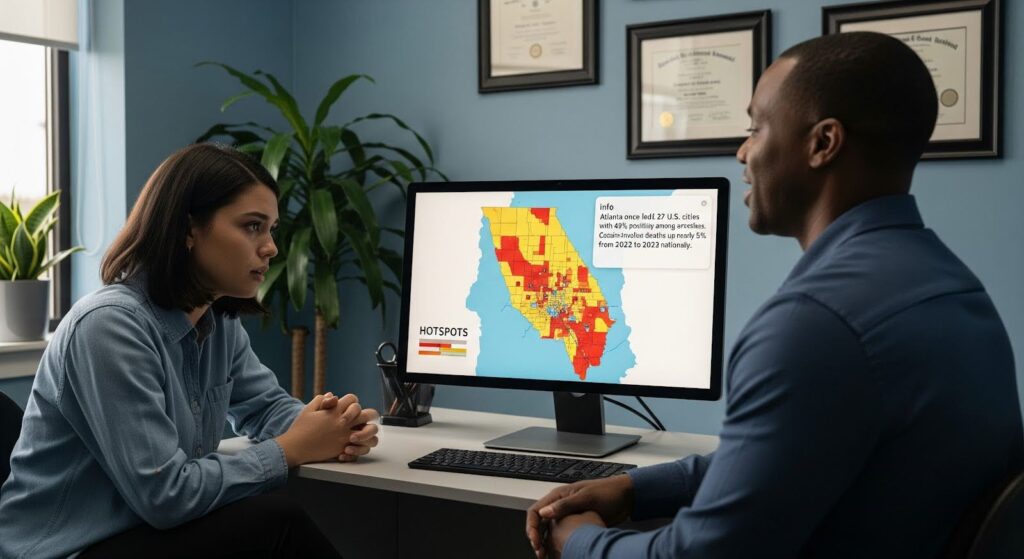
How Georgia Can Build ZIP-Level Cocaine Surveillance?
The infrastructure to produce ZIP-level cocaine trends already exists. It just needs to be activated. Here is the blueprint:
Step One: Request Custom OASIS Extracts
Georgia’s OASIS system holds overdose death records and hospital discharge data coded by drug type and residence ZIP. While the public portal does not expose a cocaine-only category at the ZIP level, the underlying data supports it.
Public health analysts can request custom tabulations for cocaine-involved deaths using the ICD-10 code T40.5 and cocaine-involved emergency department visits using T40.5X. These extracts would show annual counts, rates, and confidence intervals by ZIP of residence, following the same methods Georgia uses for opioid surveillance.
Step Two: Apply Syndromic Surveillance for Near Real Time Signals
Georgia already feeds emergency department data into the CDC’s DOSE-SYS platform, which identifies suspected overdoses from chief complaints and discharge diagnoses within 24 to 48 hours. The system includes a cocaine-specific definition that is not mutually exclusive with opioid flags, capturing the polysubstance reality.
Producing ZIP-level rates of suspected cocaine-involved visits per 10,000 emergency department visits, updated quarterly with six-month rolling windows, would provide a dynamic ranking of where harms are accelerating. Small-number suppression and data quality filters prevent misleading spikes from reporting artifacts.
Step Three: Resurrect Historical Market Maps from Arrestee Data
The original arrestee testing program collected addresses and purchase locations. Researchers can access the archived microdata through the National Archive of Criminal Justice Data to reconstruct Atlanta’s cocaine market geography from 1999 to 2003.
Overlaying historical market ZIPs with contemporary harm ZIPs reveals whether today’s hot spots are new or persistent. It also shows whether people who use cocaine live in the same neighborhoods where they obtain it, which affects whether prevention efforts should focus on buyers, sellers, or both.
Step Four: Publish Quarterly Rankings with Transparency
A public, recurring report listing the top 10 Atlanta-area ZIP codes with the fastest growth in cocaine-involved emergency visits would transform local strategy. Each entry should include:
- Recent and prior rates per 10,000 visits
- Annualized rate ratio and percent change
- Count of suspected cocaine visits and total visits
- Proportion co-involved with opioids or fentanyl
- Confidence intervals and reliability flags
This transparency allows community organizations, hospitals, and policymakers to allocate resources objectively rather than relying on anecdote or outdated patterns.
What the Data Probably Shows (Even Without Public Access)?
While no one can name specific ZIP codes without restricted data, we can make evidence-based inferences.
Urban concentration is certain. National data consistently show higher cocaine mortality in urban counties, and Atlanta’s historical 49 percent arrestee positivity confirms a durable urban market. Core and southwest Atlanta ZIP codes likely top any current ranking.
Polysubstance overlap is extensive. Given Georgia’s 2022 alert about fentanyl in stimulants and national co-involvement rates above 70 percent, most ZIP codes with rising cocaine harms also show rising opioid exposure. The correlation is not perfect, but it is strong enough that opioid-focused responses belong everywhere cocaine trends upward.
Demographic disparities matter. National analyses found large increases in cocaine-involved deaths among Black populations. Atlanta’s ranking, when published, will almost certainly show unequal harm in majority-Black neighborhoods, requiring culturally informed outreach and fair resource distribution.
Enforcement activity offers clues. An October 2025 multi-county cocaine trafficking operation led to eight arrests and seizure of 17 kilograms in southwest Georgia, with search warrants executed in Fulton County. That confirms active supply chains reaching metro Atlanta, though it does not specify which ZIP codes face the heaviest downstream impact.

Why Cocaine-by-ZIP Rankings Would Change Local Strategy?
Right now, Atlanta’s overdose response is largely undifferentiated by drug type and geography. Naloxone goes everywhere. Harm reduction vans follow intuition or historical routes. Treatment programs advertise broadly.
ZIP-level cocaine data would enable precision:
- Targeted naloxone placement: Flood the five fastest-growing ZIPs with take-home kits, train users on the signs of fentanyl co-involvement, and embed peer navigators in emergency departments serving those areas.
- Test strip distribution: Pair fentanyl and xylazine test strips with cocaine harm reduction messages in ZIPs where co-involvement is documented, normalizing testing before use.
- Treatment access mapping: Identify deserts where cocaine use is high but outpatient slots are scarce, then expand capacity or transportation support.
- Equity monitoring: Track whether interventions reduce disparities or inadvertently widen them by serving some ZIPs better than others.
These strategies are impossible without measurement. You cannot improve what you do not track.
Limitations and Cautions
Even perfect ZIP-level data comes with interpretive challenges.
Small numbers mean instability. Low-population ZIPs may show dramatic rate swings from year to year based on a handful of cases. Analysts must smooth trends, suppress cells with fewer than 10 events, and report confidence intervals to prevent over-reaction to noise.
Categories are not mutually exclusive. A single overdose can involve cocaine and fentanyl and benzodiazepines. Summing drug-specific counts will exceed total overdoses. Rankings must focus on rates and proportions, not additive counts.
Syndromic data rely on preliminary coding. Chief complaint text and initial diagnoses can misclassify substances. Without toxicology confirmation, suspected cocaine involvement may actually reflect other stimulants or mixed exposures. The signal is directionally correct but not laboratory precise.
Residence versus occurrence matters. All recommended metrics use ZIP of residence, not where the overdose happened. A person who lives in one ZIP but overdoses in another gets counted at home. This aligns with public health norms and reflects exposure risk where people actually live, but it can surprise stakeholders who assume hot spot means location of incident.
The Path Forward: A 90-Day Implementation Plan
Atlanta and Georgia partners can produce the first ZIP-level cocaine ranking within three months:
Days 1 to 10: Define the Atlanta ZIP universe for city limits and Fulton/DeKalb County, submit custom data requests to Georgia’s Office of Health Indicators for cocaine-involved deaths and emergency visits by ZIP, and request population denominators.
Days 1 to 20: Apply for access to historical arrestee microdata through the National Archive of Criminal Justice Data, specifying ZIP-level geography and market variables for the Atlanta site.
Days 15 to 40: Receive and quality-check OASIS extracts, apply small-number suppression, and compute rolling averages for ZIPs with low counts.
Days 30 to 60: Receive arrestee data, map residence and purchase ZIPs, compute crack versus powder ratios by area, and analyze market modalities.
Days 45 to 80: Integrate contemporary harm ZIPs with historical market ZIPs, run trend analyses, and identify persistent versus emergent clusters.
Days 70 to 90: Draft a technical report with full methods, compile a policy brief with prioritized ZIPs and matched interventions, and prepare reproducible code for quarterly updates.
This timeline is realistic. The data exist. The methods are standard. The barrier is administrative, not technical.
Why Does This Matter Now?
Cocaine-involved harms are rising, not falling. National mortality climbed through 2023, and Georgia’s syndromic surveillance captures ongoing emergency department visits. Without ZIP-level visibility, Atlanta is fighting blind.
The fentanyl era makes cocaine more dangerous than it was when Atlanta last led the nation in arrestee positivity. People who used cocaine in 2000 risked dependence and cardiovascular harm. People who use cocaine in 2025 risk sudden death from unintentional opioid overdose. The stakes are higher, and the response must be faster and more targeted.
Other cities have shown that small-area surveillance works. Philadelphia publishes overdose data by ZIP. San Francisco maps fentanyl test strip distribution against emergency visit hot spots. Baltimore overlays syringe service with neighborhood-level mortality. Atlanta has the infrastructure to join them. It just needs to commit.
If you or someone you care about is struggling with cocaine or polysubstance use in the Atlanta area, Summit Wellness Group’s specialized support is available right now. Our evidence-based care addresses both stimulant use and potential opioid co-exposure to make the difference. Reach out to explore our addiction treatment options tailored to your needs.