Identifying the Atlanta suburbs with the highest ER overdose rates requires analyzing both real-time syndromic reports and validated discharge records.
Current data signals indicate that Cobb County and DeKalb County face the highest nonfatal burden in 2025, while Gwinnett County trends comparatively lower.
We explain these rankings and how to interpret the latest statistics.
Understanding Atlanta County Overdose Statistics
Tracking overdose trends across a major metropolitan area is complex because different systems measure different things.
To get an accurate picture of Atlanta county overdose statistics, you must look at two distinct types of data.
The first is syndromic surveillance, which tracks suspected overdoses in near-real time based on emergency department (ED) chief complaints.
This data is timely but uses total ED visits as the denominator rather than the population.
The second type is discharge data, which provides confirmed diagnoses and allows for population-based comparisons.
This is the gold standard for ranking counties because it calculates rates per 100,000 residents. However, this data often lags by several months.
By combining these sources, we can see which suburbs are currently experiencing spikes and which have historically high baselines.
Reliable analysis relies on the CDC DOSE‑SYS for recent trends and the CDC DOSE‑DIS for validated annual rates.
Using the “all-drug” category is essential for these comparisons because it prevents double-counting incidents where multiple substances are involved.
Atlanta ER Overdose Rates by County: The Top Tiers
When reviewing the available evidence for 2025, two counties consistently appear at the top of the list for nonfatal overdose burden.
Cobb County
Cobb County shows strong signals of elevated risk in the most recent reporting periods. Syndromic surveillance has flagged recurring spikes in fentanyl-involved ED visits throughout early 2025.
Analysis of local trends indicates that while overall drug visits may be stable, the intensity of opioid-related incidents is rising.
This places Cobb among the highest-burden areas for Atlanta ER overdose rates by county in the current year. Specific reports on Marietta and Cobb highlight these shifts in nonfatal emergency presentations.
DeKalb County
DeKalb County also ranks as a top-tier jurisdiction for overdose ED visits. Historical baselines established through state data portals show DeKalb consistently has high utilization rates for drug-related emergencies.
The county’s diverse mix of urban and suburban zones contributes to this volume. Recent assessments of Atlanta ER visits point to DeKalb maintaining a high rank when benchmarked against population size.
Suburban Overdose ER Rates Atlanta: Middle and Lower Tiers
Not every suburb follows the same trajectory. Some large counties show different patterns that suggest a lower relative burden for emergency departments.
Gwinnett County
Gwinnett County is a massive population center, but its overdose metrics often differ from its western and central neighbors. Mortality data from 2020 to 2022 showed Gwinnett with a death rate significantly lower than both the state and national averages.
While mortality is not the same as nonfatal overdose, a lower death rate typically correlates with a comparatively lower rate of severe ED visits.
Recent metro county trends suggest Gwinnett likely ranks below Cobb and DeKalb in per-capita ER burden, though the sheer size of the county means the absolute number of visits remains significant.
Other Metro Counties
For counties like Clayton, Douglas, Henry, and Cherokee, the most accurate ranking method involves pulling the latest “all-drug” annual rates directly from federal dashboards.
These areas often lack the detailed independent reports available for Cobb or DeKalb, making the CDC DOSE‑DIS the best tool for placing them in the correct order.

Atlanta Overdose Data 2025: Fentanyl and Stimulants
A major driver of Atlanta overdose data 2025 is the presence of fentanyl in non-opioid drugs.
Since 2020, the local drug supply has seen a sharp increase in stimulants containing fentanyl.
This means that an ED visit coded as a cocaine or methamphetamine overdose may actually be a polysubstance event involving opioids.
This “contamination” makes it difficult to rely solely on substance-specific categories for ranking. A county might appear to have a stimulant problem when it actually has a fentanyl problem affecting stimulant users. State health officials emphasize that drug surveillance must account for these overlaps.
Consequently, using the “all-drug” rate is the most honest way to compare the total burden across different suburbs.
County-by-County Overdose Comparison Atlanta Methodology
To produce a definitive county-by-county overdose comparison Atlanta ranking, analysts use a specific protocol. This involves triangulating data from three primary systems, each serving a different purpose.
The table below outlines the strengths and best uses for each data source when building a county ranking.
| Data System | Update Frequency | Best Use for County Ranking |
| CDC DOSE-SYS | Monthly | Detecting sudden spikes and recent trends (per 10,000 visits). |
| CDC DOSE-DIS | Annual | Establishing the official population-based rank (per 100,000 people). |
| Georgia OASIS | Varies | Mapping hotspots within counties and checking demographics. |
To finalize a ranking for the current month, you would take the confirmed annual baseline from DOSE-DIS and adjust your expectations based on the real-time directional signals from DOSE-SYS.
You can verify local demographic shifts using OASIS Trendable Maps to see if specific neighborhoods are driving the county-wide numbers.
ER Overdose County Rankings Atlanta: Why It Matters
Understanding ER overdose county rankings Atlanta is about more than just statistics. It helps public health officials and families decide where to focus resources.
High-ranking counties like Cobb and DeKalb have a greater immediate need for harm reduction tools.
Legal Protections
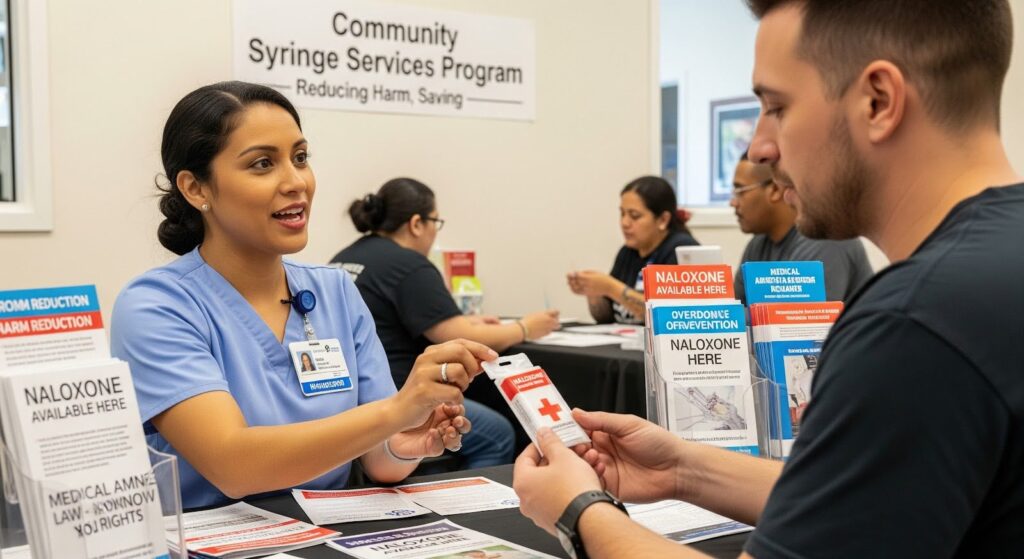
Georgia law encourages people to seek help during an overdose without fear of arrest. The 9-1-1 Medical Amnesty law protects callers and victims from prosecution for small amounts of drugs or paraphernalia if they call for emergency assistance.
Awareness of this Medical Amnesty overview is critical in high-burden suburbs to ensure that an overdose does not become a fatality.
Syringe Services Programs
Counties with high ER rates also benefit from Syringe Services Programs (SSPs). These programs do more than provide sterile supplies; they are hubs for naloxone distribution and linkage to care.
Expanding Georgia DPH SSP locations in top-tier counties is a proven strategy to lower ED utilization and save lives.
Taking Action Based on the Data
The data is clear: the overdose crisis shifts geographically, and suburbs are often the new front lines. Whether you live in a high-rate county like Cobb or a lower-rate area like Gwinnett, the risk of fentanyl remains present. Families should stay informed about local trends and keep naloxone accessible.
If you or a loved one needs support navigating recovery, Summit offers compassionate, evidence-based addiction treatment programs personalized to your needs.