Emergency department overdose visits in Atlanta are climbing even as fatal overdoses show signs of stabilizing in some metro counties.
This disconnect between nonfatal ER visits and deaths reflects a complex shift in the region’s drug crisis, one driven by fentanyl’s spread into stimulants, increased naloxone availability, and changing patterns of polysubstance use.
Understanding why these two measures can move in opposite directions is essential for Atlanta’s public health response in 2025, and this article will explain the surveillance systems tracking both trends, the substances driving each pattern, and what the data means for people at risk.
Atlanta ER Overdose Statistics Show Fentanyl Dominance
The CDC’s Nonfatal Drug Overdose Surveillance and Epidemiology (DOSE) system provides the most comprehensive view of emergency department overdose trends across the United States.
As of July 2025, DOSE reports participation by 49 states and the District of Columbia, with approximately 80% coverage of ED facilities nationwide.
The system operates through two complementary streams: DOSE-SYS, which uses syndromic surveillance from electronic health records to detect suspected overdoses in near real-time, and DOSE-DIS, which analyzes finalized discharge data with standardized ICD-10-CM codes to categorize nonfatal overdoses by drug class.
For Atlanta, anchored by Fulton and DeKalb counties, DOSE-SYS offers the fastest signal for changes in suspected nonfatal overdoses.
These syndromic definitions flag visits based on chief complaint text, triage notes, and preliminary diagnosis codes, enabling weekly or even daily trend reviews.
The categories tracked include all drugs, all opioid, fentanyl, heroin, benzodiazepines, all stimulants, methamphetamine, and cocaine. This breadth matters because Atlanta’s overdose landscape is no longer dominated by a single substance.
Georgia Department of Public Health explicitly notes that beginning in 2020, the state experienced a sharp increase in overdose deaths due to fentanyl’s spread into stimulants like cocaine and methamphetamine.
This pattern is mirrored in Atlanta’s ER data. Fentanyl-involved suspected ED visits have become the primary driver of nonfatal overdose trends in the metro area, often co-occurring with stimulants.
Meanwhile, heroin-specific ER indicators capture a shrinking share of the overall burden, reflecting the structural transition in the drug supply.
DeKalb County reported 217 overdose deaths in 2023 and 203 in 2024, with fentanyl involved in roughly 65 to 70 percent of fatalities.
While these figures describe deaths rather than nonfatal ER visits, they underscore fentanyl’s persistent dominance across the entire overdose spectrum in Atlanta’s core counties.
The same market dynamics that drive fatal overdoses also shape nonfatal ER patterns, making fentanyl-focused surveillance essential for both streams.
Why Nonfatal ER Overdose Visits Are Rising in Atlanta?
Several converging factors explain why nonfatal ER visits may increase even as deaths stabilize or decline. First, widespread naloxone distribution and training have improved bystander response and EMS protocols, enabling more people to survive overdoses that would previously have been fatal.
Georgia maintains a statewide naloxone standing order for pharmacy access, and community organizations like Georgia Overdose Prevention deploy naloxone through training programs and innovative public access boxes.
When naloxone reverses an overdose in the field, the individual often presents to an ED for observation and further care, converting what might have been a death into a nonfatal visit.
Second, fentanyl’s infiltration of the stimulant supply has expanded the population at risk.
People who use cocaine or methamphetamine but do not identify as opioid users may unknowingly consume fentanyl, leading to overdoses that bring them to emergency departments.
A 2025 CDC analysis of 2022 national mortality data found that 53.6 percent of synthetic opioid deaths co-involved stimulants, with distinct occupational patterns suggesting that workplace pressures and desired effects shape polysubstance use.
In physically demanding sectors like construction and extraction, psychostimulant co-involvement was more common, while cocaine co-involvement was higher in less physically strenuous occupations.
This occupational patterning implies that Atlanta’s diverse labor market, spanning logistics, hospitality, construction, and business services, faces differentiated overdose risks that manifest in ER visit patterns.
Third, increased awareness and reduced stigma may encourage more people to seek emergency care after an overdose or suspected overdose.
Public health campaigns, harm reduction outreach, and Georgia’s Medical Amnesty Law, which provides civil and criminal protections for naloxone administration and limited possession, have collectively lowered barriers to calling 911 and accessing emergency services.
Fourth, the nature of fentanyl itself contributes to higher nonfatal visit rates. Fentanyl’s potency and short half-life can lead to multiple overdose episodes in a single day, and its unpredictable presence in the drug supply means that even experienced users may miscalculate doses.
Each episode can generate an ER visit, inflating nonfatal counts even if the same individuals are involved.
Finally, surveillance definitions and coverage matter. DOSE-SYS captures suspected overdoses based on syndromic signals, which are broader and more sensitive than finalized diagnoses.
As ED participation in the National Syndromic Surveillance Program (NSSP) has expanded and data quality has improved, more suspected overdose visits are being detected and reported.
This improved capture can create the appearance of rising trends even if the underlying incidence is stable.
Fatal Overdoses Atlanta 2025 Analysis: What the Data Shows
Georgia’s OASIS (Online Analytical Statistical Information System) provides the authoritative source for final county-level drug overdose mortality.
OASIS offers two complementary tools: a mapping interface that visualizes age-adjusted mortality rates and counts by county, census tract, and demographic characteristics for 1999 through the most recent completed year, and a web query tool that produces customizable tables with counts and rates stratified by year, county, age, race, sex, education, and socioeconomic status.
OASIS definitions follow NCHS standards: drug overdose deaths are identified by underlying cause codes X40–X44, X60–X64, X85, and Y10–Y14, with an “All Opioids” subset captured by multiple cause codes T40.0 through T40.6.
These codes include heroin (T40.1), natural and semi-synthetic opioids (T40.2), methadone (T40.3), synthetic opioids other than methadone such as fentanyl (T40.4), and unspecified opioids (T40.6).
The categories overlap and do not sum to totals, reflecting the reality of polysubstance involvement.
For Atlanta’s core counties, Fulton, DeKalb, Cobb, and Gwinnett, final 2024 data confirm that opioid-involved mortality remains concentrated in these urban areas, with counts consistently above the suppression threshold of 1 to 9 deaths.
In contrast, many surrounding or rural counties exhibit suppressed heroin-involved counts, limiting fine-grained tracking and necessitating district-level aggregation or reliance on broader “All Opioids” or “All Drug Overdoses” categories.
The modest year-over-year decrease in DeKalb County, from 217 deaths in 2023 to 203 in 2024, exemplifies a region that may be experiencing stabilization or slight decline in some subareas, even as the structural fentanyl risk remains entrenched.
This pattern aligns with national observations that some jurisdictions are seeing tapering or plateauing of overdose deaths, though sustainability is uncertain without intensified interventions.
Importantly, heroin-involved fatalities represent a diminishing minority of opioid-involved deaths in metro Atlanta.
While heroin persists as a subset, fentanyl, often co-involved with cocaine or psychostimulants, defines the principal mortality risk.
This transition has profound implications for surveillance priorities: focusing narrowly on heroin-specific fatal overdose trends in 2025 misses the larger fentanyl-stimulant dynamic that drives both deaths and nonfatal ER visits.
The Disconnect Between Nonfatal and Fatal Trends
The divergence between rising nonfatal ER visits and stabilizing or declining deaths is not paradoxical; it reflects the success of harm reduction interventions and the changing composition of overdose events.
When naloxone is widely available and bystanders are trained to use it, more overdoses are reversed before they become fatal. Each successful reversal adds to the nonfatal ER count while preventing a death.
In this sense, rising nonfatal visits can be a positive indicator of improved emergency response capacity.
However, the disconnect also signals ongoing risk. High nonfatal visit rates indicate that people continue to use substances in ways that lead to overdose, even if fewer of those overdoses are fatal.
This sustained exposure to risk means that any lapse in naloxone availability, delays in EMS response, or emergence of novel adulterants could quickly translate rising nonfatal visits back into rising deaths.
Polysubstance use further complicates the picture. Fentanyl’s co-involvement with stimulants means that some individuals may experience repeated nonfatal overdoses as they navigate unpredictable drug potency and combinations.
These repeat ER visits inflate nonfatal counts but may not immediately translate into higher mortality if naloxone and emergency care are consistently accessible.
Over time, however, repeated overdoses increase cumulative risk and can lead to fatal outcomes, especially if individuals do not engage with treatment or harm reduction services.
Surveillance timeliness also contributes to the apparent disconnect. DOSE-SYS provides near-real-time suspected overdose signals, enabling weekly or daily trend reviews, while final mortality data lag by months or even a year.
Provisional mortality data from CDC WONDER can offer more timely signals, but the most recent months are undercounted and subject to frequent revisions.
This temporal mismatch means that nonfatal ER trends may appear to rise or fall ahead of corresponding changes in deaths, creating a perception of divergence that may resolve as final mortality data become available.

Surveillance Systems and Data Quality
Understanding the reliability and limitations of Atlanta’s overdose surveillance systems is essential for interpreting trends. DOSE-SYS, built on NSSP/ESSENCE infrastructure, emphasizes timeliness over diagnostic certainty.
Syndromic definitions are designed to flag suspected overdoses quickly, making them ideal for cluster detection and rapid response. However, they are provisional and may be revised as records mature.
This means that short-term fluctuations should be interpreted cautiously, with standard operating procedures for retrospective correction handling and clear communication of provisional status.
DOSE-DIS, by contrast, uses finalized billing data with standardized ICD-10-CM case definitions.
A multi-state comparison of DOSE discharge data with HCUP (Healthcare Cost and Utilization Project) for 2018 to 2020 found that 82 percent of quarterly crude rates for emergency departments and 93 percent for inpatient admissions were within plus or minus 0.5 nonfatal overdoses per 100,000 population.
Trend estimates were similar between DOSE and HCUP, validating DOSE-DIS as a reliable, timely data source for estimating nonfatal overdose burden at the state level.
For Atlanta, this validation strengthens the case for using DOSE-DIS to corroborate syndromic trends and to inform quarterly or semiannual reporting, even if county-resolved public views are limited.
Georgia DPH’s Drug Surveillance Unit curates multiple public data tools, including OASIS for fatality maps and tables, CDC’s SUDORS dashboard for detailed fatal overdoses, CDC’s DOSE dashboard for ED nonfatal overdoses, and NEMSIS for EMS overdose-related runs.
These complementary streams enable triangulation: suspected nonfatal ED spikes can be cross-checked against EMS naloxone administrations and fatal overdose trends to assess whether a signal represents a true increase in overdose events or an artifact of improved reporting.
Small-number suppression applies to OASIS county cell counts of 1 to 9 deaths, limiting granularity for heroin-specific analyses in smaller counties.
For Atlanta’s core metro counties, counts typically exceed suppression thresholds, but caution remains when disaggregating by race, age, or other characteristics in smaller sub-areas.
This constraint underscores the importance of using broader categories, such as all opioids or all drugs, when heroin-specific data are sparse, and of aggregating to public health districts when county-level signals are unstable.
Table: Key surveillance streams and their roles for Atlanta in 2025
| Stream | Scope | Timeliness | Strengths | Limitations | Use in Atlanta 2025 |
| DOSE-SYS (NSSP/ESSENCE) | Suspected nonfatal ED overdoses | Near real-time | Timely trend detection; standardized definitions | Not finalized diagnoses; public county views limited | Weekly monitoring; cluster response |
| DOSE-DIS | Finalized ED/inpatient discharge | Lagged (monthly/quarterly) | Validated ICD-10-CM based; comparable across states | Less timely for rapid response | Quarterly validation, burden estimation |
| NEMSIS (EMS) | EMS overdose runs | Near real-time | Scene-level insight; geospatial specificity | Varies by jurisdiction; linkage to ED may be incomplete | Spatial targeting; response planning |
| Georgia OASIS (fatal) | County-level deaths | Finalized (through prior year) | Authoritative fatal baseline | Not nonfatal | Contextualizing mortality burden |
Implications for Public Health Response
The divergence between nonfatal ER visits and fatal overdoses in Atlanta demands a dual-track response.
First, the persistence of high nonfatal visit rates signals ongoing exposure to overdose risk and the need for sustained harm reduction efforts.
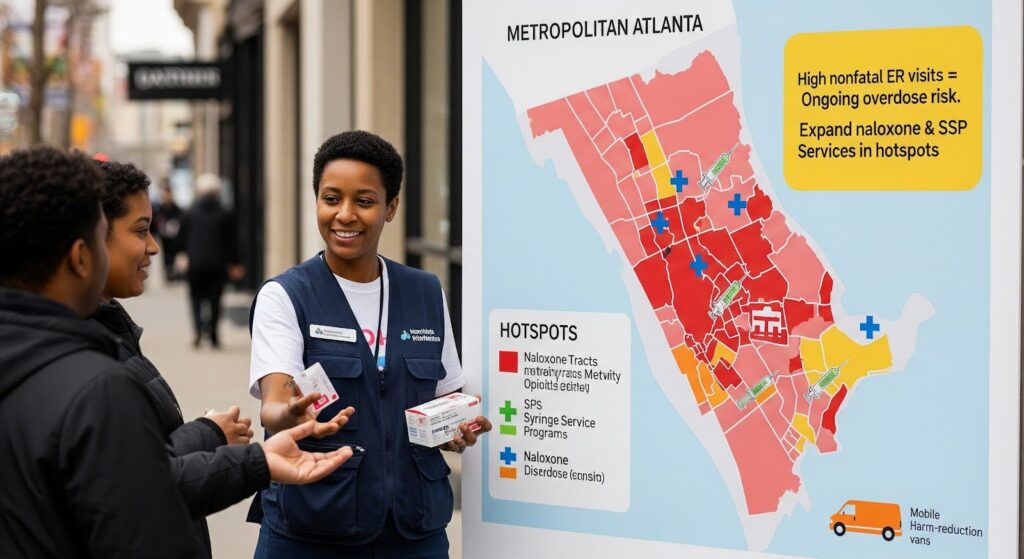
Naloxone saturation must continue and expand, particularly in neighborhoods and workplaces where OASIS census tract mapping and EMS data identify hotspots.
Georgia’s legal framework for Syringe Services Programs (SSPs) sets mandatory services including free sterile syringes, safe disposal, naloxone distribution and training, overdose and disease prevention education, referrals to medications for opioid use disorder (MOUD), and aggregated data for resource placement.
In metro Atlanta, providers such as Georgia Harm Reduction Coalition sites, SafeWorks ATL, and Georgia Overdose Prevention deliver these services locally, and scaling mobile and fixed SSP capacity in high-burden areas is a high-impact strategy for fatality reduction.
Second, the stabilization or modest decline in deaths in some metro counties should not be mistaken for resolution of the crisis.
Fentanyl’s dominance and polysubstance patterns remain potent enough to reverse gains absent continuous investment.
Expanding low-threshold MOUD access, including ED-based buprenorphine induction, same-day starts in SSP settings, and transportation-supported linkages to methadone, can convert nonfatal ER visits into treatment engagement opportunities.
Deploying peer recovery specialists for retention and rescue after nonfatal overdose further strengthens the pathway from emergency care to sustained recovery.
Third, addressing stimulant co-involvement requires evidence-based interventions tailored to the substances involved.
Federal SOR (State Opioid Response) funding now explicitly allows services across the continuum for both opioid and stimulant use disorders, including contingency management (CM) for stimulant use disorder.
A 2025 Government Accountability Office report highlights CM as an evidence-based intervention with demonstrated efficacy for stimulant use disorder, and encourages state consideration within SOR-funded portfolios to improve outcomes.
Georgia’s FY2025 SOR award of approximately $28.96 million provides an opportunity to scale CM across metro Atlanta treatment networks, particularly where stimulant co-involvement is common in fentanyl overdoses.
Fourth, workplace-oriented prevention and harm reduction represent an underutilized lever.
The occupational patterning of polysubstance overdoses, psychostimulants more common in physically demanding work, cocaine more common in less physically strenuous occupations, suggests that Atlanta’s diverse labor market faces differentiated risks.
Partnerships with major employers, unions, and trade associations in construction, logistics, hospitality, and business sectors could deliver high-yield naloxone distribution, overdose education, and confidential linkage to care, especially in sectors with higher injury rates and shift work.
Finally, real-time surveillance and rapid response protocols must be institutionalized.
Weekly review of DOSE-SYS suspected overdose indicators for Fulton, DeKalb, Cobb, and Gwinnett, combined with monthly triangulation against EMS overdose runs and quarterly DOSE-DIS validation, enables Atlanta to detect and address surges before they translate into increased mortality.
Public Health Analysts embedded in each of Georgia’s 18 public health districts coordinate overdose prevention and response, engage law enforcement and community partners, respond to clusters, and distribute harm reduction materials.
In metro Atlanta districts, these analysts are critical liaisons for aligning employer-based initiatives, SSP operations, hospital linkages, and data-driven targeting to local conditions.
Moving Forward in 2025
Atlanta’s overdose landscape in 2025 is defined by fentanyl and polysubstance patterns, not heroin alone.
The divergence between rising nonfatal ER visits and stabilizing or declining deaths reflects both the success of harm reduction interventions and the persistence of underlying risk.
Naloxone saves lives and converts fatal overdoses into nonfatal ER visits, but high nonfatal visit rates signal that people continue to use substances in ways that lead to overdose.
Sustaining reductions in mortality requires intensified investment in MOUD access, contingency management for stimulant use disorder, workplace partnerships, and harm reduction saturation in the neighborhoods and workplaces where risk is highest.
Georgia’s surveillance and policy infrastructure is fit for purpose. DOSE-SYS and DOSE-DIS provide timely and validated nonfatal overdose signals, OASIS offers authoritative final mortality baselines, and legal SSPs, naloxone standing orders, and SOR financing align with the need to address fentanyl-stimulant co-involvement.
The path to sustainable reductions in overdose mortality runs through coordinated, data-driven execution that treats stimulant co-use as an integral part of the opioid crisis, builds workplace partnerships, and persists through the provisional noise of short-term data.
If you or someone you care about is navigating substance use challenges in the Atlanta area, compassionate, evidence-based support is available.
Reach out to explore Summit’s addiction treatment options that integrate medical care, therapy, and holistic services personalized to your needs.