Wondering how much alcohol is too much is a fair question, since there is no single number that fits everyone. NIAAA defines heavy drinking as four or more drinks a day or eight or more a week for women, and five or more a day or fifteen or more a week for men. This guide explains what counts as heavy drinking, how binge drinking differs from a standard drink, and when cutting back alone might not be safe.
How Much Alcohol Is Too Much?
There isn’t one universal cutoff, but researchers and health agencies have settled on useful reference points. The newest federal dietary guidance simply advises people to drink less for better health, without listing a daily number the way earlier versions did. That shift matters for public messaging, but it does not erase the more specific thresholds that clinicians still rely on when someone asks whether their drinking is a concern.
Moderate drinking, under the common definition, means up to one drink a day for women and up to two for men, only on days when drinking happens. That is not a goal to hit every day.
What Counts as Heavy Drinking
NIAAA lays out clear heavy drinking thresholds that split by sex and by two different timeframes. A person only needs to meet one of the two to qualify. That word “or” changes how you should read the numbers.
| Group | Heavy on any single day | Heavy across a week |
| Women | 4 or more drinks | 8 or more drinks |
| Men | 5 or more drinks | 15 or more drinks |
How Many Drinks a Week Is Too Much?
Here is where the weekly rule catches people who never think of themselves as heavy drinkers. A woman who has two drinks on four evenings a week never hits four in a day, yet she reaches eight for the week, which meets the weekly threshold on its own. A man drinking three beers on five nights never reaches five in a day but lands at fifteen for the week, meeting the male threshold the same way.
This matters because people often judge their drinking by the worst single night, not by the steady pattern across seven days. A quiet, spread out habit can still add up to a heavy weekly total even when no single evening looks dramatic.
Binge Drinking Versus Heavy Drinking
Binge drinking is a different measurement entirely. NIAAA ties it to blood alcohol concentration, defining it as a pattern that brings BAC to 0.08% or higher, which for a typical adult works out to about four or more drinks for women or five or more for men within around two hours. The focus is speed and peak level, not a daily total.
That distinction has real consequences. Someone who drinks five beers slowly across a long evening meets the male heavy drinking threshold for the day, but that alone does not confirm they reached a binge level pattern.
Accurate counting also depends on knowing your standard drink size.
How Much Alcohol Is Too Much for Your Health?
The current dietary guidelines recommend drinking less as a general health message, even if the document stops short of naming a specific daily limit the way older versions did.
Meeting a heavy drinking threshold is a meaningful warning sign, but it is not the same thing as having alcohol use disorder. Diagnosis of alcohol use disorder requires a clinician to find at least two of eleven specific symptoms within the same twelve month period, covering things like craving, failed attempts to cut back, and continuing to drink despite clear harm. A person can drink heavily without meeting that bar, and someone drinking less can still show a concerning symptom pattern.
Severity under that framework is graded by how many symptoms show up, not by how many drinks someone had last week. Two or three symptoms point to a mild disorder, four or five to moderate, and six or more to severe. None of that can be calculated from a weekly total alone.
What Is a Standard Drink?
A standard drink is a way to measure how much pure alcohol a beverage contains, regardless of the type of drink. According to the National Institute on Alcohol Abuse and Alcoholism (NIAAA), one standard drink in the United States contains approximately 14 grams of pure alcohol. That equals about 12 ounces of regular beer at 5% alcohol by volume (ABV), 5 ounces of wine at 12% ABV, or 1.5 ounces of distilled spirits at 40% ABV.
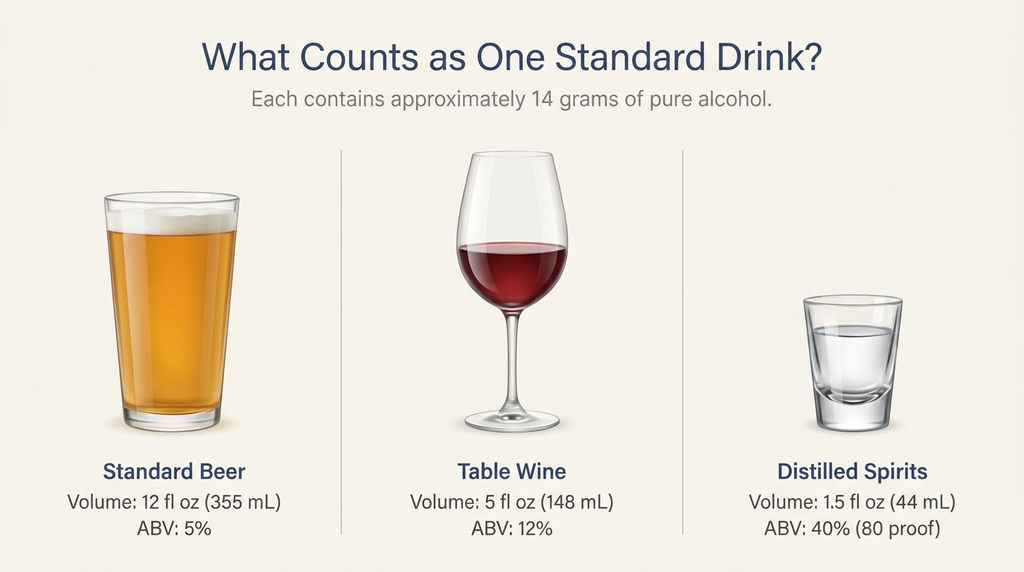
These measurements are useful because the amount of alcohol in a glass does not always equal one standard drink. A stronger beer, a larger pour of wine, or a mixed drink may contain more than one standard drink. Understanding these differences makes it easier to track alcohol consumption and recognize when drinking reaches heavy drinking thresholds.
Signs Your Drinking Has Become a Concern
A few patterns deserve attention beyond the raw numbers. Needing more alcohol than you used to in order to feel the same effect suggests rising tolerance, which your body is quietly adapting to repeated exposure. Repeatedly planning to cut back and failing points toward impaired control rather than simple lack of willpower.
The AUDIT-C screening method asks just three questions about frequency, typical quantity, and how often you have six or more drinks on one occasion, producing a score from zero to twelve. A positive score is a reason to look closer, not a diagnosis by itself.
It is worth noting that someone can score positive on AUDIT-C while staying below the NIAAA heavy drinking category. The two measures ask slightly different questions, so neither one replaces a real conversation with a clinician about symptoms, consequences, and history.
Why Cutting Back Alone Can Be Risky
This is the part that surprises people the most. If someone has been drinking heavily and regularly for a long stretch, their body may have adapted to a steady presence of alcohol. Cutting back sharply, not just stopping completely, can trigger withdrawal while alcohol is technically still detectable in their system.
Early signs of alcohol withdrawal risk often include shaking, sweating, nausea, a racing pulse, and trouble sleeping, usually starting within roughly six to twenty four hours after intake drops. Withdrawal seizures can follow within the first two days, sometimes without much warning beforehand. Confusion, hallucinations, or a seizure call for emergency care immediately, not a wait and see approach.
The NHS specifically warns that stopping suddenly can be dangerous for someone who has become dependent on alcohol. If you notice morning shaking that settles after a drink, rising tolerance, and repeated failed attempts to cut down all together, that combination is a strong reason to get a medical assessment first before trying to reduce intake on your own.
Why It Matters
Knowing how much alcohol is too much gives you a starting point, not a final verdict. The NIAAA thresholds flag concerning patterns, screening tools open the door to a deeper conversation, and a full clinical assessment is what actually determines whether someone has alcohol use disorder or needs structured help to stop safely.
The most important takeaway is simple. If you or someone close to you is hitting these numbers regularly, struggling to cut back, or showing signs that might be withdrawal, that is worth raising with a professional rather than guessing at home.

If any of this sounds familiar, you do not have to sort it out alone. Reaching out to an alcohol treatment program at The Summit Wellness Group can help you get a clear picture of what is going on and what safe next steps look like.