Figuring out the real IOP program cost before you commit to treatment is confusing, since prices shift based on location, insurance, program length, and whether the program is hospital-based or community-based. A full course commonly runs $7,700 to $15,100 without insurance, though someone with a met deductible might pay closer to $1,550 for a 24 day course of the same care. Here’s what changes those numbers, and how to get a straight answer before you enroll.
What Really Drives IOP Program Cost
An intensive outpatient program, or IOP, sits between regular weekly therapy and a full day program like partial hospitalization. Medicare describes it as structured treatment for mental health conditions and substance use disorders that needs more support than an office visit but less than round the clock care, and coverage generally requires at least nine hours weekly of therapeutic services.
Most programs follow a similar pattern. Three hours a day, three days a week, for eight to twelve weeks. Medicare’s regional contractor describes typical scheduling in its coverage guidance, and that same three day, three hour pattern shows up in commercial policy descriptions too. That works out to somewhere between 24 and 36 treatment days for a full course, sometimes more if the program runs four or five days a week.
Program Length Is the Biggest Lever
Here’s the part people miss. The intensive outpatient program cost you see advertised often depends more on how many days are included than on the daily rate itself. A program built around 24 days will usually cost less than one built around 36 days, even if both charge the exact same amount per session. Before comparing two quotes, check how many total treatment days each one actually covers.
IOP Program Cost Without Insurance
If you’re paying out of pocket, the cost of an IOP program varies more than most people expect, and the setting matters as much as the length. Medicare publishes what it pays per treatment day, which gives you a public benchmark to measure quotes against. Under the CY2026 payment rates, a hospital-based program is paid roughly $320 for a three-service day and about $420 for days with four or more services. Across a 24 to 36 day course, that works out to somewhere between $7,700 and $15,100.
Community mental health centers are paid at 40 percent of the hospital-based rate, or roughly $128 a day. That’s why some national guides quote figures as low as $3,000 to $10,000 for a full course. Those numbers usually aren’t wrong, they’re just describing a community-based program rather than a hospital-based one.
Self-pay pricing at private programs typically runs above the Medicare benchmark, since nothing obliges them to match it. To get a real number rather than a national average, use the hospital price transparency rule. Hospitals must publish their discounted cash price, meaning the charge that applies to someone paying cash, both in a machine-readable file and in a consumer-friendly display. That’s the actual figure for the specific program you’re considering.
So how much does an IOP program cost without coverage, realistically? Based on these published ranges, plan on somewhere between $6,000 and $18,000 for a standard course, and treat anything well below that as a sign to ask what’s missing. Higher intensity schedules, four or five days a week, or programs in expensive cities, can climb past $20,000. How much do IOP programs cost once you add psychiatric visits, drug testing, or medication management on top of the base price? Often several thousand dollars more, so ask for a full itemized estimate before you sign anything.
A published estimate for the cost of an IOP program often assumes a bare bones package. It may leave out the intake psychiatric evaluation, ongoing medication management, drug screening, family therapy sessions, and any care you need after the program ends. Get a complete list of what’s included before you compare one facility’s price against another’s.
How Insurance Changes IOP Program Cost
Insurance doesn’t make IOP free, and it doesn’t always make it cheap either. How much does IOP cost with insurance depends heavily on whether the program gets billed as a simple office visit or as a facility based outpatient service, and those two categories can carry very different price tags.
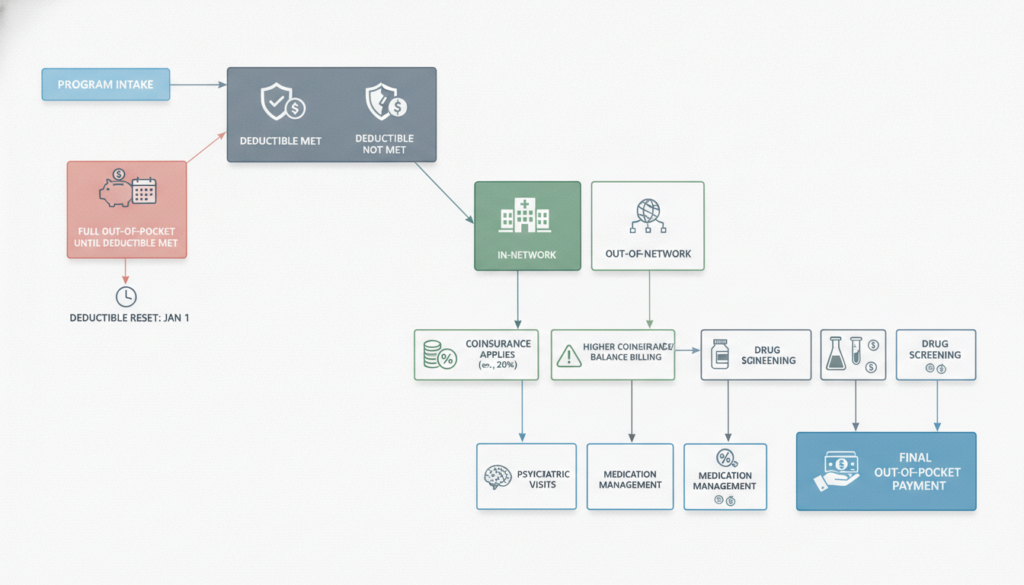
Here’s the trap many people fall into. A 2026 marketplace plan lists a $40 copay for a regular behavioral health office visit, but a separate category called other outpatient services carries 50 percent coinsurance after the deductible. Since IOP is usually delivered as a structured facility program rather than a single therapy appointment, it often gets billed under that second, pricier category instead of the office visit copay you were expecting.
So how much is IOP with insurance in real dollars? Picture a 24 day course with an allowed amount of $7,200. If your deductible is already met and your plan applies 20 percent coinsurance, you’d owe about $1,440. If $3,000 of your deductible is still outstanding and the plan applies 50 percent coinsurance afterward, you could owe closer to $5,100 for that same program. Same treatment, same insurer, wildly different bill, depending entirely on where you stand with your deductible and how the claim gets coded.
An employer benefit plan shows just how much these numbers can shift even within one company’s own options. One tier pays 90 percent after the deductible, while another pays only 50 percent for care received outside the network. Before you enroll anywhere, ask your plan for the exact coinsurance rate, the remaining deductible, and whether IOP falls under the office visit benefit or the facility benefit.
If you’re already close to your annual out of pocket maximum because of other medical care this year, IOP might cost far less than these examples suggest, since spending above that cap is generally covered in full for in network, covered services. A generic benefits summary won’t tell you where you stand. You need the exact numbers for your plan, checked right before you start.
Medicare, Medicaid, and What You Might Pay
Traditional Medicare began covering IOP for mental health and substance use conditions on January 1, 2024, in hospital outpatient departments, community mental health centers, and a few other approved settings. After the Part B deductible is met, beneficiaries generally pay Part B coinsurance of 20 percent of the Medicare approved amount for each treatment day.
That coinsurance adds up over a full course. On a 24 day program with an approved rate of $300 a day, the total approved amount comes to $7,200, and a 20 percent share would land around $1,440, before any Medigap or Medicaid secondary coverage reduces it further. That’s a real drop from self pay pricing, but it isn’t free, and beneficiaries without supplemental coverage should still expect a bill in the four figure range.
Medicare Advantage doesn’t automatically follow that same math. Those plans can use copays instead of coinsurance, require prior authorization, and apply their own network rules, so a beneficiary enrolled in Medicare Advantage should confirm the daily cost, authorization steps, and out of pocket maximum directly with that specific plan rather than assuming traditional Medicare numbers apply.
Medicaid often produces the lowest direct cost for covered IOP care, though how much does intensive outpatient treatment cost under Medicaid really depends on the state and the managed care plan involved. A Texas Medicaid plan requires prior authorization and typically expects three to five treatment days a week. Because Medicaid runs state by state rather than through one national fee schedule, there’s no single number that applies everywhere. For a lot of Medicaid patients, the bigger obstacle isn’t the price at all, it’s finding a program with an open spot that actually accepts their specific plan.
Costs That Can Sneak Up on You
A quoted IOP program cost rarely covers everything you’ll actually end up paying. Psychiatric evaluations, medication management visits, drug screening, and lab work are frequently billed apart from the daily program rate, and each one can carry its own copay or coinsurance separate from the main course. Four monthly medication visits at a modest specialist copay can quietly add a few hundred dollars to a course you thought was fully priced.
Choosing an out of network provider is usually the riskiest financial move you can make. Federal surprise billing protections mostly cover emergencies and accidental out of network bills at facilities that are otherwise in network. They generally don’t apply if you knowingly choose a provider outside your network, and most state consumer protections work the same narrow way. That means an out of network program can leave you owing a much larger share of the bill, sometimes close to the full charge the facility would ask an uninsured patient to pay.
Timing matters too. Most plans reset the annual deductible on January 1. If your treatment spans two plan years, you could end up facing two separate deductibles for one continuous course of care, which can add real money to a program that would have cost less if it started or finished a few weeks on either side of that date.
Getting an Accurate Quote Before You Enroll
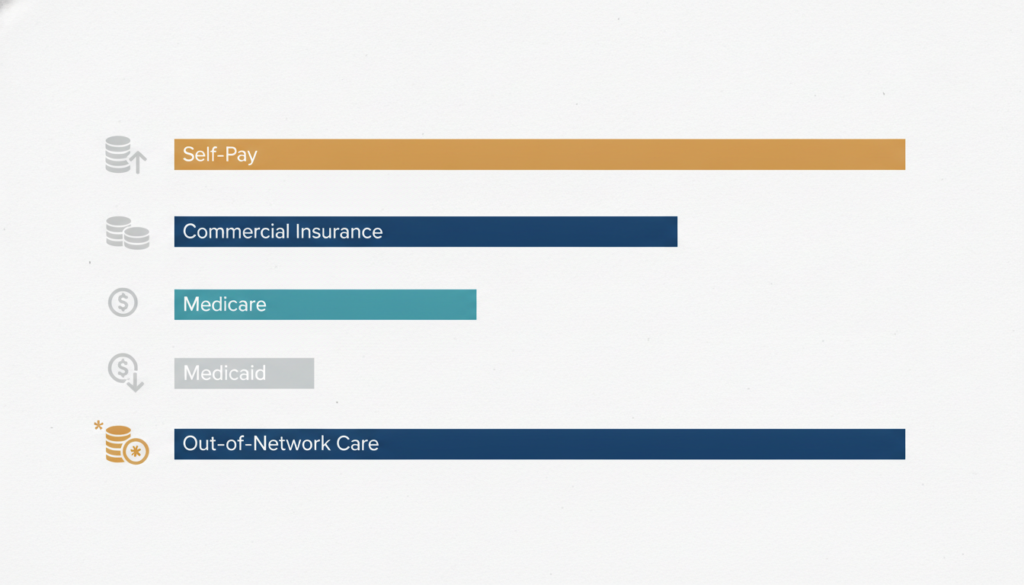
Before committing to any program, ask both your insurer and the facility for a written estimate covering the entire course, not just a single day or session. Verbal reassurance that a plan “covers behavioral health” tells you almost nothing about your actual bill. The table below summarizes what a full course commonly costs across the payment types covered above.
| Payment type | Typical patient cost for a full course |
| Self pay, standard eight to twelve week course | $6,000 to $18,000 |
| Traditional Medicare, deductible met | Around $1,440 for a 24 day course |
| Medicaid, covered and authorized | Often low or no direct cost, though access varies by state |
| Commercial insurance, deductible met | Often a few hundred dollars up to about $1,500 |
| Commercial insurance, deductible unmet | Commonly $2,000 to $6,000 or more |
| Out of network care | Can approach the full billed charge |
Ask the facility whether medication management, drug testing, and psychiatric visits are included in the daily rate or billed separately. Ask your insurer whether the program will be processed as an office visit or as a facility service, how many days are authorized up front, and what happens if you need more time than that initial authorization covers. A short phone call before admission can save you from a surprise bill weeks into treatment.
Why Understanding This Cost Matters
Getting a straight answer about the cost of an intensive outpatient program before you start protects more than your budget. It protects the treatment itself. Patients who run into unexpected bills partway through a course sometimes cut treatment short, which works against the entire point of getting structured help in the first place.
The ranges in this article are exactly that, ranges. Your actual bill depends on your specific plan, your deductible status, and the program you choose. But now you know which questions to ask. What’s the daily allowed amount, how many days are authorized, is the facility actually in network, and what happens if you need more time than the plan first approved. Ask those questions early, and the number on your final bill will look a lot less like a surprise.
If the math here feels like a lot to sort out on your own, you don’t have to figure it out alone. Reach out to our team at The Summit Wellness Group to talk through your coverage and what treatment could realistically cost for your situation, and take a look at our IOP program in Atlanta, GA to see what a typical week of care looks like.