Mitragynine and 7-hydroxymitragynine are different kratom alkaloids, and the biggest difference is that concentrated 7-hydroxymitragynine acts more strongly at opioid receptors. In a mitragynine vs 7-hydroxymitragynine comparison, leaf kratom contains mostly mitragynine and trace 7 hydroxymitragynine, while processed products over 1 mg of 7 hydroxymitragynine are treated in proposed federal summaries as a key risk marker. This guide explains potency, product labels, dependence, withdrawal, overdose signs, and when to seek care with less guesswork.
Mitragynine vs 7-Hydroxymitragynine Basics
Direct answer: mitragynine is the main alkaloid in leaf kratom, while 7 hydroxymitragynine is the more potent opioid active alkaloid that becomes much riskier when concentrated.
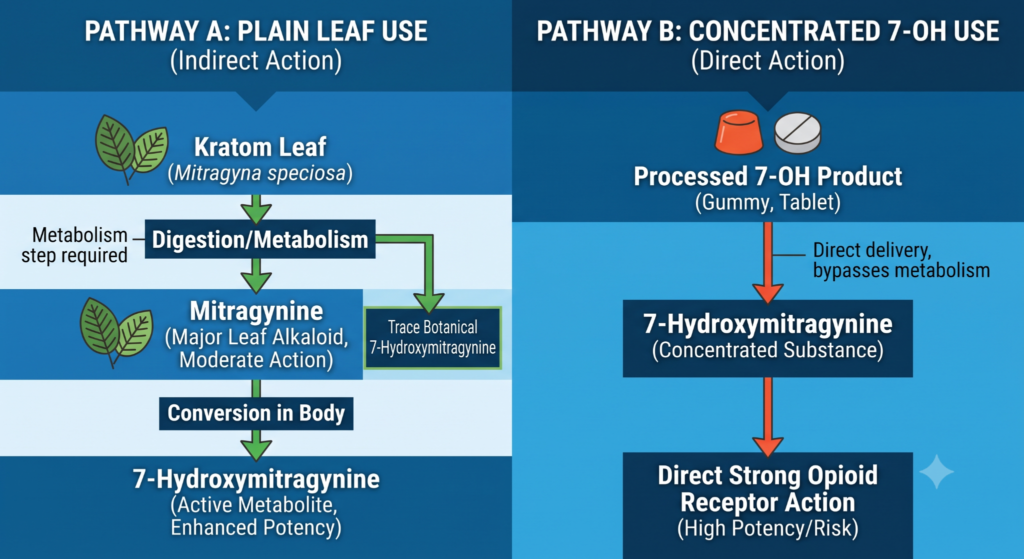
Kratom comes from the leaves of *Mitragyna speciosa*. A plain leaf product is usually mitragynine dominant. It may contain 7 hydroxymitragynine naturally, but the supplied research describes that amount as trace rather than a direct milligram strength dose.
That difference sounds small, but it changes the exposure. A 2025 review describes newer concentrated 7 hydroxymitragynine products as chemically distinct from traditional leaf kratom because they can deliver the stronger alkaloid directly.
So when people compare mitragynine and 7 hydroxymitragynine, the useful question is not just, “Which one is stronger?” It is also, “What product am I actually using?”
A bag of plain leaf powder and a tablet labeled with 7 hydroxymitragynine are not the same type of exposure. One is a plant product with a mixture of alkaloids. The other may be an enriched or semi synthetic product that bypasses the body’s normal limits on converting mitragynine into 7 hydroxymitragynine.
That is why the phrase “kratom” can be too vague. It can refer to leaf powder, capsules, extracts, shots, gummies, tablets, drink mixes, dissolvable strips, or stand alone 7 hydroxymitragynine products. Those products can differ in strength, dependence risk, overdose risk, and legal status.
How They Act in the Body
Mitragynine and 7 hydroxymitragynine both interact with opioid receptors, especially the μ opioid receptor. That does not make them identical to prescription opioids, but it does explain why some people report pain relief, sedation, euphoria, tolerance, and withdrawal.
Mitragynine is the main alkaloid in kratom leaf. The body can convert some mitragynine into 7 hydroxymitragynine. A 2019 study identified 7 hydroxymitragynine as an active metabolite of mitragynine and a key mediator of analgesic effects.
That metabolic step matters. With plain leaf kratom, the body has to process mitragynine first. With concentrated 7 hydroxymitragynine, the product delivers the stronger opioid active alkaloid directly. That can make the experience more intense and can raise the risk of tolerance, withdrawal, and slowed breathing.
A safety review also points to the need for better product standards, including limits on active constituents and clearer labeling by serving. In plain terms, people need to know what they are taking and how much of the active alkaloids are in each dose.
When people ask about 7-hydroxymitragynine vs mitragynine, they often want a simple ranking. The simple answer is that 7 hydroxymitragynine is the stronger opioid active compound. The safer answer is that product form, concentration, dose, and daily use pattern matter just as much.
Mitragynine vs 7-Hydroxymitragynine Potency
The mitragynine vs 7-hydroxymitragynine potency question matters most when the product is an extract, tablet, gummy, shot, or product labeled with 7 hydroxymitragynine milligrams.
The 2025 review reports that 7 hydroxymitragynine has nanomolar affinity at the μ opioid receptor and greater efficacy than mitragynine. It also reports animal findings tied to pain reduction, respiratory depression, tolerance, dependence, withdrawal, and reinforcing effects.
That is the core potency difference. Mitragynine is the main leaf alkaloid and has opioid receptor activity. 7 hydroxymitragynine is more opioid active, and when it is concentrated, the risk category shifts.
Here is a simple comparison.
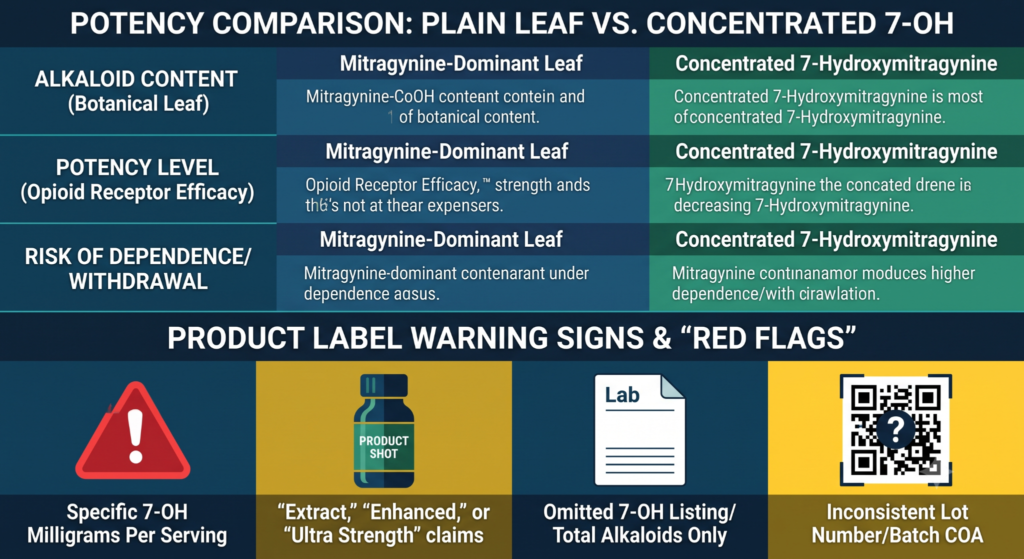
| Feature | Mitragynine dominant leaf kratom | Concentrated 7 hydroxymitragynine |
| Main source | Plain leaf powder, crushed leaf, tea, capsules | Tablets, gummies, shots, strips, extracts, drink mixes |
| Usual alkaloid pattern | Mostly mitragynine with trace 7 hydroxymitragynine | Elevated or direct 7 hydroxymitragynine |
| Potency concern | Lower than concentrated 7 hydroxymitragynine | Stronger opioid receptor activity |
| Dependence risk | Possible with daily use | Higher concern with repeated use |
| Withdrawal pattern | Can resemble opioid withdrawal | Can be stronger and more medically complex |
| Overdose concern | Product dependent | Greater concern for sedation and slowed breathing |
| Label red flag | Vague extract claims | Milligrams of 7 hydroxymitragynine per serving |
The key point is not that leaf kratom is risk free. It is not. Daily leaf use can still lead to dependence and withdrawal. The point is that concentrated 7 hydroxymitragynine can move the risk closer to an opioid type exposure, especially when used every day.
What Product Labels Can Hide
A label that says “kratom” does not tell you enough. You need to know the form, ingredient list, serving size, and alkaloid content.
Plain leaf products are more likely to list *Mitragyna speciosa* leaf powder, crushed leaf, or capsules. Concentrated products may use terms such as 7 hydroxymitragynine, 7 hydroxy, extract, alkaloid, enhanced, ultra, strong, extra strength, shot, tablet, gummy, or drink mix.
FDA related summaries note concern about products sold as gummies, tablets, shots, and related forms. The FDA letters described action against companies marketing unlawful 7 hydroxymitragynine products.
Some labels may also list total alkaloids without saying how much 7 hydroxymitragynine is in the serving. That is not enough for risk judgment. A product can have kratom derived alkaloids and still behave more like a concentrated opioid active product than plain leaf tea.
If a product lists a specific milligram amount of 7 hydroxymitragynine, treat that as a major warning sign. Traditional leaf contains only trace 7 hydroxymitragynine. A tablet or shot that gives a direct milligram dose is not acting like ordinary leaf from a dosing standpoint.
The most useful label question is this: does the product prove it is plain botanical leaf with low 7 hydroxymitragynine content, or does it ask you to trust marketing language?
A certificate of analysis can help, but it should be batch specific and should list both mitragynine and 7 hydroxymitragynine by serving or by weight. If the lab panel omits 7 hydroxymitragynine, does not match the lot number, or lists only total alkaloids, it leaves a major gap.
Dependence and Withdrawal Differences
Daily use changes the picture. Even plain leaf kratom can cause dependence. Withdrawal can include anxiety, restlessness, irritability, body aches, insomnia, runny nose, yawning, sweating, diarrhea, low mood, chills, and cravings.
A UIC review states that there are no FDA approved medications specifically for kratom withdrawal and that treatment evidence is limited. It also notes that buprenorphine or buprenorphine naloxone has been reported in case literature, though it should not be automatic for every person.
Concentrated 7 hydroxymitragynine can produce a heavier withdrawal picture. The symptoms may look like stronger kratom withdrawal with more opioid type features: worse muscle pain, sweating, chills, diarrhea, vomiting, panic, intense cravings, and trouble sleeping. Some people may wake up in withdrawal or feel sick between doses.
A severe case report described withdrawal involving concentrated 7 hydroxymitragynine and high dose nicotine pouches, with agitation, psychosis, respiratory compromise, intubation, and intensive care. Co use makes the case complex, but it shows how severe and medically difficult concentrated 7 hydroxymitragynine withdrawal can become.
This is where a mitragynine vs 7 hydroxymitragynine comparison matters in real life. A person using plain powder once daily may have a different risk profile than someone taking 7 hydroxymitragynine tablets several times daily. Both people deserve care. They may not need the same level of care.
Overdose Risk and Emergency Signs
The most serious risk with concentrated 7 hydroxymitragynine is opioid type toxicity. That can include heavy sedation, confusion, loss of consciousness, shallow breathing, and seizures.
America’s Poison Centers reported 1,690 kratom exposure reports from January 1 through July 31, 2025, and 165 exposure reports involving 7 hydroxymitragynine in 2025. Among 7 hydroxymitragynine only cases, 35 percent had serious health problems and 67 percent were treated at a healthcare facility.
Those numbers do not prove every product will cause harm. They do show that poison centers are seeing serious outcomes linked to 7 hydroxymitragynine exposure.
Washington Poison Center also describes a key toxicology difference. Its Washington guidance notes that pure mitragynine and pure 7 hydroxymitragynine differ in respiratory effects in animal evidence, with 7 hydroxymitragynine causing respiratory depression that naloxone reversed.
That does not mean naloxone replaces emergency care. It means that if someone has slowed breathing, cannot be awakened, or has blue or gray lips after using a concentrated 7 hydroxymitragynine product, it is reasonable to use naloxone if available while calling emergency services.
Mixing products raises risk. Alcohol, benzodiazepines, sleep medications, opioids, kava, and other sedating substances can make breathing and consciousness problems more likely. This matters because many people do not think of a kratom branded product as something that can interact with other depressants.
If you are unsure whether a reaction is serious, treat slowed breathing, loss of consciousness, seizure, severe confusion, or repeated vomiting with sedation as urgent.
What This Means for Daily Users
If you use kratom or 7 hydroxymitragynine daily, the most useful step is to identify the product before making a plan.
Start with the package. Is it plain leaf powder or capsules, or is it a shot, gummy, tablet, strip, drink mix, or extract? Does the label say 7 hydroxymitragynine, 7 hydroxy, enhanced, ultra, alkaloid, extra strength, or high potency? Does it list milligrams of 7 hydroxymitragynine?
Next, look at your body’s pattern. Do you need it every morning to feel normal? Do you get sweating, anxiety, diarrhea, aches, chills, or insomnia if a dose is late? Have you raised the amount over time? Do you feel scared to run out? Have you tried to stop and gone back because withdrawal felt too strong?
Those signs suggest dependence. They do not mean you failed. They mean your body adapted to repeated exposure.
If the product is plain leaf and the withdrawal is mild, a careful taper with medical support may be enough. If the product is concentrated 7 hydroxymitragynine, or if you are using several times per day, waking up sick, mixing with sedatives, or have a history of opioid use disorder, medical support becomes more important.
As of July 24, 2026, legal summaries reported that DEA had filed notices about temporary scheduling of 7 hydroxymitragynine and related substances, while distinguishing targeted concentrated or synthetic products from qualifying botanical kratom. The DEA notices were described as pending at that time rather than already in effect.
Legal change can also affect health. If someone is dependent and suddenly loses access, withdrawal can push them toward unsafe substitutes. That is one reason care planning matters. The goal is not shame. The goal is to reduce harm and help the person stabilize.
Getting Support Without Shame
The mitragynine and 7 hydroxymitragynine difference is not just chemistry. It changes how a person should think about product safety, withdrawal planning, overdose risk, and when to ask for help.
A practical rule is this: if you cannot verify that a product is plain botanical leaf with trace 7 hydroxymitragynine, treat it as a higher risk extract until proven otherwise. That is especially true for gummies, tablets, shots, strips, drink mixes, and any product listing 7 hydroxymitragynine milligrams.
If you are using daily and feel stuck, do not try to solve it alone through guesswork. A clinician can help sort out whether you need outpatient support, a taper plan, symptom medicines, addiction medicine care, or a higher level of medical monitoring. Bring the package, photos of the label, and any lab report if you have one.
If daily kratom or 7 OH use has started to feel hard to control, reach out for compassionate addiction treatment today.