Professionals in high-pressure careers face a hidden risk that few employers acknowledge. When chronic job stress collides with substance use recovery, the result can be devastating.
A 2022 study found that 18% of nurses reported problematic substance use, with one in five increasing alcohol consumption during the pandemic.
This article explains how workplace stressors trigger relapse in safety-sensitive professions and what organizations can do to protect their teams.
How Job Pressure Erodes Recovery in Professional Settings?
Workplace stress operates through multiple pathways that directly threaten recovery. Excessive job demands drain the self-regulation capacity that people in recovery need to manage cravings and maintain healthy routines. When professionals work in understaffed units, face moral distress from resource scarcity, or shoulder disproportionate emotional labor, they experience the kind of sustained negative affect that research identifies as a robust trigger for substance use episodes.
The mechanism is straightforward but powerful. Chronic overload leads to burnout, characterized by emotional exhaustion, cynicism, and reduced professional efficacy. This exhaustion impairs executive control and increases impulsivity, especially when combined with sleep disruption from shift work. For professionals with easier access to controlled substances or working in environments where help-seeking carries career consequences, these conditions create a perfect storm for relapse.
Women clinicians face an additional burden. They typically report higher workloads, tighter time pressures, and more psychosocially complex patient care than their male counterparts. Research shows that supportive work environments with flexible scheduling correlate with lower burnout among women in healthcare, pointing to modifiable organizational levers that can reduce relapse risk.
The Pandemic Amplification Effect
COVID-19 intensified every dimension of workplace stress. Healthcare workers experienced rapid redeployments, sometimes outside their disciplines, and telehealth transitions made with little notice. These disruptions elevated stress, reduced job security, and were associated with burnout and turnover intentions across the mental health workforce.
The data from this period are striking. During the pandemic, surveys documented that one in five nurses increased alcohol consumption and three percent increased use of other substances. In a 2022 sample, 6.6% of nurses screened positive for chemical dependency. These figures represent real people whose recovery was threatened by system-level failures to protect workforce well-being during crisis conditions.
Professional Culture and the Stigma Barrier
The culture surrounding substance use in highly skilled professions often makes the problem worse. Fear of licensure consequences and intrusive mental health disclosures deter early help-seeking, allowing risky use to escalate. National campaigns explicitly target these barriers, recognizing that employer and regulatory policy are modifiable determinants of relapse risk.
In safety-sensitive professions, compliance imperatives layer additional pressure onto this dynamic. Transportation workers subject to Department of Transportation testing protocols face immediate removal from duty and mandatory evaluation by a Substance Abuse Professional following any violation. While these safeguards protect public safety, they can create perceived career jeopardy that suppresses preemptive help-seeking.
The evidence suggests that job-related problems and the disciplinary process itself can precipitate crisis. Research on nurse suicide cases has identified workplace problems and disciplinary proceedings as proximal stressors, indicating that unmanaged occupational strain and punitive responses contribute to high-risk periods for both relapse and self-harm.
When Monitoring Programs Miss the Mark?
Alternative-to-Discipline programs for nurses and other licensed professionals can support recovery when properly resourced and accessible. These programs typically include structured assessments, individualized treatment plans, random toxicology testing, peer support, and workplace agreements. When they emphasize support and accountability rather than punishment, they show better engagement and recovery outcomes.
However, significant financial and logistical barriers reduce participation. The costs of mandated monitoring, without employer or insurance support, can limit access and prolong unemployment. This creates a troubling paradox: the very programs designed to reduce relapse risk may inadvertently increase it by imposing delays and economic distress during critical transitions.
The Multi-Level Risk Model
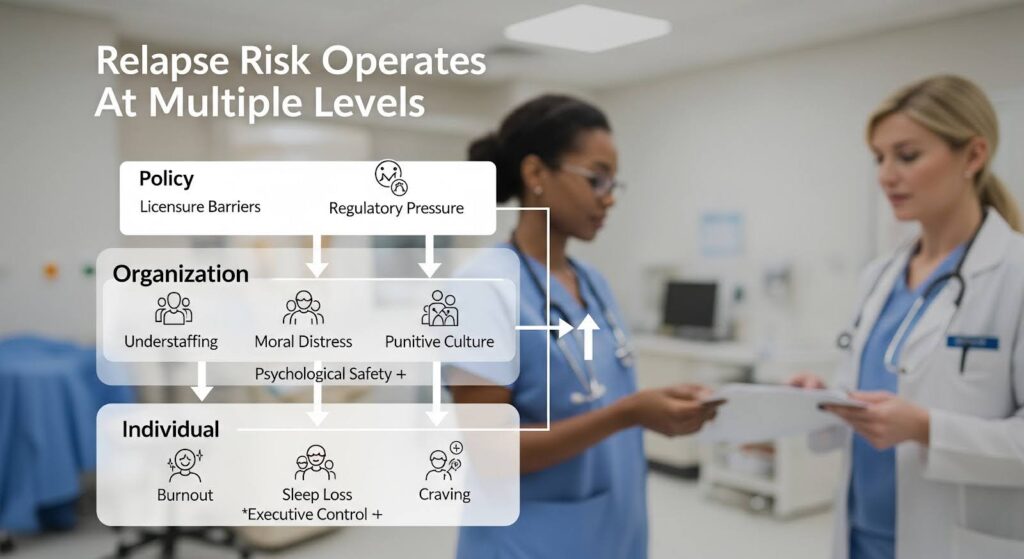
Understanding how workplace stressors drive relapse requires looking at individual, organizational, and policy levels simultaneously. At the individual level, burnout elevates sustained negative affect, which triggers craving and use episodes. Sleep loss from shift work degrades executive control and increases impulsivity. For women clinicians, disproportionate psychosocial caseloads and role strain compound emotional exhaustion and reduce recovery time.
At the organizational level, resource constraints and moral distress intensify burnout and increase reliance on maladaptive coping. Units without psychological safety or with punitive cultures deter disclosure and help-seeking, which increases clandestine use and late presentation to care. This pattern worsens relapse trajectories and can lead to the kind of crisis that triggers disciplinary action.
Policy and regulatory factors complete the picture. Intrusive mental health questions on licensure applications disincentivize early help-seeking, encouraging deterioration. Economic barriers to treatment and monitoring programs limit access and prolong distress. The National Academies of Sciences, Engineering, and Medicine and the U.S. Surgeon General have explicitly charged healthcare systems with addressing these structural determinants, moving responsibility from individual clinicians to organizational design.
What the Evidence Shows Across Sectors?
The convergent evidence across multiple research branches supports a clear conclusion: relapse risk is modifiable at the organizational level. Systems that redesign work to reduce chronic overload, create psychologically safe cultures, and provide accessible support see measurable improvements in retention, safety, and recovery outcomes.
Primary care settings offer one promising intervention point. Brief alcohol interventions are evidence-based but underutilized due to training gaps. When primary care teams receive training in screening and brief counseling, they increase early intervention for hazardous drinking. This approach can intercept risk before it progresses to relapse, especially among stressed professionals who engage primary care before specialist services.
Peer recovery support represents another high-value strategy. Certified peer support specialists with lived experience of substance use disorder deliver education, empathy, coping skills, and recovery modeling across community, hospital, and treatment settings.
When integrated into collaborative care teams with proper training and supervision, peers demonstrate low workforce turnover and strong role definition. During COVID-19, peers most commonly used text messaging, phone calls, and videoconferencing to maintain contact, suggesting that programs should prioritize these dominant modalities for accessibility and equity.
Practical Interventions That Reduce Risk
Organizations have concrete levers they can pull to reduce relapse risk among their professional workforce. The most effective approaches operate at multiple levels simultaneously.
Organizational design changes include implementing safe staffing ratios and demand smoothing to protect recovery time. Limits on consecutive shifts and on-call intensity reduce sleep disruption and exhaustion. Flexible scheduling and caregiving support normalize flexibility without career penalties, addressing the disproportionate strain on women clinicians. Subsidized childcare and eldercare supports reduce off-hours strain that compresses recovery routines.
Cultural interventions build non-punitive environments where help-seeking is encouraged. Training leaders in supportive supervision and stigma reduction creates psychological safety. Clear communication about confidential pathways to care, combined with non-retaliation policies, increases early disclosure and reduces the clandestine use that leads to crisis.
Clinical and population health intercepts scale screening and early intervention. Embedding integrated behavioral health providers in primary care settings enables systematic screening with tools like the AUDIT-C and brief counseling. Peer recovery coaches provide confidential pathways integrated with occupational health for early engagement, bridging clinical gaps and reinforcing recovery routines between visits.
Monitoring and return-to-work redesign standardizes core components nationally and provides financial assistance or insurance coverage for mandated monitoring. Reducing administrative complexity prevents treatment gaps. Individualized, phased return-to-work plans with clear supervision and safety checks include relapse prevention planning and family supports, reducing the stress of reintegration.
The Recovery-Ready Workplace Framework
A 2025 national survey found that most employees do not view their employers as recovery ready. Awareness and confidence in recovery-aligned activities were low across prevention, education, employment, and treatment domains. Critically, companies with higher-risk workforces or more resources were not consistently doing more.
However, employees broadly support recovery-ready actions, suggesting feasibility for scale-up if employers prioritize communication, access, and culture change. The Recovery Friendly Workplace model piloted in Maryland employs a tiered approach: an initial survey and advisor consultation, then a menu of activities including policy updates for hiring and support, stigma-reducing education, and naloxone training. This pragmatic structure allows employers to engage at their capacity and advance over time.
The framework explicitly centers recovery-supportive environments that prevent exposure to workplace risk factors and lower barriers to care. For professionals in recovery, this means workplaces that acknowledge the reality of substance use disorder, provide clear pathways to confidential support, and design jobs and schedules that protect rather than erode recovery capital.
Addressing the Evidence Gaps
Despite strong conceptual plausibility and convergent signals across multiple literatures, important methodological gaps remain. No eligible studies from 2020 to 2022 directly employed mediation or structural equation models to link post-pandemic burnout and related stressors to relapse among licensed professionals. Without mechanistic modeling, much of the causal chain remains inferred from adjacent literatures and plausible pathways.
This gap limits precise causal inference and underscores the need for longitudinal, mechanism-focused studies. Priority study designs include cohort studies with repeated measures of burnout, sleep, moral distress, substance use, and relapse, with nested mediation analyses by gender, role, and schedule characteristics. Pragmatic trials comparing Alternative-to-Discipline models on relapse and return-to-work outcomes would clarify which program components drive the best results.
Implementation research on primary care brief alcohol interventions targeting professional populations, including the effectiveness of integrated behavioral health champions within large systems, would strengthen the evidence base for early intervention. Standardized burnout and well-being instruments validated in licensed professional cohorts, along with interoperable return-to-work outcome measures, would enable cross-program comparisons and accelerate learning.
The Case for Action Now
The absence of perfect causal evidence should not delay action. The preponderance of convergent evidence supports targeted system redesign, surveillance and early intervention in primary care, strengthened and equitable monitoring supports, and policy reform to reduce stigma and licensure barriers.
For women and safety-sensitive roles in particular, the evidence justifies immediate investment in organizational supports. Women clinicians face unique convergence of role strain and bias that heightens burnout and, indirectly, relapse risk. Safety-sensitive professions require compliance frameworks that protect public safety while providing confidential, supportive pathways that encourage rather than suppress early help-seeking.
The U.S. Surgeon General’s 2022 guidance explicitly charges healthcare systems with addressing mental health and burnout, moving responsibility from individual clinicians to organizational design. This shift is essential for relapse risk reduction at scale and applies across all highly skilled professions where chronic stress, access to substances, and career consequences intersect.
A Roadmap for Employers and Systems
Employers that want to reduce relapse risk among their professional workforce should implement a phased, multi-level approach.
Phase one focuses on policy and culture. Adopt recovery-aligned policies and conduct a language and stigma audit. Communicate non-retaliation for self-referral and clarify confidentiality and support pathways. Provide supervisory training on recognizing stress and relapse warning signs and on referral protocols. For safety-sensitive roles, publish plain-language guides to compliance processes with flowcharts and contacts, and create confidential pre-incident self-referral pathways.
Phase two redesigns employee assistance programs around process transparency. Enhance clarity about what happens when someone calls, how data are protected, and what the timeline looks like. Embed warm handoff navigation from supervisors and HR to assistance programs and peers. Monitor time-to-first-contact and satisfaction, and add standard process evaluation alongside outcomes to identify which components drive utilization and impact.
Phase three integrates peer support. Contract with or hire peer recovery specialists aligned with core competencies, and provide supervision and training in digital modalities like text messaging, phone, and video. Prioritize dominant modalities for access and equity. Pilot fidelity monitoring and supervision enhancements, exploring analytics to support scale and quality.
Phase four addresses job design and workload. Implement meeting hygiene and asynchronous workflows to reduce technostress. Create camera-optional norms and protect time for recovery routines with flexible scheduling. Adjust staffing and workload to minimize chronic overload, especially during high-demand periods, and incorporate recovery-supportive scheduling into policy.
Phase five establishes measurement and continuous improvement. Track a balanced scorecard including burnout indices, assistance program and peer utilization, time-to-first-contact, compliance referrals and completion, return-to-duty outcomes, absenteeism, turnover, and employee perceptions of stigma and recovery support. Participate in evaluation surveys and contribute to multi-employer learning collaboratives to benchmark and share practices.

Why This Matters for Safety and Performance?
The business case for reducing workplace relapse risk extends beyond compassion. Relapse-related incidents carry direct costs in absenteeism, turnover, safety events, and regulatory exposure. Indirect costs include degraded team morale, increased burden on colleagues, and reputational risk.
Conversely, organizations that successfully support recovery see measurable gains. Retention improves when employees trust that seeking help will not end their careers. Safety improves when early intervention prevents the kind of impairment that leads to incidents. Performance improves when professionals can sustain their recovery routines without choosing between their health and their job.
The evidence from monitoring programs, when they are accessible and supportive, shows positive outcomes in sustained abstinence, successful return to work, and retained licensure. The evidence from peer support integration shows improved engagement and reduced costly escalations of care. The evidence from primary care brief interventions shows that training increases screening and early intervention, intercepting risk before it progresses.
Taken together, these findings point to a clear conclusion: workplace stressors are not immutable forces. They are products of organizational design, professional culture, and policy choices. Employers that redesign these elements can materially reduce relapse risk while strengthening the workforce.
Moving From Awareness to Action
The convergent evidence across occupational health, nurse and physician well-being, regulatory monitoring programs, and primary care interventions tells a coherent story. Chronic job pressure and burnout raise relapse risk through recognized pathways of negative affect regulation, sleep disruption, and reduced help-seeking. Professional cultures that stigmatize substance use disorder and regulatory frameworks that impose career jeopardy without support amplify this risk.
At the same time, practical interventions exist at every level. Organizational design changes reduce chronic overload and protect recovery time. Cultural interventions create psychological safety and normalize help-seeking. Clinical intercepts in primary care and through peer support provide early intervention and ongoing reinforcement. Monitoring and return-to-work programs, when properly resourced and accessible, support successful reintegration.
The methodological gaps in the literature should drive research investment, not paralysis. Longitudinal studies with mediation analyses, pragmatic trials of program components, and implementation research on integrated supports will sharpen our understanding and quantify benefits. But the evidence we have now is sufficient to act.
Systems that move from piecemeal, individual-focused coping advice to integrated organizational redesign and equitable support infrastructures will see measurable gains in retention, safety, and recovery outcomes. The priority is to make recovery-supportive policies real and visible, redesign assistance programs around transparency and navigation, integrate trained peer support with accessible digital modalities, and provide compliance pathways that balance safety with support.
For professionals in recovery, the workplace can be either a source of relapse risk or a foundation of recovery capital. The choice belongs to employers, regulators, and systems. The evidence points the way.
If you or someone on your team is navigating the intersection of workplace stress and recovery, you don’t have to face it alone. Reach out to explore Summit’s evidence-based treatment designed for professionals who need flexible, confidential support that fits their lives.