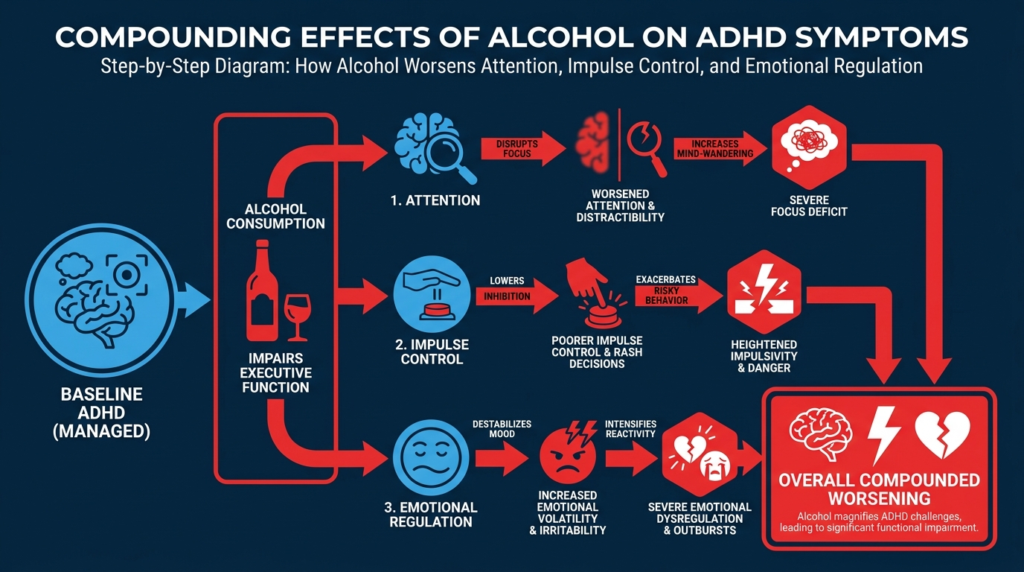
People with ADHD often wonder whether drinking is safe or how alcohol might worsen their symptoms. Alcohol directly impairs the same brain functions already challenged by ADHD—attention, impulse control, and emotional regulation, creating a compounding effect that can intensify both immediate impairment and long-term risk.
Research shows that adults with ADHD symptoms face roughly four times higher odds of alcohol dependence compared to those without ADHD, and alcohol may partially mediate the link between ADHD and broader physical health problems.
This article explains how alcohol affects people with ADHD, why they are more vulnerable to problematic drinking, and what the evidence says about managing both conditions together.
How Alcohol Worsens Core ADHD Symptoms?
Alcohol is a central nervous system depressant that disrupts attention, working memory, inhibition, and judgment in anyone who drinks. For people with ADHD, these effects land on an already fragile foundation.
ADHD is defined by developmentally inappropriate inattention, hyperactivity, and impulsivity, often accompanied by executive dysfunction and emotion dysregulation. When alcohol enters the picture, it does not simply add generic intoxication, it compounds preexisting vulnerabilities.
Acute alcohol consumption can worsen impulsivity and difficulty focusing, while long-term use is associated with cognitive decline, decision-making problems, memory impairment, and speech difficulties that further compound ADHD-related challenges.
A person with ADHD who drinks may experience steeper declines in capacities such as sustained attention, delayed gratification, inhibitory control, emotional restraint, risk appraisal, and behavioral self-monitoring. This interaction helps explain why clinicians increasingly note that people with ADHD often experience more serious consequences from a given level of drinking, even when they do not always consume more alcohol than peers at every stage of life.
The bidirectional nature of this relationship is especially concerning. ADHD-related executive deficits may raise the risk of problematic drinking, while drinking further impairs executive function. That impairment can weaken treatment adherence, coping skills, and future self-control, creating a reinforcing cycle that becomes harder to break over time.
The Self-Medication Trap: Short-Term Relief, Long-Term Harm
Some people with ADHD report using alcohol to feel calmer, less restless, or more socially comfortable. A nationwide Japanese study interpreting the ADHD–alcohol dependence link through a reward deficiency framework suggests that underactive reward systems and weak top-down control may increase vulnerability to problematic drinking, including self-medication motives.
Similarly, some individuals with ADHD report using alcohol for short-term relief from restlessness, negative emotion, depression, anxiety, sleep difficulties, and racing thoughts.
While these subjective reports do not prove causality, they align with stronger mechanistic evidence around negative emotionality and reward dysfunction. The critical distinction lies between short-term perceived relief and objective long-term worsening:
- Reduced internal tension in the moment gives way to increased tolerance and dependence risk over time
- Feeling more socially fluent temporarily masks poorer judgment and disinhibition
- Temporary dampening of restlessness leads to rebound dysregulation and impaired sleep
- Emotional numbing prevents development of healthier coping strategies and worsens mood instability
- “Turning off” racing thoughts results in greater cognitive inefficiency, memory problems, and decision errors
This asymmetry is central to understanding ADHD and alcohol: alcohol may feel useful precisely because it targets distressing ADHD-adjacent states in the short run, but it tends to worsen the broader syndrome of dysfunction over time. The relief is real but temporary, while the consequences accumulate.
ADHD Increases Alcohol Risk, But Not Uniformly
Across the evidence base, ADHD is consistently treated as an established risk factor for substance use disorder, including alcohol-related problems. The relationship, however, is moderate, heterogeneous, and developmentally contingent rather than absolute.
People with ADHD are about 50% more likely to develop a drug or alcohol use disorder than individuals without ADHD. Prospective evidence suggests a lifetime alcohol use disorder risk approximately 1.5 to 2.5 times higher in adults with ADHD, while a meta-analysis of 13 prospective studies yielded an odds ratio of roughly 1.35 for alcohol use or disorder.
These effect sizes are not trivial, but neither are they uniformly enormous. They support a careful conclusion: ADHD meaningfully raises alcohol risk on average, but the average masks substantial subgroup variation.
Not every person with ADHD develops alcohol misuse, and some long-term outcomes are strongly shaped by comorbid conduct disorder, antisocial personality disorder, mood disorders, negative emotionality, and whether ADHD symptoms persist into adulthood rather than remit.
Timing Matters: Age-Specific Risk Patterns
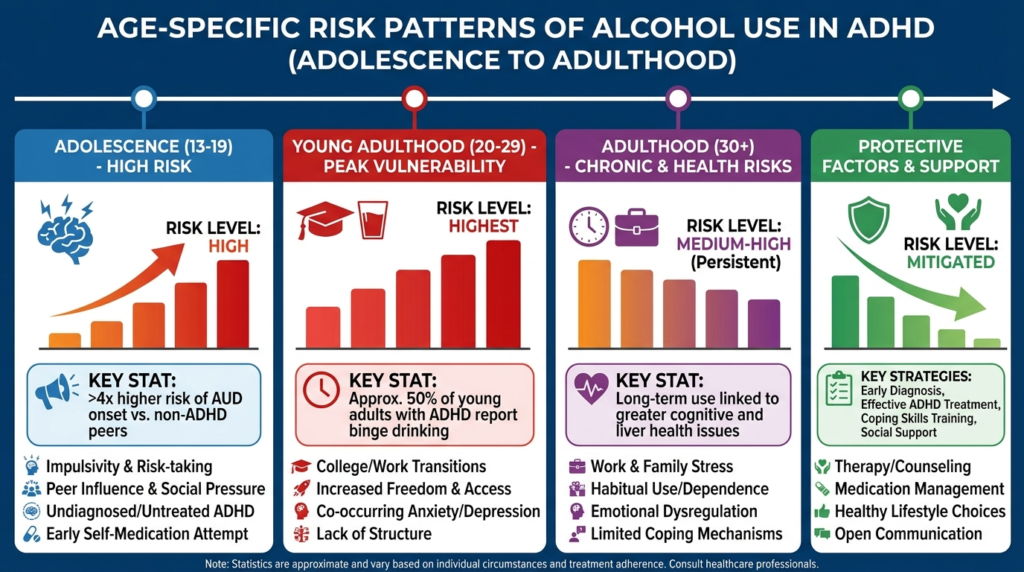
One of the most important findings in the literature is that ADHD-related risk for heavy drinking and alcohol use disorder is age-specific. The association changes across adolescence and early adulthood rather than remaining constant.
This matters because simplistic statements like “ADHD patients drink more” can be misleading. Some studies found no overall difference in broad lifetime alcohol-use measures while still detecting important differences in age at first drink, heavy drinking in mid-adolescence, escalation trajectories, binge drinking in early adulthood, or alcohol use disorder in persistent-ADHD subgroups.
A longitudinal study showed that growth in adolescent alcohol use among youth with childhood ADHD was shaped by functional impairments, ADHD symptom persistence, and parental knowledge.
This is a sophisticated finding because it indicates that ADHD does not simply “cause” alcohol escalation biologically. Rather, ADHD alters developmental pathways involving ongoing impairment and family monitoring.
Persistent ADHD Carries the Highest Risk
Persistence of ADHD into adulthood is one of the clearest markers of elevated later substance dependence risk.
Individuals whose ADHD persisted into adulthood were significantly more likely to meet criteria for alcohol, marijuana, and nicotine dependence across three young-adult time points, even after controlling for age, sex, childhood stimulant medication use, and childhood conduct problems.
This finding is highly informative. It suggests that the greatest alcohol-related risk is not simply having ever had childhood ADHD; rather, risk is concentrated in those whose ADHD remains active and impairing over time. This reframes prevention: successful long-term management of ADHD symptoms may affect alcohol vulnerability.
Why Are People With ADHD More Vulnerable to Alcohol Use?
The evidence points to several interacting mechanisms rather than a single explanation.
Impulsivity: A Key but Incomplete Pathway
Impulsivity is the most established candidate mechanism. ADHD is an impulsivity-linked disorder, and impulsivity is also strongly implicated in alcohol misuse and alcohol use disorder.
A review concluded that ADHD is an established risk factor for alcohol use disorder, but impulsivity appears to be one key pathway linking them rather than a simple direct effect alone. Longitudinal studies found indirect effects through unique facets of impulsivity, including poor inhibition, sensation seeking, urgency under emotion, and impatience with delayed reward.
Impulsivity increases experimentation, difficulty stopping once started, binge drinking risk, risky behaviors while intoxicated, and repeated decisions favoring immediate relief over long-term consequences. But impulsivity is not the whole story. If it were, the relationship would be more uniform across ages and subgroups than it actually is.
Emotion Dysregulation and Negative Emotionality
A deeper and increasingly important branch of the literature concerns emotion dysregulation. Emotion dysregulation is common in ADHD and may be a major associated feature, perhaps even a core component in some conceptualizations.
Emotional impulsiveness contributes uniquely to adult-life impairment in people with childhood hyperactivity or ADHD, supporting the idea that impulsivity and emotion regulation interact rather than act as isolated risk factors.
In youth with ADHD, emotion dysregulation appears markedly elevated. Population data show mood lability in 38% of children with ADHD, about a ten-fold increase over population rates. This suggests an early-emerging vulnerability pathway that is highly relevant to later substance misuse.
Additional longitudinal evidence supports this branch: anger-irritability has been identified as a mediator of ADHD risk for adolescent alcohol use, with coping skills also playing a role.
This is a major insight because it explains why alcohol may be especially attractive for some people with ADHD even when they are not unusually sensation-seeking. For these individuals, alcohol may function less as thrill-seeking and more as negative reinforcement, an attempt to dampen irritability, emotional volatility, shame, frustration, or internal overstimulation.
Reward Deficiency and Dopaminergic Vulnerability
A nationwide study explicitly links ADHD-related alcohol misuse vulnerability to the reward deficiency hypothesis, suggesting that some adults with ADHD may use alcohol as self-medication for dopaminergic reward dysfunction and weak top-down control over drinking. This model is conceptually consistent with neurobiological observations that ADHD and alcohol use disorder both involve dopaminergic abnormalities.
A clinician-focused review notes that a common pathogenic pathway between ADHD and alcohol use disorder may involve reduced dopaminergic activity, with alcohol use disorder characterized by reduced dopamine release in limbic pathways and decreased receptor availability.
While these models remain partly inferential, they offer a coherent explanation for why alcohol can become disproportionately reinforcing in some people with ADHD: low tonic reward responsiveness, high reward seeking, poor delay tolerance, rapid relief from aversive states, and weak executive braking once drinking begins.
Executive Dysfunction and Poor Response Inhibition
The broader developmental ADHD literature repeatedly highlights executive dysfunction and poor response inhibition. Heavy drinking itself worsens performance on executive-function tasks, potentially feeding back into ADHD-related vulnerability. Poor response inhibition in at-risk adolescents has been shown to predict later problem drinking and illicit drug use.
Thus, alcohol and ADHD interact bidirectionally. ADHD-related executive deficits may raise risk for problematic drinking. Drinking may further impair executive function. That impairment can weaken adherence, coping, and future self-control. The result is a reinforcing cycle.
Social and Functional Impairment Pathways
ADHD often brings school problems, peer difficulties, conflict, and social rejection. These impairments matter because they shape alcohol exposure and coping. Common ADHD-related impairments, such as poor school performance and social rejection, should be studied as contributors to later substance disorder and are immediate intervention targets.
Interestingly, social pathways may work in opposite directions. One longitudinal study found that parent-rated relationship problems with same-aged peers mediated the association between childhood ADHD and adolescent alcohol use, but via two pathways with opposite effects: some social impairment linked to delinquency and drinking, whereas another pathway linked social impairment to lower drinking frequency, possibly through isolation. This nuance is crucial.
ADHD does not increase alcohol risk through one monolithic social mechanism. Some youths become embedded in deviant peer groups and escalate use; others become socially excluded and may show delayed or different patterns.
Family Monitoring and Parental Knowledge
Adolescent alcohol-use growth among youth with childhood ADHD was influenced by functional impairments, ADHD symptom persistence, and parental knowledge. This indicates that family monitoring may partly buffer escalation trajectories.
In practical terms, ADHD-related disorganization and impulsivity can increase exposure to risky settings, but attentive parental awareness may reduce opportunities for unsupervised escalation. This is one of the clearest examples of how environmental factors interact with neurodevelopmental vulnerability.
Heterogeneity: Why Not Everyone With ADHD Has the Same Alcohol Risk?
One of the most important corrections to public discourse is that ADHD is not a uniform destiny toward alcohol use disorder.
Conduct Disorder and Externalizing Comorbidity
Some prospective studies indicate that ADHD alone may not consistently predict later substance abuse or dependence unless it co-occurs with conduct disorder or other externalizing problems.
Longitudinal evidence suggests that the ADHD–alcohol relationship is strongly shaped by comorbidity: heavy drinking and alcoholism symptoms were elevated in ADHD youth ages 15 to 17, but at ages 18 to 25 the highest risk was concentrated among those with ADHD plus antisocial personality disorder, while ADHD plus conduct disorder showed the greatest alcoholism symptoms in adolescence.
This is one of the strongest reasons to reject simplistic causal claims. The evidence indicates that externalizing comorbidity often magnifies alcohol risk dramatically.
Bipolar Disorder: Particularly Elevated Risk
Among people with bipolar disorder, comorbid ADHD is associated with substantially higher alcohol use disorder risk. A meta-analysis of 11 studies found that bipolar patients with ADHD were about 2.5 times more likely to have alcohol use disorder than bipolar patients without ADHD, with negligible heterogeneity and no clear publication bias.
This is a high-value finding because it comes from meta-analytic synthesis, the effect size is substantial, heterogeneity was low, and it identifies a clearly high-risk subgroup. From a clinical standpoint, bipolar disorder plus ADHD should be treated as a major alcohol-risk cluster.
Alcohol May Worsen Broader Health Burden in ADHD
The consequences of alcohol in ADHD are not confined to intoxication or addiction diagnosis. Alcohol may help mediate broader health burden.
A Japanese study found that alcohol dependence may partially mediate the association between adult ADHD symptoms and multiple physical comorbidities. This is highly significant because it reframes alcohol use as a modifiable bridge from ADHD symptom burden to worse general health.
Potential downstream areas include sleep disruption, cardiovascular risk behaviors, injury and accidents, poor medication adherence, reduced exercise and dietary regularity, and chronic stress-related deterioration. This aligns with the broader literature showing that alcohol amplifies the real-world consequences of impaired executive control.
Screening and Identification
ADHD is often underdetected in alcohol-treatment settings, and alcohol problems are often underdetected in ADHD settings. This two-way underrecognition is a major systems problem.
Lack of systematic screening of substance use disorder in mental health services and ADHD in drug and alcohol services results in poor detection and treatment. A review on ADHD and alcohol use disorder reported that ADHD is overrepresented in substance-use treatment centers, with estimated prevalence around 21 to 23% when screening practices are implemented. This suggests many cases are being missed unless clinicians actively look.
For adults with ADHD symptoms, the AUDIT and DAST are acceptable screening instruments for alcohol and drug use problems, respectively. For ADHD screening in substance use disorder populations, the 6-item ASRS Part A is commonly recommended.
For adolescents, brief substance screening tools with good psychometric support include S2BI, BSTAD, TAPS, CRAFFT, and NIAAA youth alcohol screening. A study found that S2BI, BSTAD, and TAPS all had adequate psychometric properties for identifying nicotine, alcohol, and cannabis use disorders among adolescents.
Is Abstinence Required Before ADHD Assessment?
This remains a contested clinical issue, but newer trusted sources increasingly argue that abstinence is not required for screening and diagnosis, although active heavy use can complicate interpretation. Abstinence is not a prerequisite for ADHD screening and diagnosis, and delaying treatment until full abstinence may undermine recovery.
By contrast, some guidelines state that in most cases clinicians should begin treatment aimed at abstaining from or reducing substance use first, because current substance use disorders may complicate diagnosis and treatment of ADHD, but ADHD treatment should not be unnecessarily delayed.
These positions are not irreconcilable. The best synthesis is that abstinence is not mandatory for screening or even diagnosis, but intoxication or withdrawal and unstable heavy use can blur diagnostic clarity, so assessment should be repeated longitudinally and interpreted by qualified clinicians.
Treatment Implications: What Should Be Done Clinically?
Integrated Care is Now the Preferred Model
Multiple sources agree that ADHD and substance use disorder or alcohol use disorder should not be treated in isolation. ADHD and substance use disorder commonly co-occur in adults, and management should account for both conditions together rather than separately.
Simultaneous or concurrent treatment is described as best practice. Treatment should focus on both disorders concurrently and consider their interrelationship. This is one of the strongest practice conclusions in the evidence base.
Stimulants Remain First-Line for ADHD, But Require Thoughtful Monitoring
General ADHD treatment literature still supports stimulants as first-line pharmacotherapy due to strong efficacy and established safety. Amphetamine products may be slightly more efficacious, whereas methylphenidate products may be better tolerated overall, which often leads clinicians to start with methylphenidate-based options.
In co-occurring substance use disorder populations, however, misuse and diversion risk must be considered. Recommendations include careful titration and monitoring, considering non-stimulants if use is not stabilized, and preferring long-acting rather than short-acting stimulants to reduce misuse or diversion risk.
Extended-release formulations and monitoring commensurate with risk, potentially including pill counts, drug testing, frequent contact, and prescription drug monitoring program checks, are recommended when psychostimulants are prescribed to patients with co-occurring substance use disorder and ADHD.
Non-Stimulants: When and Why They Matter?
When misuse or diversion is a concern, non-stimulants become especially attractive. Atomoxetine has no known misuse liability, making it appealing in ADHD–substance use disorder populations where stimulant misuse or diversion is a concern.
Non-stimulants such as atomoxetine, viloxazine, clonidine extended-release, and guanfacine extended-release are appropriate when stimulants are ineffective or not tolerated, though they have slower onset and smaller effect sizes than stimulants.
For alcohol-specific comorbidity, atomoxetine has shown improvement in ADHD symptoms but inconsistent or limited benefit on drinking outcomes. A placebo-controlled study in adults with ADHD and comorbid alcohol use disorder found that atomoxetine improved ADHD symptoms but had inconsistent effects on drinking.
Another review notes that atomoxetine was effective in reducing ADHD symptoms in abstinent ADHD and alcohol use disorder individuals but did not impact relapse into heavy drinking.
Thus, atomoxetine may be best understood not as an alcohol use disorder medication, but as an ADHD treatment with low abuse potential that can be useful in high-risk populations.
Does Treating ADHD Reduce Alcohol Risk?
While the provided evidence set does not offer a single definitive alcohol-specific meta-analysis proving that ADHD medication reduces future alcohol use disorder across all groups, multiple sources suggest that treating ADHD is not associated with worsening addiction risk and may reduce broader negative outcomes.
Stimulants have been found to reduce negative ADHD outcomes, including illicit drug use. Early treatment for ADHD can help reduce the risk of alcohol and other drug dependence in young people and reduce relapse risk among adults recovering from dependence. Addressing ADHD can improve engagement in recovery.
My interpretation of the evidence is that fear-driven undertreatment of ADHD is more likely to worsen alcohol outcomes than appropriately monitored ADHD treatment is to worsen addiction.
Psychotherapy and Psychoeducation Are Essential
Because the medication evidence in ADHD–substance use disorder populations remains limited, reviews recommend combining medication with psychotherapeutic interventions.
Psychoeducation and structured or adapted psychotherapy are advised because the pharmacologic evidence base in ADHD with comorbid substance use disorder is limited. A multidisciplinary approach integrating therapy and medications, especially psychoeducation, motivational interviewing, and cognitive behavioral therapy, is recommended.
This is especially relevant because several of the strongest mechanisms linking ADHD and alcohol, emotion dysregulation, coping deficits, deviant-peer processes, disorganization, and treatment nonadherence, are not fully addressed by medication alone.
Substance-Specific Care Still Matters
Using substance-specific evidence-based guidelines for alcohol, cannabis, stimulants, and opioids, alongside ADHD care, is emphasized. This is a crucial reminder: ADHD treatment does not replace evidence-based alcohol use disorder treatment.
For alcohol specifically, this means integrated management should include alcohol screening and diagnostic assessment, motivational interviewing, relapse-prevention planning, psychotherapy or cognitive behavioral therapy where indicated, and, when appropriate, guideline-based alcohol use disorder pharmacotherapy under relevant alcohol-treatment standards.
Combining ADHD Medications With Alcohol
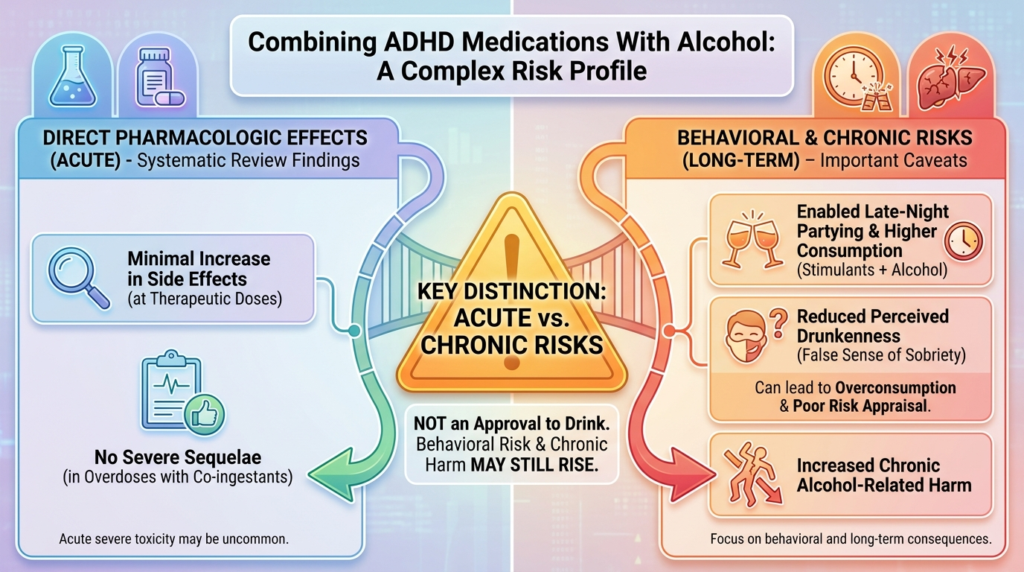
A systematic review examining potentially dangerous pharmacologic effects of combining ADHD medications with alcohol and drugs of abuse found only a minimal increase in side effects when ADHD medication at therapeutic doses was taken with alcohol, and no reviewed studies showed severe sequelae among overdoses involving ADHD medication and co-ingestants including alcohol.
However, this should not be misread as approval to drink on ADHD medications. The same review noted that co-ingestion of stimulants such as methylphenidate or amphetamine with alcohol may enable more late-night partying and higher levels of alcohol consumption, increasing chronic alcohol-related harm. This is an important distinction: acute severe pharmacologic toxicity may be uncommon, but behavioral risk and chronic harm may still rise.
Some studies also reported that stimulants taken with alcohol can reduce perceived drunkenness, allowing longer socializing and more drinking. Reduced subjective intoxication can be dangerous because it may encourage overconsumption and poor risk appraisal.
Integrating the Evidence: A Coherent Model
The literature branches converge on a multi-level model. Childhood ADHD increases vulnerability to adolescent substance use and alcohol escalation, especially when symptoms persist and functional impairments remain active.
Alcohol risk rises sharply when ADHD is accompanied by conduct disorder, antisocial features, or bipolar disorder. Impulsivity, poor inhibition, reward dysregulation, and executive dysfunction create susceptibility to early initiation, binge patterns, and poor stopping control.
Emotion dysregulation, irritability, and negative emotionality make alcohol especially reinforcing as short-term relief, linking ADHD to alcohol problems through internal distress rather than only impulsive novelty-seeking.
Integrated care, early screening, and concurrent treatment outperform siloed approaches. Stimulants remain first-line for ADHD generally, but long-acting formulations, close monitoring, and non-stimulants such as atomoxetine are important when misuse concerns are high.
Alcohol may mediate broader physical health burden in adults with ADHD, meaning alcohol intervention is not only about addiction but also about reducing downstream morbidity.
Concrete Evidence-Based Opinion
Based on the supplied evidence, my concrete opinion is as follows: alcohol affects people with ADHD more adversely than it affects many people without ADHD because it directly amplifies preexisting deficits in inhibition, attention regulation, emotional control, and judgment.
ADHD should be treated as a meaningful, clinically actionable vulnerability factor for alcohol-related harm, not as a guaranteed path to alcoholism, but as a condition that materially raises risk, especially when symptoms persist and when comorbid emotional or externalizing disorders are present.
The strongest explanatory model is not “ADHD causes alcoholism” but “ADHD creates multiple interacting vulnerability pathways to alcohol problems.” Those pathways include impulsivity, emotion dysregulation, reward dysfunction, functional impairment, deviant-peer risk, and weak family monitoring. Emotion dysregulation is underappreciated and likely one of the most important deep mechanisms.
The literature increasingly shows that alcohol vulnerability in ADHD is not only about thrill-seeking or impulsive acting out; for many individuals it is about escaping chronic emotional disequilibrium.
Persistent ADHD matters more than childhood history alone. Longitudinal findings showing greater alcohol dependence in persistent ADHD than in childhood-limited ADHD strongly support active treatment and follow-up into adulthood. Comorbidity is not a side issue; it is a central determinant of risk. ADHD with conduct disorder, antisocial traits, or bipolar disorder should be regarded as high priority for alcohol screening and preventive intervention.
Clinical practice should move decisively away from treatment silos. The evidence favors concurrent, integrated care. The old logic of “wait for perfect abstinence before addressing ADHD” is too blunt and often counterproductive.
Medication avoidance based on stigma is not evidence-based. Properly monitored ADHD pharmacotherapy, especially with long-acting stimulants or low-misuse-liability non-stimulants where appropriate, is generally a safer and more rational strategy than leaving clinically significant ADHD untreated.
In short, the best-supported position is neither alarmist nor minimizing: ADHD substantially increases vulnerability to alcohol harm, but that vulnerability is modifiable with early identification, nuanced risk assessment, and integrated treatment.
Practical Clinical Implications
For clinicians, screen for alcohol problems in ADHD patients routinely. Screen for ADHD in alcohol use disorder or substance use disorder settings rather than assuming symptoms are only substance-related. Pay special attention to persistent ADHD, emotional impulsiveness, irritability, conduct or antisocial features, bipolar disorder, and poor family or social supports.
Use concurrent treatment plans. Consider long-acting stimulants when appropriate, with careful monitoring. Consider atomoxetine or other non-stimulants when misuse or diversion risk is high. Add psychoeducation, cognitive behavioral therapy, motivational interviewing, and relapse-prevention strategies.
For patients and families, alcohol may temporarily feel calming or socially helpful, but it often worsens ADHD-related functioning over time. Earlier drinking and binge patterns deserve attention, not dismissal. Persistent ADHD symptoms in late adolescence and adulthood are important warning signs. Treating ADHD is part of alcohol-risk reduction, not separate from it.
For health systems, build bidirectional screening pathways between mental health and addiction services. Avoid forcing patients into artificial diagnostic silos. Use substance-specific treatment guidelines alongside ADHD care.
If you or someone you care about is navigating ADHD and alcohol concerns, you don’t have to face it alone. The Summit Wellness Group offers dual diagnosis treatment that addresses both ADHD and substance use together, with evidence-based therapies, medication management, and holistic support personalized to your needs.