Alcohol and Weed: Can You Mix Weed and Alcohol?
Mixing weed and alcohol is one of the most common substance combinations, but the research is clear that doing both at the same time raises your risk of harm well beyond what either substance causes alone.
A 2021 meta-analysis of 57 driving studies found that combining cannabis and alcohol produces greater impairment than either drug by itself.
This article walks through what the science actually shows about mixing alcohol and weed, who is most at risk, and what you can do if the combination has become a pattern.
Alcohol and Weed: What Happens When You Mix Them?
When you drink alcohol and use cannabis at the same time, the effects of both substances overlap in ways that are often harder to predict than people expect.
Researchers call this simultaneous use, and it is distinct from simply using both substances at different points in the same week. The distinction matters because overlapping intoxication is consistently linked to worse outcomes than using each substance separately.
The dominant finding across the behavioral pharmacology literature is that alcohol and cannabis together tend to produce additive impairment. As one co-use review puts it, most clinical laboratory research on co-administration has found additive performance impairment effects, with pharmacologic interactions affecting absorption, bioavailability, and subjective experience.
In plain terms, the combination does not simply add a little buzz on top of a little high. It tends to produce worse coordination, slower reaction time, poorer attention, and riskier judgment than either substance alone.
The “Crossfading” Effect and Why It Misleads?
Many people who mix weed and alcohol describe the experience as “crossfading,” a term for the overlapping intoxication that can feel different from either substance on its own. Some people report feeling less globally intoxicated when they use both together, which sounds reassuring but is actually a warning sign.
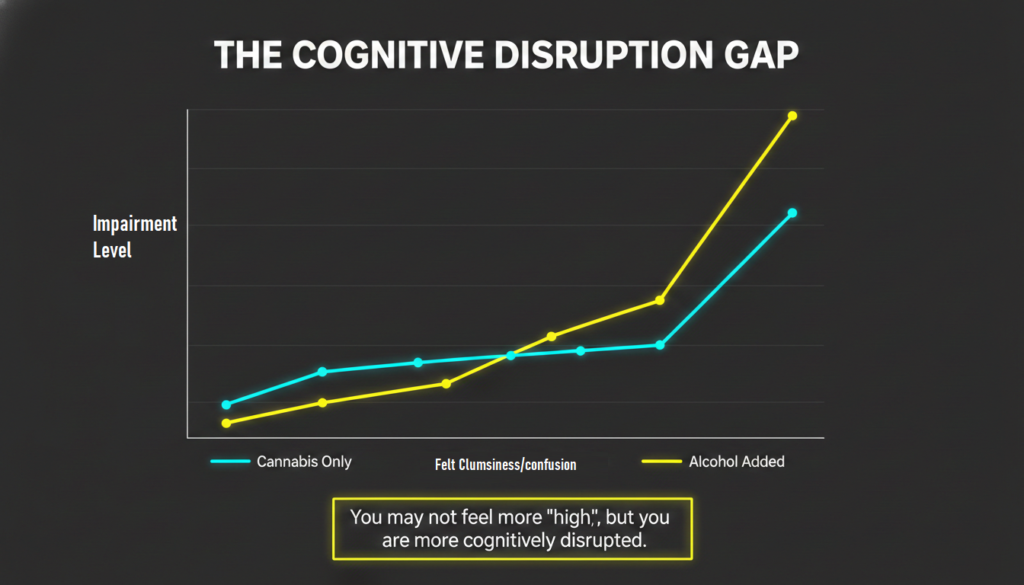
A 2025 ecological momentary study among college students found that simultaneous use did not significantly change the overall level of subjective intoxication compared with alcohol-only or cannabis-only occasions. Yet the same study found that feelings of being clumsy, confused, and unable to concentrate were stronger during simultaneous use than during alcohol-only occasions.
The subjective effects summary of this research makes the implication clear: people may not feel more intoxicated overall, but they are more cognitively disrupted. That gap between felt intoxication and actual impairment is exactly how accidents happen.
Does Cannabis Reduce How Much You Drink?
One recent randomized controlled crossover trial found that smoked THC acutely reduced alcohol consumption in a laboratory task, even though participants still drank after using cannabis.
This is a genuinely interesting finding, but it should not be read as evidence that mixing is safe. The Metrik et al. study authors themselves state that whether reduced alcohol consumption leads to reduced harms from simultaneous use is unknown.
Drinking slightly less alcohol while also intoxicated on THC still leaves a person impaired by both substances.
Mixing Alcohol and Weed: The Driving Evidence
The clearest and most policy-relevant evidence against mixing alcohol and weed comes from driving research. If a combination worsens driving more than either substance alone, that is already enough to call it unsafe for most everyday situations.
The highest-quality source on this question is a systematic review and meta-analysis by Arkell and colleagues, published in 2021, which analyzed 57 studies and 1,725 participants. The findings were consistent and striking:
- Cannabis alone worsened lane control and increased lateral position variability compared with placebo.
- The combination of cannabis and alcohol produced greater lane deviation and more time out of lane than alcohol alone.
- The combination also produced greater lateral position variability and more time out of lane than cannabis alone.
In short, adding alcohol to cannabis makes driving worse, and adding cannabis to alcohol also makes driving worse. The combination is more detrimental than either drug by itself.
Population-level data reinforce this. A CDC-linked survey analysis of U.S. drivers found that among people who had used both alcohol and cannabis in the past year, 42% reported driving under the influence of one or both substances.
Simultaneous use was associated with nearly three times higher adjusted odds of cannabis-impaired driving and more than three times higher adjusted odds of driving under the influence of both substances compared with those who did not drive impaired.
There is also no reliable blood THC cut-off that indicates impairment the way blood alcohol concentration does. A 2024 health review notes that recovery of driving-related skills may occur around five to six hours after cannabis intoxication in some people, but there is substantial individual variability, and oral cannabis can prolong impairment even further.
This means you cannot rely on feeling okay, on a rough estimate of time elapsed, or on assumed THC numbers to decide whether you are safe to drive.
What Happens in Your Body When You Mix Weed and Alcohol?
Beyond driving, mixing weed and alcohol affects your body in several ways that are worth understanding.
Impairment Compounds
Alcohol impairs reaction time, judgment, coordination, and risk-taking. Cannabis impairs psychomotor function, attention, and lane control. Together, these effects stack.
The co-use review summarizes the field by stating that most research has found additive performance impairment, with pharmacologic interactions affecting how each substance is absorbed and experienced.
Acute Physical Reactions
Emergency department data show that cannabis can cause significant acute symptoms on its own, including anxiety, vomiting, agitation, palpitations, and reduced consciousness. A European emergency department analysis of cannabis intoxication presentations found that 52% of cases involved alcohol co-ingestion.
Among those presentations, 28% involved anxiety, 24% involved vomiting, 23% involved agitation, and 13% involved reduced consciousness. Alcohol co-ingestion adds unpredictability to these reactions and can make them harder to manage safely.
Nausea and Vomiting
Nausea is a common feature of both heavy alcohol use and high-dose cannabis use. When combined, vomiting can become more distressing and harder to self-manage, particularly if a person’s level of consciousness is reduced.
This is not a trivial concern. Choking on vomit during heavy intoxication is a real and preventable cause of serious harm.
Anxiety and Panic
High-THC cannabis can trigger anxiety and panic in some people, especially those with underlying psychiatric vulnerability. Alcohol can reduce inhibition and coping capacity, which may make a panic reaction harder to manage.
A 2023 emergency department study of acute cannabis toxicity found that among patients evaluated for cannabis-related anxiety, presentations included panic attacks, aggression, and hallucinations, with higher rates among those with a history of polysubstance use.
Can You Mix Weed and Alcohol? The Honest Answer!
Yes, people can physically use both at the same time, and many do. But the evidence strongly supports that mixing weed and alcohol is unsafe, particularly in situations that require coordination, attention, or sound judgment.
The Subbaraman and Kerr National Alcohol Survey analysis found that simultaneous users had more alcohol-related social consequences, harms to self, and drunk driving than people who used alcohol alone or who used both substances but at separate times. Simultaneous use is riskier than concurrent use, and concurrent use is already riskier than using neither.
A daily survey analysis of college students found that these young adults were more likely to endorse driving under the influence of cannabis than alcohol, and the authors explicitly recommended that interventions highlight the dangers of cannabis-impaired driving while also targeting alcohol consumption to reduce other harms.
Who is Most at Risk When Mixing Alcohol and Weed?
Not everyone who mixes alcohol and cannabis will end up in an emergency room, but some people face meaningfully higher risk than others.
* People who use high-potency cannabis products, including concentrates and edibles, face greater impairment because oral cannabis produces more prolonged blood THC elevations and longer impairment than inhaled cannabis.
* Adolescents and young adults already have elevated baseline crash risk and less driving experience. Research cited in the co-use literature found that high school seniors who used cannabis and alcohol together had the highest rates of unsafe driving compared with peers who used them less frequently or separately.
* People with anxiety, panic disorder, or other psychiatric conditions may be more likely to experience acute destabilizing reactions when combining both substances.
* People who drink heavily are at greater risk because the intensity of alcohol exposure matters. The more alcohol consumed, the more the combination amplifies impairment.
* Pregnant individuals face a distinct and serious risk. A 2023 review concluded that early exposure to both alcohol and cannabis is associated with a higher risk of severe developmental outcomes than exposure to either drug alone, describing synergistic developmental effects that make the combination especially harmful during pregnancy.
Longer-Term Risks of Mixing Alcohol and Weed
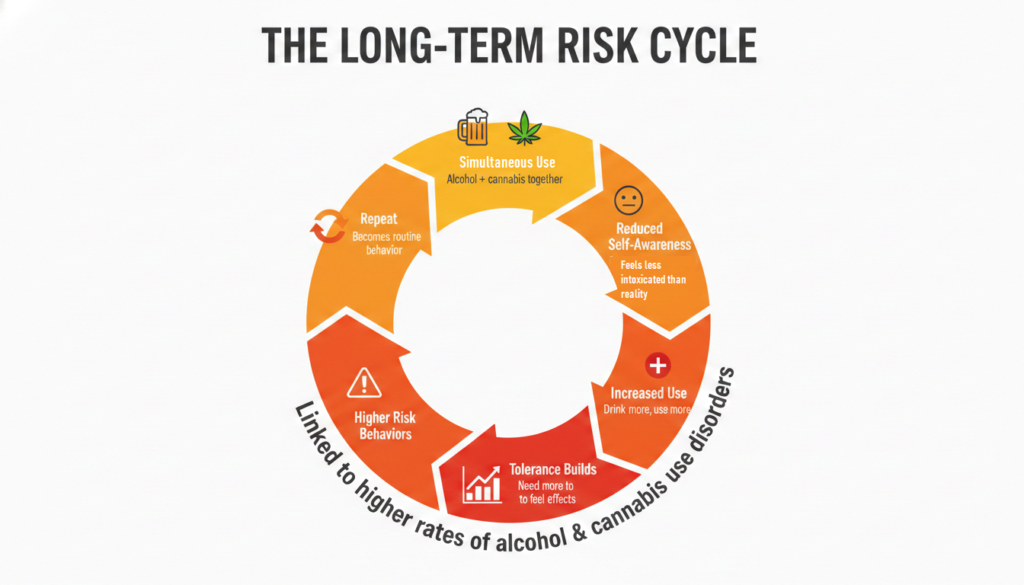
The risks of mixing alcohol and weed are not limited to a single night. The co-use review consistently links simultaneous use with increased likelihood of current and future cannabis and alcohol use disorders. People with cannabis use disorder have increased likelihood of developing alcohol use disorder, and the overlap in diagnoses is high.
Co-use also clusters with heavier and more frequent use overall. Some research suggests that mixing may distort self-monitoring, meaning people may feel less globally intoxicated than expected, overlook mounting clumsiness or confusion, continue drinking, and then decide to drive. That chain is precisely how indirect harms accumulate over time.
Repeated simultaneous use is a warning sign rather than a harmless lifestyle detail. If you find yourself regularly mixing alcohol and weed, especially if you are also driving, supervising others, or noticing that you need more of both to feel the same effect, it is worth taking that pattern seriously.
What to Do If Mixing Has Become a Pattern?
If mixing alcohol and weed has become a regular habit, or if you have noticed that you feel unable to enjoy social situations without both, that is worth paying attention to.
The evidence does not support treating simultaneous use as a neutral personal preference. It reliably raises the probability of impairment, misjudgment, and injury, and it is associated with higher rates of substance use disorders and psychiatric problems.
The safest recommendation based on the research is straightforward: do not mix alcohol and weed, especially if you may drive, supervise children, swim, use machinery, or are vulnerable to anxiety, heavy drinking, or psychiatric instability. If you are already using both regularly and finding it hard to stop, professional support can make a real difference.
If you or someone you care about is struggling with alcohol, cannabis, or both, reaching out to a treatment program is a practical next step. The Summit Wellness Group offers individualized, evidence-based care for substance use and co-occurring mental health concerns. You can learn more or start a conversation through their addiction treatment programs today.