Many people who use cannabis daily report using it to help them sleep, and some also take prescription sleep medications like Ambien. If you’ve ever wondered whether it’s safe to combine these substances, you’re asking an important question.
Mixing Ambien and marijuana can increase drowsiness, worsen confusion, and raise the risk of dangerous side effects like slow breathing and memory blackouts.
This article explains what happens when you combine these substances, reviews the research on using Ambien for cannabis withdrawal, and helps you understand the real risks.
What Happens When You Mix Ambien and Marijuana?
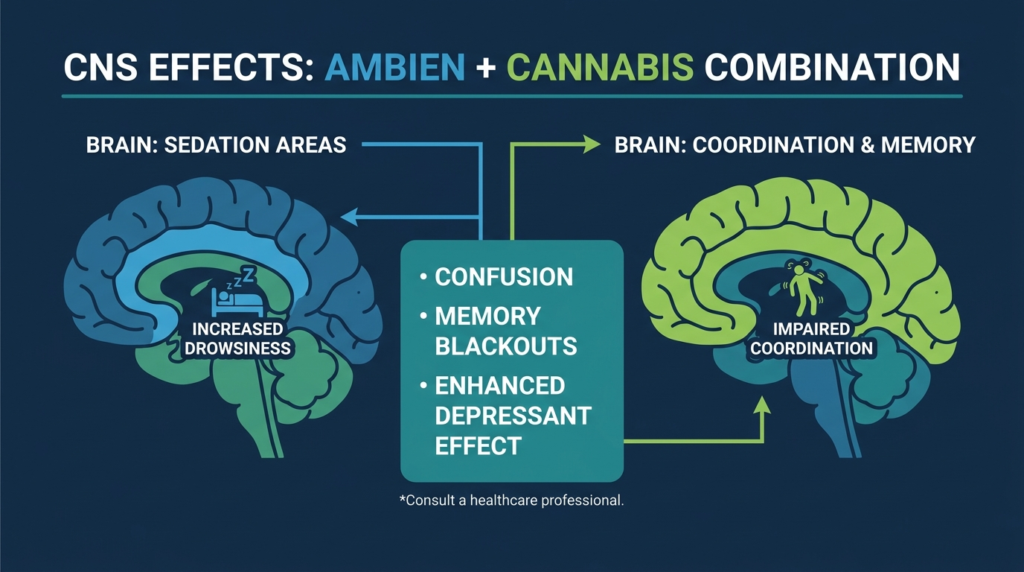
Combining Ambien and weed creates overlapping effects on your central nervous system. Both substances slow down brain activity, which can amplify sedation beyond what either drug produces alone.
When you take Ambien with cannabis, you may experience increased drowsiness, worse coordination, slowed reflexes, and impaired judgment. Some people describe feeling disoriented or experiencing “blacking out” episodes where they cannot remember what happened.
The combination can also lead to slow or shallow breathing, especially if you add alcohol or other sedatives to the mix.
These risks matter because they affect your ability to drive safely, make decisions, and remember events. Even if you feel only mildly sleepy, your actual performance on tasks requiring attention and coordination may be significantly worse than you realize.
Understanding Ambien and Its Effects
Ambien, known generically as zolpidem, is a non-benzodiazepine sleep medication prescribed for short-term insomnia. It works by enhancing GABA, an inhibitory neurotransmitter that calms brain activity and promotes sleep.
While Ambien is effective at helping people fall asleep, it carries notable risks. The medication can cause next-morning drowsiness, memory problems, and complex sleep behaviors like sleepwalking, sleep-driving, and eating while not fully awake. These behaviors can occur even at recommended doses and sometimes result in serious harm.
Ambien also has documented associations with accidents, falls, delirium, and behavioral disinhibition. Regulatory agencies have issued warnings about impaired driving ability the morning after taking Ambien, especially when people don’t allow at least eight hours between taking the medication and driving.
Cannabis Withdrawal and Sleep Problems
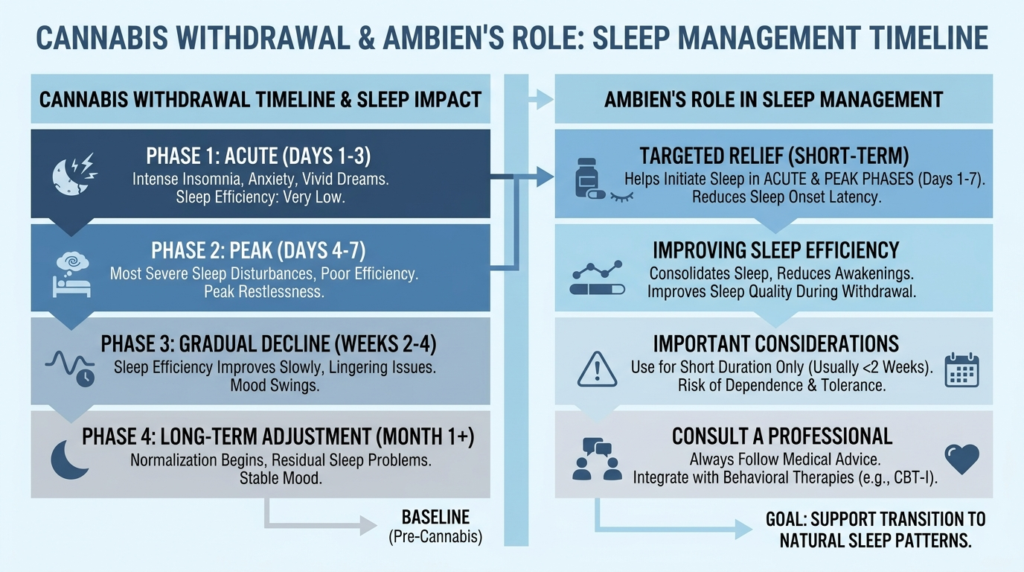
Cannabis withdrawal commonly includes insomnia, reduced sleep efficiency, longer time to fall asleep, and changes in sleep architecture. These symptoms typically start within 24 to 72 hours after stopping cannabis, peak around days two to six, and can last one to two weeks.
Sleep difficulty is both a withdrawal symptom and a reason many people use cannabis in the first place. This creates a challenging cycle: people use cannabis to sleep, then struggle with worse insomnia when they try to quit, which often leads them back to cannabis use.
Because sleep problems are frequently reported as barriers to successful quitting, researchers have investigated whether treating insomnia with medications like Ambien might help people stop using cannabis.
Research on Ambien for Cannabis Use Disorder
Scientists have studied whether Ambien can help people with cannabis use disorder quit or reduce their use. The research shows a consistent but limited pattern: Ambien improves withdrawal-related sleep problems in the short term, but that benefit doesn’t reliably translate into reduced cannabis use or sustained abstinence.
Laboratory Studies Show Sleep Improvement
Early controlled studies confirmed that stopping cannabis abruptly degrades sleep quality and that extended-release Ambien can reduce these effects.
In one study of 20 daily cannabis users, Ambien normalized sleep efficiency and reversed changes in sleep stages compared to placebo during three-day abstinence periods.
However, improved sleep didn’t clearly reduce overall withdrawal severity or craving. The researchers noted that better sleep alone didn’t translate into improved clinical outcomes.
Ambien Alone Doesn’t Reduce Cannabis Relapse
A more revealing study tested whether Ambien could reduce relapse-like behavior in a controlled laboratory setting. Researchers gave 11 daily cannabis users either placebo, Ambien alone, or Ambien combined with nabilone, a synthetic cannabinoid medication.
Both Ambien alone and the combination improved sleep. But only the Ambien plus nabilone combination improved mood, food intake, and broader withdrawal symptoms.
Most importantly, only the combination reduced participants’ self-administration of cannabis when it became available again. Ambien alone did not.
This finding is crucial because it directly tests whether fixing sleep problems alone can prevent relapse. It cannot.
The Largest Clinical Trial Found No Abstinence Benefit
The most clinically relevant evidence comes from a 12-week randomized controlled trial in 127 treatment-seeking adults with cannabis use disorder who had sleep-related quitting difficulties.
All participants received evidence-based therapy and incentives for abstinence. Half also received extended-release Ambien, while half received placebo.
During the first one to two weeks, Ambien improved sleep efficiency compared to placebo. Participants taking placebo saw their sleep efficiency drop from 82% to 74%, and their time to fall asleep increased from 28 to 82 minutes, while the Ambien group didn’t show significant deterioration.
However, there were no statistically significant differences in cannabis abstinence between groups. Although 27% of the Ambien group achieved abstinence at the end of treatment compared to 15% in the placebo group, this difference wasn’t large enough to rule out chance.
Importantly, sleep worsened after Ambien was stopped during weeks 10 to 12, suggesting rebound insomnia or re-emergence of underlying sleep problems once the medication was withdrawn.
The trial’s lead investigator noted that the lack of significant abstinence difference “suggests that sleep is not the predominant factor driving successful cessation attempts.”
Why Ambien Alone Isn’t Enough?
The research reveals that cannabis withdrawal is multidimensional. Sleep dysfunction is one component, not the sole driver of continued use or relapse.
Treating insomnia alone may improve comfort without reducing the reinforcing effects of cannabis or the propensity to relapse. Cannabis relapse appears to be driven by factors beyond sleep disturbance, including mood changes, appetite disruption, irritability, and the direct rewarding effects of cannabis itself.
This explains why combination approaches that address both sleep and cannabinoid withdrawal biology show more promise than Ambien monotherapy, though even those strategies need larger real-world trials before clinical endorsement.
Safety Concerns When Mixing Ambien and Cannabis
The short-term cannabis-specific studies found no major immediate safety signals for Ambien alone in controlled settings. Participants didn’t show meaningful next-day cognitive impairment in brief laboratory studies.
However, the broader safety literature on Ambien is much less reassuring. Ambien is associated with accidents, falls, overdoses, delirium, infections, and harms to others including vehicular accidents and assaults. Much of this harm occurs at therapeutic prescribed doses of 10 to 30 mg.
Overlapping Central Nervous System Effects
When you combine Ambien with cannabis, especially THC-rich products, you increase the risk of additive sedation. Both substances slow down your central nervous system, which can lead to:
- Increased drowsiness and confusion
- Worse physical impairment and coordination problems
- Potentially intensified Ambien effects
- Raised risk of slow or shallow breathing
While these aren’t high-quality clinical trial data, the direction of risk aligns with established guidance that combining Ambien with other CNS depressants increases psychomotor impairment and CNS depression.
Memory Blackouts and Complex Behaviors
Ambien is associated with dose-dependent anterograde amnesia, meaning you may not remember events that occur after taking it. This creates a dual hazard: impaired performance combined with inability to recall the impairment afterward.
Ambien can also cause complex sleep behaviors like sleep-driving, sleepwalking, and eating while not fully awake, with possible serious harm or death even at recommended doses. These behaviors can occur even without alcohol or other CNS depressants.
When cannabis is added to the mix, the risk of memory blackouts and unusual behaviors may increase, though specific research on this combination is limited.
Driving Risks After Taking Ambien
One of the most serious concerns about Ambien is impaired driving ability the next morning. This risk is especially relevant because many people who use cannabis also drive regularly.
Next-Morning Impairment is Real
Studies using actual on-road driving tests show that Ambien can significantly impair lane control and increase weaving, especially when taken in the middle of the night with less than eight hours before driving. Impairment can be detectable as early as four hours after dosing on some measures.
Importantly, real driving tests sometimes detect impairment even when standard laboratory cognitive tests don’t, suggesting that driving is a more sensitive measure of Ambien’s residual effects.
Real-World Crash Risk
A population-based study in South Korea found that having a zolpidem prescription the previous day was associated with a 48% increased risk of fatal motor vehicle collisions. The risk was even higher among younger adults, people with multiple health conditions, and new users of the medication.
The FDA received about 700 reports of impaired driving associated with Ambien from 2007 to 2013, mostly related to prior-day use. In 2013, the FDA required stronger labeling and lowered the recommended starting dose for women from 10 mg to 5 mg because of next-morning impairment concerns.
Regulatory Warnings
The European Medicines Agency concluded that mental alertness impairment is higher when Ambien is taken with less than a full night of sleep remaining.
They recommend at least eight hours between taking Ambien and driving or operating machinery, and warn against taking it more than once per night or combining it with alcohol or other CNS depressants.
Who is at Higher Risk?
Certain groups face greater risk when using Ambien, especially in combination with cannabis:
Older adults may have lower clearance of Ambien, leading to higher drug levels in the body. They may also be taking other medications that interact with Ambien and may already have baseline vulnerabilities in balance and reaction time.
Women tend to have about 35% lower clearance of Ambien than men on average, which may contribute to higher morning blood levels and greater impairment risk.
New users face particularly high risk. One study found that new Ambien users had more than double the risk of fatal crashes compared to their own baseline before starting the medication.
People with liver problems metabolize Ambien more slowly, which can increase exposure and prolong effects.
Anyone combining substances faces amplified risk. Mixing Ambien with alcohol, opioids, or other sedatives significantly increases the danger of severe CNS depression, respiratory problems, and complex behaviors.
What the Evidence Means for You?
If you’re considering using Ambien while also using cannabis, or if you’re trying to quit cannabis and wondering whether Ambien will help, here’s what the evidence supports:
Ambien can genuinely improve withdrawal-related insomnia in the short term. If severe sleep disruption is blocking your quit attempts, Ambien may provide temporary relief as part of a broader treatment plan.
However, Ambien is not an effective standalone treatment for cannabis use disorder. Improving sleep alone doesn’t reliably lead to reduced cannabis use or sustained abstinence.
The most meaningful anti-relapse signals in research appear only when sleep treatment is paired with cannabinoid agonist medications like nabilone, though that approach still needs more study.
Mixing Ambien and cannabis increases your risk of excessive sedation, impaired coordination, memory blackouts, and dangerous behaviors. If you’re actively using cannabis and also taking Ambien, you should be especially cautious about driving, operating machinery, or performing tasks requiring alertness and coordination.
Safer Alternatives and Better Approaches
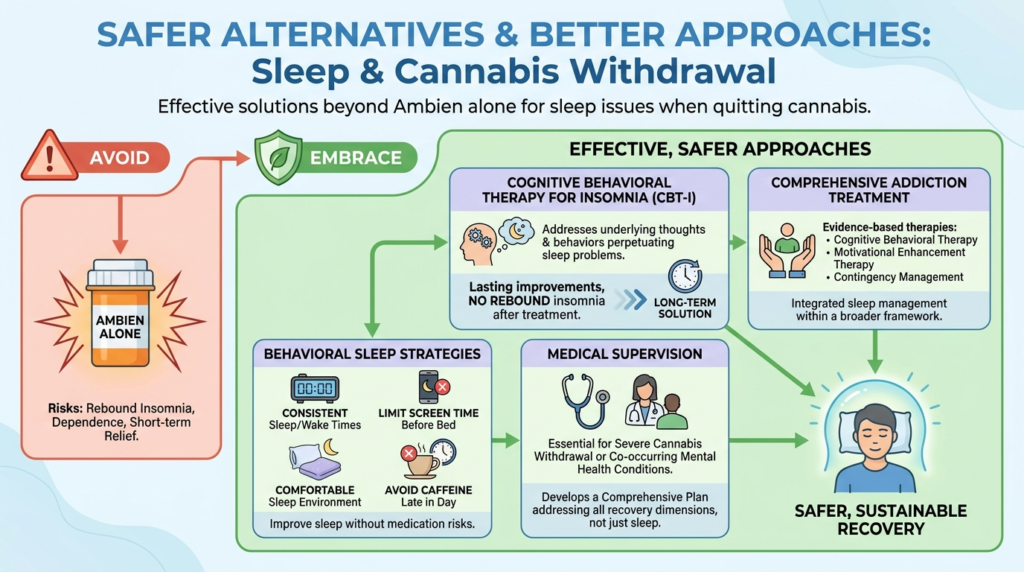
If sleep problems are interfering with your ability to quit cannabis, several approaches may be more effective and safer than relying on Ambien alone:
Cognitive behavioral therapy for insomnia (CBT-I) addresses the underlying thoughts and behaviors that perpetuate sleep problems. Unlike medication, CBT-I produces lasting improvements without rebound insomnia when treatment ends.
Comprehensive addiction treatment that includes evidence-based therapies like cognitive behavioral therapy, motivational enhancement therapy, and contingency management has the strongest support for helping people with cannabis use disorder. Sleep management can be integrated into this broader framework.
Behavioral sleep strategies such as maintaining consistent sleep and wake times, limiting screen time before bed, creating a comfortable sleep environment, and avoiding caffeine late in the day can improve sleep without medication risks.
Medical supervision is essential if you’re experiencing severe cannabis withdrawal or have co-occurring mental health conditions. A treatment provider can help you develop a comprehensive plan that addresses all dimensions of your recovery, not just sleep.
Key Takeaways
- Mixing Ambien and marijuana increases drowsiness, confusion, impaired coordination, and risk of memory blackouts and dangerous behaviors.
- Research shows Ambien improves cannabis withdrawal insomnia in the short term but doesn’t significantly improve abstinence rates when used alone.
- Ambien can impair driving ability the next morning, especially with less than eight hours of sleep or when combined with other substances.
- Cannabis withdrawal is multidimensional, and treating sleep alone doesn’t address the full range of factors that drive continued use.
- Combination approaches that address both sleep and cannabinoid withdrawal show more promise than Ambien monotherapy, though more research is needed.
- Safer alternatives include cognitive behavioral therapy for insomnia and comprehensive addiction treatment programs.
Getting Help With Summit for Cannabis Use Disorder
If you’re struggling with cannabis use and sleep problems are making it harder to quit, you don’t have to face this alone. Our professional treatment can address both the sleep disruption and the underlying patterns that maintain cannabis use.
The Summit Wellness Group offers evidence-based addiction treatment programs that integrate medical support, therapy, and holistic approaches personalized to your individual needs. Our team understands the complex relationship between substance use and sleep, and we can help you develop a comprehensive recovery plan that works for you.