Mixing CBD and alcohol is something millions of people do without thinking twice, yet the science behind what actually happens is more nuanced than most wellness blogs suggest.
The best current human evidence shows that alcohol remains the main driver of intoxication whether or not CBD is present, and a 2023 controlled study found that oral CBD had only trivial effects on breath alcohol levels and subjective intoxication.
This article walks through what the research actually says, where the real risks lie, and how CBD oil and gummies may differ when alcohol is involved.
CBD and Alcohol: What the Research Shows?
The short answer is that combining CBD and alcohol does not create a dramatic new intoxication state, but it is not risk-free either. Alcohol still impairs you, CBD does not reliably cancel that out, and the most credible concern is added sedation rather than a catastrophic toxic reaction.
The direct human evidence is surprisingly thin. Only a handful of controlled studies have actually given people both substances and measured what happens.
The Classic 1979 Study
The most frequently cited early experiment gave 10 healthy volunteers placebo, CBD alone (200 mg), alcohol alone, and CBD plus alcohol in a randomized crossover design.
The results were clear on one point: alcohol caused impairment in motor and psychomotor performance, while CBD alone did not. The combination looked a lot like alcohol alone.
One finding did stand out: blood alcohol levels were lower in the CBD-plus-alcohol condition than in the alcohol-only condition. But that lower reading did not translate into meaningfully better functioning. People were still impaired.
That last detail matters enormously. A lower number on a breathalyzer means nothing if your reaction time and coordination are still off.
The More Important Modern Study
A 2023 placebo-controlled crossover study enrolled 36 heavy-drinking participants who took 30 mg or 200 mg of oral CBD before a standardized alcohol dose. The researchers measured breath alcohol concentration, craving, stimulation, sedation, and subjective alcohol effects across time.
Their conclusion was direct: oral CBD had minimal influence on breath alcohol levels and subjective effects of alcohol. Some small differences in the time-course of stimulation and sedation appeared, but the magnitude was trivial overall.
This study carries more weight than the 1979 work because it used placebo control, crossover randomization, two CBD doses, and a more alcohol-relevant participant group. Its practical message is plain: do not expect CBD to blunt intoxication in any meaningful way.
What Earlier Comparison Studies Found?
Two other controlled human experiments from the same era add useful context. Belgrave et al. found that cognitive, perceptual, and motor deficits were related to alcohol, while CBD was essentially inactive.
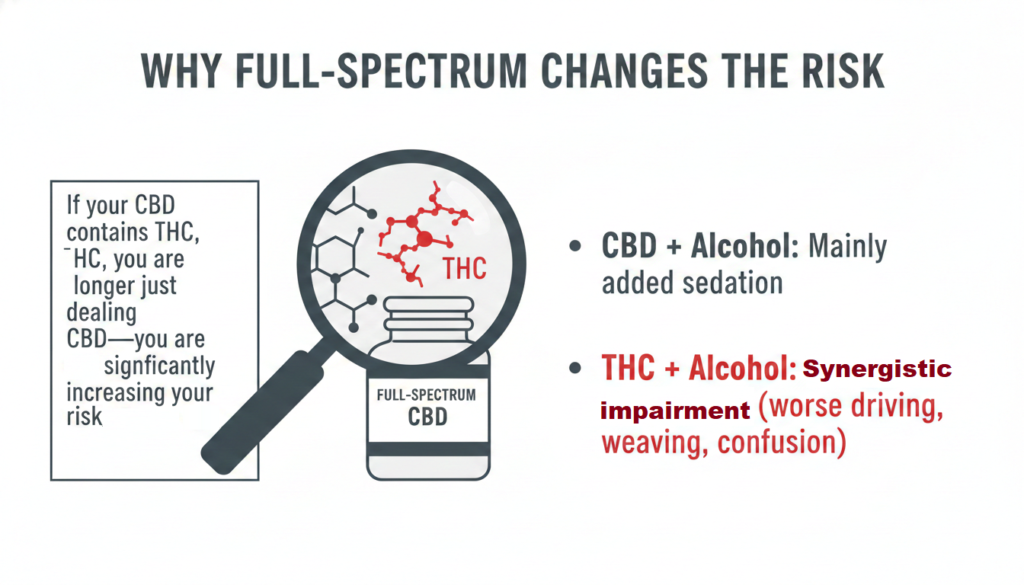
Bird et al. compared CBD, THC, and cannabinol combined with alcohol and found that only THC produced significant synergistic performance declines. CBD did not show the same interaction pattern, as summarized in a systematic review of cannabidiol and alcohol-related outcomes.
This distinction is worth holding onto. CBD is not THC. The fear that CBD plus alcohol behaves like THC plus alcohol is not supported by the controlled human evidence.
The Real Risk: Sedation, Not Toxicity
The most credible acute risk when you mix CBD and alcohol is not a dramatic toxic reaction. It is additive sedation. Both substances can reduce alertness, and layering them together can worsen sleepiness, slow reaction time, and reduce your ability to judge your own impairment.
StatPearls clinical guidance specifically flags that concurrent CBD and alcohol use may enhance CNS depressant effects, including somnolence, and recommends close observation especially during initiation and dose changes.
Prescribing-level summaries for cannabidiol similarly warn that alcohol may worsen dose-related somnolence and advise against driving or operating machinery until effects are known.
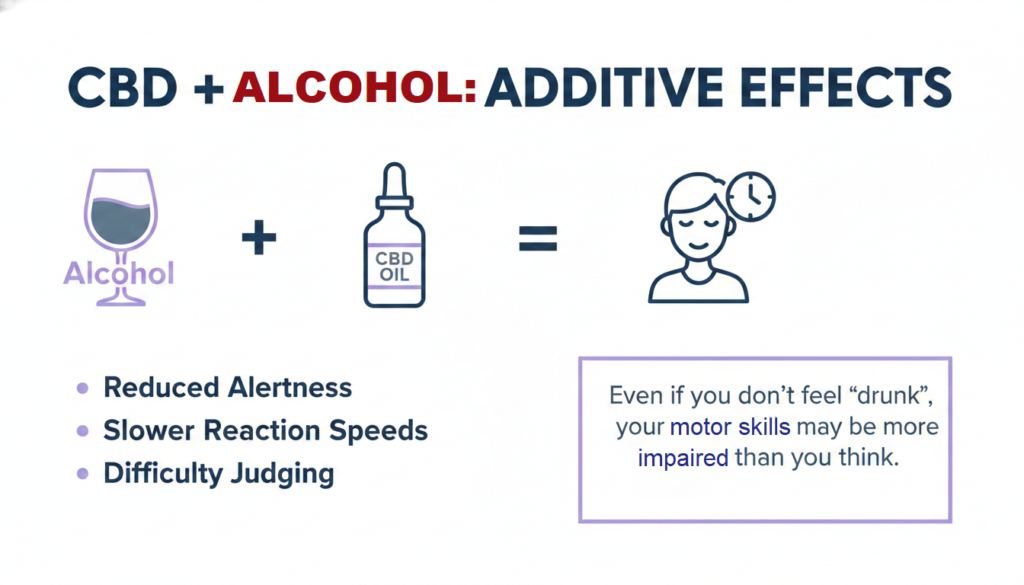
A 2020 systematic review and meta-analysis of randomized clinical trials found that CBD increased the odds of somnolence and sedation compared with placebo, though the strongest signals came from childhood epilepsy populations where CBD was often combined with other medications.
Even so, the broader implication is clear: CBD can be sedating at higher doses, in sensitive individuals, or when combined with other CNS-active substances.
The practical consequences of added sedation include:
- greater sleepiness than expected after one or two drinks
- slower reaction time and worse balance
- reduced ability to judge your own alertness
- higher fall and injury risk
- impaired driving, even if you do not feel obviously drunk
This risk is especially relevant for older adults, people taking benzodiazepines, opioids, sleep medications, or sedating antihistamines, and anyone who needs to drive or work after consuming either substance.
Geriatric pharmacology guidance specifically warns about excessive sedation and advises avoiding coadministration with CNS depressants when possible, as noted in guidance for older adults on cannabis-drug interactions.
CBD Oil and Alcohol vs CBD Gummies and Alcohol
People often ask whether CBD oil and CBD gummies behave differently with alcohol. The honest answer is that the CBD molecule itself does not interact with alcohol in a fundamentally different way depending on whether it comes in a dropper or a chewable square.
What does differ is how the formulation behaves in your body.
Why Formulation Matters More Than the Label?
Oral CBD exposure is highly formulation-dependent. Research on low oral CBD doses found that water-soluble formulations achieved much greater plasma concentrations than standard MCT oil or crystalline powder preparations.
Food also increases CBD plasma concentrations substantially. That means two products labeled “25 mg CBD” can produce very different blood levels depending on the carrier, the delivery system, and whether you have eaten.
Here is how oils and gummies tend to differ in practice when alcohol is involved:
| Feature | CBD Oil | CBD Gummies |
|---|---|---|
| Onset | Potentially faster, especially if held sublingually | Slower and more delayed due to digestion |
| Dose flexibility | Easier to titrate with a dropper | Fixed dose per piece, harder to adjust |
| Food effect | Variable by formulation | Often substantial; eating increases absorption |
| Timing predictability | Somewhat more controllable | More likely to surprise you later |
| Ingredient complexity | Carrier oil, flavorings | Sugars, gelatin, colorants, possible added supplements |
| THC contamination risk | Possible in full-spectrum oils | Possible in full-spectrum gummies |
The biggest practical difference is timing. Gummies are digested before CBD enters your bloodstream, which means onset can be delayed by an hour or more. If you drink while waiting for a gummy to “kick in,” you may end up with more alcohol on board than you intended by the time the CBD effect arrives.
That delayed stacking is a real-world risk that has nothing to do with a unique chemical interaction and everything to do with how edibles work.
Oils may allow slightly more control because you can adjust the dose more precisely and may notice effects somewhat sooner. But swallowed oil is still an oral product subject to first-pass metabolism and food effects. Neither form should be treated as reliably predictable.
Full-Spectrum Products Add Another Variable
Whether a product is full-spectrum, broad-spectrum, or isolate may matter more than whether it is an oil or a gummy. Full-spectrum products can contain low levels of THC. Because THC has clearer evidence of worsening alcohol-related impairment than CBD does, a “CBD” product that contains meaningful THC changes the picture significantly.
If you want to understand what CBD specifically does with alcohol, a THC-free broad-spectrum or isolate product is more interpretable and likely safer from a cognitive impairment standpoint.
Product quality is also a serious concern. A 2024 study of commercially available CBD products found that the majority tested were inaccurately labeled, and some contained heavy metals and pesticides that violated regulatory thresholds.
A mislabeled product may contain more THC than expected, more CBD than expected, or contaminants that change the experience in unpredictable ways. When someone reports an unusual or intense reaction to “CBD and alcohol,” the real explanation may be product quality rather than a unique pharmacological interaction.
Liver Considerations and Drug Interactions
Beyond acute sedation, two deeper concerns deserve attention for people who drink regularly or use CBD at higher doses.
Liver Health
Alcohol is hepatotoxic with chronic use. CBD is also metabolized by the liver and has been associated with elevated liver enzymes in some clinical settings.
A systematic review and meta-analysis found that among participants taking CBD, the pooled proportion of liver enzyme elevations was 7.4%, with drug-induced liver injury at 3.0%. High-dose CBD and concurrent antiepileptic drug use were the main risk factors.
Importantly, no cases were reported in adults using CBD doses below 300 mg per day in that analysis.
For most healthy adults taking a low-dose CBD product and having one or two drinks occasionally, the liver risk is probably not a major concern.
For heavy drinkers, people with existing liver disease, or those using high-dose CBD alongside other medications, the picture is more complicated and warrants medical input.
Drug Interactions
CBD can inhibit several cytochrome P450 enzymes, including CYP2C19 and CYP3A4, which means it can alter how other medications are metabolized. A 2024 systematic review confirmed that CBD and THC can decrease the metabolism of psychotropic agents and other co-administered drugs.
When alcohol is added to that mix alongside a benzodiazepine, an opioid, a sedating antidepressant, or an antiepileptic, the risk picture can worsen through both sedation and altered medication levels.
The combination of CBD, alcohol, and another CNS depressant is where the most serious real-world risk likely lives, not in the simple two-substance pairing most people think about.
What CBD Cannot Do With Alcohol?
It is worth being direct about what the evidence does not support, because several popular claims circulate without good backing.
CBD does not reliably lower blood alcohol levels in a clinically meaningful way. The older signal from 1979 has not been confirmed by modern work.
The 2023 study found only trivial breath alcohol differences, and even the older study showed that lower measured alcohol did not mean less impairment.
CBD does not neutralize alcohol’s psychomotor effects. In every controlled human study, alcohol caused the impairment. CBD did not rescue performance.
CBD does not protect you from making alcohol-related mistakes in real time. Believing it does may actually worsen decision-making by creating false confidence.
And CBD is not a hangover cure. There is no good human evidence that taking CBD before or after drinking reliably reduces next-day symptoms.
Could CBD Ever Help With Alcohol Problems?
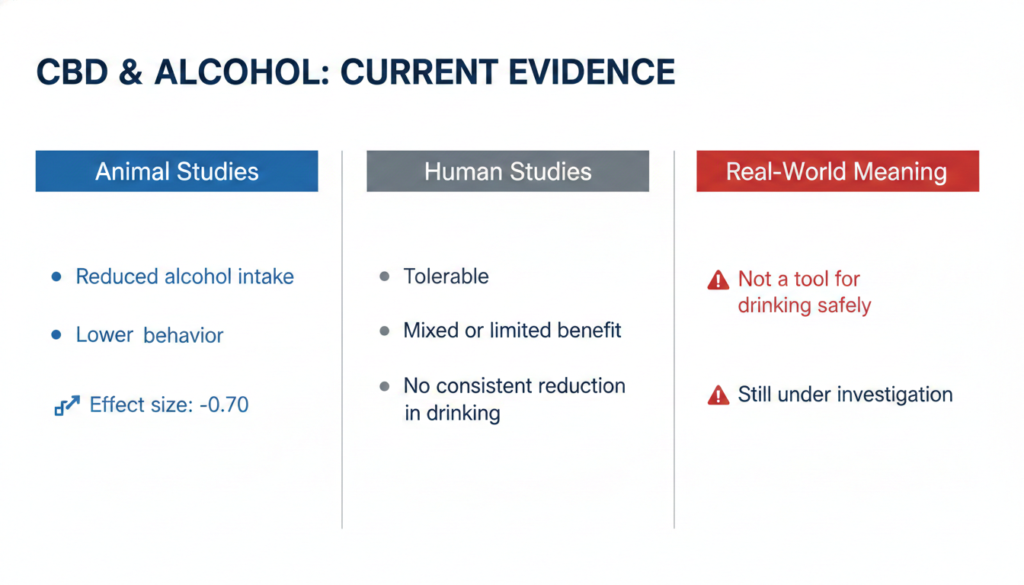
This is a separate and genuinely interesting question, but it is easy to confuse with the acute co-use question. Preclinical research in animals suggests CBD may reduce alcohol intake, relapse-like behavior, withdrawal severity, and alcohol-related liver and brain injury.
A 2026 translational systematic review and meta-analysis reported a pooled effect size suggesting CBD reduces alcohol intake in animal models, with a standardized mean difference of -0.70 (95% CI -1.07 to -0.34).
Human AUD research is emerging but not yet mature. A 2025 proof-of-concept trial in AUD patients found tolerability but no clear evidence for efficacy across two randomized trials.
A separate 2025 preliminary randomized trial of hemp-derived CBD in AUD found some signals of improvement in craving and AUD symptoms in some conditions, though drinking outcomes were not consistently changed.
These findings point toward possible supervised therapeutic use in the future, not toward casual co-use during drinking. A compound may eventually help treat a condition under controlled dosing while still being a poor choice for simultaneous recreational use.
Those are two different questions, and conflating them leads to bad decisions.
Practical Guidance Based on the Evidence
If you want the lowest-risk approach, do not use CBD and alcohol at the same time. Separate them by enough time that peak effects do not overlap, and do not drive or do anything safety-sensitive if you have taken both.
If you choose to combine them anyway, the evidence-based steps to reduce risk are:
- Keep both doses low
- Use a verified, third-party-tested product to reduce the chance of hidden THC or contaminants
- Avoid all other sedating substances that day if possible
- Do not drive, cycle in traffic, swim, or use machinery
- Eat something, since alcohol effects are less predictable on an empty stomach
- Watch for unusual drowsiness, dizziness, or imbalance
- Be especially cautious if you have liver disease, sleep apnea, are older, or take interacting medications
Co-use is especially inadvisable before driving, while using benzodiazepines or opioids, during illness or sleep deprivation, during pregnancy, or when the product source is uncertain.
Why Alcohol’s Baseline Risk Matters Here?
Any honest discussion of CBD and alcohol has to acknowledge that alcohol itself is not a neutral starting point. The CDC notes that even moderate drinking may increase the risk of death and other alcohol-related harms compared with not drinking at all.
International public health guidance has moved further in that direction, with some bodies stating that no safe amount of alcohol can be identified for health.
Adding CBD to alcohol therefore happens on top of an already non-trivial risk exposure. The question is not just whether CBD makes alcohol more dangerous. It is whether CBD makes alcohol safer, and the current human evidence says it does not.
The Bottom Line on CBD and Alcohol
Mixing CBD and alcohol is not proven to be catastrophically dangerous in every instance, but it is also not proven to be safe or beneficial.
The most defensible summary of the current evidence is this: alcohol drives the acute experience, CBD does not reliably change intoxication or protect performance, and the most plausible real-world risk is added sedation that worsens safety-sensitive activities.
CBD oil and CBD gummies are not fundamentally different in how they interact with alcohol at the molecular level. The practical differences come down to timing, absorption, dose predictability, and product quality.
Gummies are more likely to produce delayed and unpredictable effects when combined with drinking. Oils may be somewhat easier to dose carefully. Neither should be treated as a tool for managing intoxication.
If you are using CBD regularly and also drinking, and you are concerned about how those habits interact with each other or with medications you take, that conversation is worth having with a clinician who knows your full health picture.
If alcohol use has become something you are struggling to manage on your own, professional support can make a real difference. Reach out to alcohol addiction treatment to learn about evidence-based options that can help.