Mixing ketamine and alcohol creates a dangerous polysubstance combination that can overwhelm your central nervous system, suppress breathing, and increase overdose risk.
Public health authorities explicitly warn against combining these substances because the interaction substantially increases the chance of severe harm.
This article explains what happens when ketamine and alcohol interact, why the combination is medically concerning, and what the evidence shows about both recreational co-use and therapeutic ketamine in alcohol treatment settings.
What Happens When You Mix Ketamine and Alcohol?
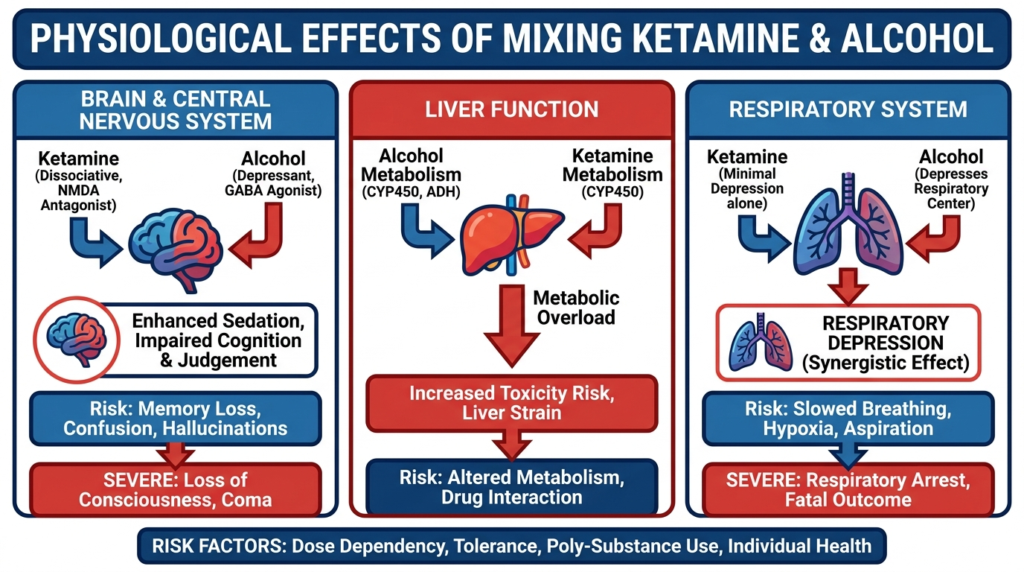
Ketamine and alcohol both affect your brain’s glutamate signaling pathways, particularly through NMDA receptors. When you take them together, their overlapping effects on consciousness, coordination, and vital functions can amplify in unpredictable ways.
The most directly relevant research review on this combination concludes that ketamine plus alcohol may place users’ lives at risk through harmful interactions affecting multiple organ systems.
The danger is not limited to feeling more intoxicated. Ketamine produces dissociation, altered perception, and impaired judgment, while alcohol adds sedation, disinhibition, and motor impairment.
Together, these effects create a state where you may lose awareness of your surroundings, fail to recognize danger, or become unable to protect your airway if you vomit. The UK Advisory Council on the Misuse of Drugs states that overdose risk substantially increases when ketamine is combined with depressants such as alcohol.
Beyond acute intoxication, repeated co-use may contribute to cumulative organ damage. Both substances independently stress the liver, and ketamine has been linked to bile duct injury and cholestatic liver problems in chronic users.
Alcohol’s well-known hepatotoxicity combined with ketamine’s emerging liver risk profile creates a plausible pathway for accelerated harm, especially in heavy or frequent users.
The Immediate Risks of Ketamine and Alcohol Interaction
Impaired Consciousness and Judgment
The most immediate danger when mixing alcohol and ketamine is severe impairment of your ability to think clearly, move safely, or respond to emergencies. Ketamine can produce profound dissociation where you feel detached from your body or surroundings.
Alcohol impairs reaction time, balance, and decision-making. When these effects combine, you face sharply increased risk of:
- Accidental injury from falls or collisions
- Drowning in water environments
- Aspiration if you vomit while unconscious
- Inability to seek help or communicate distress
- Sexual victimization or unsafe situations
- Dangerous redosing because you misjudge your level of intoxication
Public health guidance emphasizes that you should never use ketamine alone and should avoid settings where intoxication could expose you to injury, drowning, or violence. The combination with alcohol makes these scenarios more likely and more dangerous.
Respiratory Depression
While ketamine at therapeutic doses is sometimes described as preserving respiratory drive better than some sedatives, that reassurance does not extend to mixed intoxication scenarios. In real-world co-use, doses may be high, alcohol intake may be heavy, and other depressants may also be present.
The respiratory system is flagged as one of the key areas of concern in ketamine-alcohol co-exposure.
Respiratory risk increases when:
- You are lying on your back and cannot reposition yourself
- Vomiting occurs and stomach contents enter the airway
- Multiple depressants are combined
- You are in an unsupervised setting with no one to monitor breathing
Even if ketamine alone might not severely suppress breathing at lower doses, the addition of alcohol changes the risk equation. Treatment guidance for esketamine, the pharmaceutical form of ketamine, warns that concomitant CNS depressants increase respiratory risk and warrant closer monitoring.
Cardiovascular Stress
Ketamine can cause tachycardia, elevated blood pressure, palpitations, and chest pain, effects that have been documented in emergency service reports. Alcohol adds its own cardiovascular burden, including arrhythmia risk, blood pressure variability, and dehydration. The combination may be especially dangerous if you have underlying heart disease, hypertension, or a history of arrhythmias.
The ketamine-alcohol review specifically notes that mixed exposure may plausibly increase severe cardiovascular outcomes including arrhythmias and cardiomyopathy-related decompensation.
This risk is often underappreciated compared to overdose concerns, but it matters particularly for older adults, people with cardiovascular disease, and those mixing ketamine, alcohol, and stimulants in nightlife settings.
Long-Term Organ Damage From Repeated Co-Use?
Liver and Bile Duct Injury
One of the clearest emerging harms from chronic ketamine exposure is hepatobiliary toxicity. Recent research shows that ketamine can cause cholestatic liver enzyme abnormalities, bile duct injury, biliary dilatation, fibrosis, and in severe cases cirrhosis. A 2025 review found that liver injury prevalence was about 9.8% among chronic ketamine users in one study.
Importantly, this liver toxicity is not limited to recreational abuse. Medically supervised ketamine can also cause hepatobiliary adverse events, including cases of biliary dilatation and cirrhosis in patients receiving repeated therapeutic infusions.
Animal studies have shown that long-term ketamine plus alcohol treatments produced liver and kidney damage, supporting the concern that co-use may amplify hepatotoxic risk.
If you drink heavily or have existing liver disease, repeated ketamine exposure adds a second hepatotoxic burden. The combination is especially concerning for people with alcohol-related liver damage who might encounter ketamine in treatment or recreational settings.
Bladder and Urinary Tract Toxicity
Ketamine-induced cystitis is one of the most recognized chronic harms of heavy ketamine use. Symptoms include urinary urgency, frequency, painful urination, nighttime urination, and in severe cases incontinence, blood in urine, bladder fibrosis, and kidney failure.
Research shows that urinary symptoms can be seen in over 25% of recreational ketamine users, with risk correlated to dose and frequency.
While therapeutic ketamine appears to carry lower bladder risk than heavy recreational use, the first reported case of ketamine-induced cystitis during treatment-dose ketamine for depression was published in 2024. Long-term esketamine data show low rates of serious urinary problems, but some lower urinary tract symptoms such as dysuria, frequent urination, and urgency do occur.
Alcohol may worsen the practical risk environment for bladder injury by contributing to dehydration, delaying recognition of early symptoms, and sustaining heavier overall ketamine consumption patterns.
If you are using ketamine repeatedly, whether recreationally or in treatment, staying hydrated and monitoring for urinary symptoms is important.
Neurocognitive Consequences
Long-term ketamine exposure has been associated with memory impairment, executive dysfunction, persistent dissociative symptoms, reduced grey matter volume, and altered brain connectivity in recreational users.
Alcohol independently contributes to cognitive decline, and polysubstance use more broadly is linked to compounded neurocognitive burden.
The ketamine-alcohol review identifies the neurocognitive system as one area where synergistic toxicity is plausible. If you use both substances frequently, you may experience disproportionately worse outcomes in memory, attention, and decision-making compared to using either substance alone.
Ketamine as a Treatment for Alcohol Use Disorder
A separate but important research branch examines ketamine not as a substance to mix with alcohol, but as a potential treatment for alcohol use disorder.
This distinction is critical because therapeutic ketamine studies do not endorse drinking during treatment. Instead, they evaluate ketamine as a structured intervention intended to reduce subsequent alcohol use.
Evidence for Therapeutic Benefit
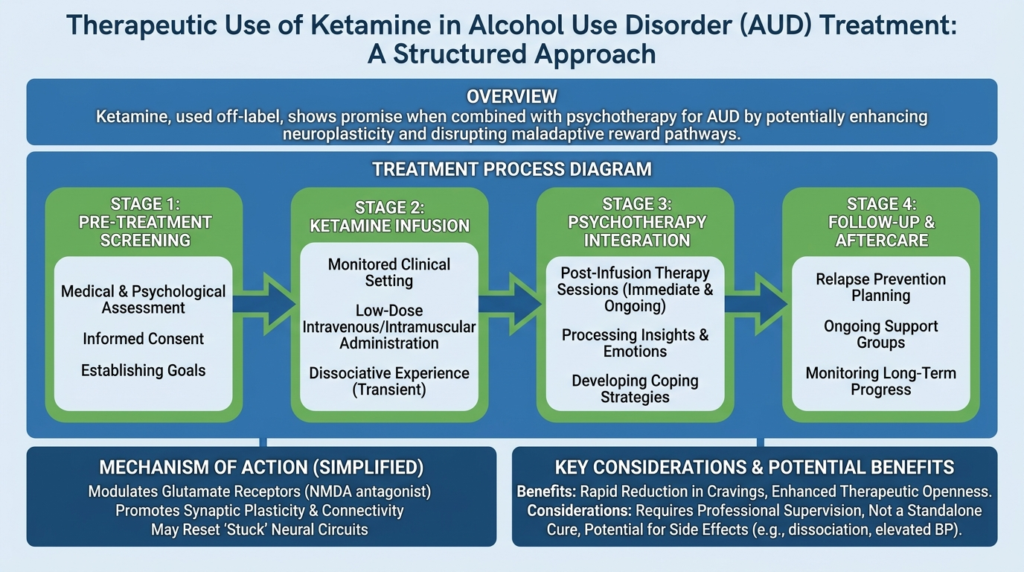
A 2023 systematic review of 11 studies involving 854 adults concluded that ketamine may lower the probability of alcohol use, reduce heavy drinking days, and increase post-infusion abstinent days. The most favorable outcomes occurred when ketamine was combined with psychotherapy rather than given alone.
The strongest modern trial is a phase 2 randomized controlled study of 96 patients with severe alcohol use disorder. Participants received three weekly ketamine infusions paired with either psychological therapy or alcohol education.
The study found that ketamine was associated with significantly more abstinent days at six months, with the greatest reduction in drinking outcomes appearing in the ketamine plus therapy group. Treatment was well tolerated with no serious adverse events attributed to the study drug.
Another pilot trial showed that a single ketamine infusion combined with motivational enhancement therapy increased abstinence and prolonged time to relapse over 21 days compared to a midazolam control. Among those followed, 75% in the ketamine group were abstinent at six months compared with 27% in controls.
How Therapeutic Ketamine May Work?
Ketamine’s potential benefit in alcohol use disorder likely stems from its effects on brain plasticity and learning. As an NMDA receptor antagonist, ketamine triggers downstream increases in AMPA-mediated neurotransmission and synaptic plasticity. This creates a temporary window during which behavioral interventions may be more effective.
Research also suggests that ketamine can weaken maladaptive alcohol reward memories when administered during a specific reconsolidation window after memory reactivation.
A sophisticated human study found that ketamine given immediately after retrieval of maladaptive alcohol reward memories reduced alcohol’s reinforcing effects and produced lasting reductions in drinking days and volume for up to nine months. This effect occurred only when memory retrieval preceded ketamine, not when ketamine was given alone.
Why Treatment Evidence Does Not Mean Co-Use is Safe?
The therapeutic literature on ketamine for alcohol use disorder should not be misinterpreted as evidence that drinking during ketamine use is acceptable. Treatment studies generally exclude active heavy drinking, use controlled dosing, provide medical supervision, and pair ketamine with structured psychotherapy. These safeguards are absent in recreational co-use scenarios.
Clinical practice guidance often recommends excluding active substance abuse, including alcohol, when considering ketamine therapy. Baseline toxicology screening may be warranted, and patients are typically advised to avoid alcohol and other depressants around treatment sessions.
The distinction is straightforward: ketamine may help some people reduce their drinking when used as a carefully supervised medical intervention, but that does not make the combination of ketamine and alcohol safe in uncontrolled settings.
Who is at Highest Risk?
Certain groups face particularly elevated danger from ketamine and alcohol interactions:
Heavy drinkers and people with alcohol use disorder carry elevated liver vulnerability, higher likelihood of repeated co-use, and impaired judgment about dosing. They may also experience overlapping depression and suicidality that increases risk.
People with cardiovascular disease face compounded risk from ketamine-related hypertension and tachycardia combined with alcohol-related arrhythmia risk. Those with underlying heart conditions, hypertension, or cardiomyopathy may experience dangerous decompensation.
Young adults in nightlife settings encounter high environmental accident risk, uncertain drug purity and dosing, delayed emergency response, and frequent co-use with additional substances such as stimulants or other depressants.
Individuals with substance use disorder histories may be more vulnerable to misuse, redosing, tolerance-based escalation, and moving from therapeutic exposure to nonmedical experimentation.
People with existing liver disease have reduced tolerance for repeated ketamine exposure, and the combination with alcohol may accelerate hepatobiliary injury.
Psychiatric patients receiving ketamine treatment who continue drinking may appear to be in treatment yet remain exposed to CNS and respiratory risk on dosing days, reduced therapeutic benefit, and greater cumulative organ burden.
What Public Health Guidance Says?
The UK Advisory Council on the Misuse of Drugs issued updated ketamine guidance in 2026 that directly addresses polysubstance risk. The report concludes that ketamine-related harms have increased and provides specific harm-reduction recommendations for users.
Key advice includes:
- Do not use ketamine alone
- Start with small, pre-measured test doses
- Space out doses and episodes, ideally limiting sessions to at least every four weeks
- Avoid risky environments such as water, heights, or isolated locations
- Strongly avoid concurrent depressants such as alcohol, opioids, or benzodiazepines because overdose risk substantially increases
The guidance also emphasizes early recognition of urinary symptoms and the need for clinician education, since young adults with recurrent urinary complaints may not volunteer ketamine use unless asked sensitively.
This public health position carries weight because it synthesizes evidence with real-world feasibility. Where peer-reviewed evidence is incomplete, strong and recent government guidance becomes more important, not less.
What the Evidence Shows and What It Does Not?
The current state of knowledge on ketamine and alcohol is uneven but decisive. Direct human evidence on the combination remains limited, yet multiple research branches converge on the same practical conclusion: this combination is risky in ways that are biologically plausible, clinically credible, and increasingly recognized by health authorities.
The strongest direct review identifies plausible synergistic toxicity in neurocognitive, respiratory, cardiovascular, hepatobiliary, and urinary systems. Newer research shows that ketamine alone has more serious chronic organ risks than once appreciated, including under some medically supervised conditions. Government guidance now explicitly warns against combining ketamine with alcohol.
At the same time, ketamine’s emerging therapeutic role in alcohol use disorder introduces important nuance. Carefully administered ketamine, especially when paired with psychotherapy, may improve abstinence and reduce craving in structured treatment settings.
But this therapeutic promise does not weaken the case against ketamine-alcohol co-intoxication. It strengthens the need to distinguish structured treatment from uncontrolled use.
What we can expect from future research is not a dramatic reversal of current caution but a more detailed map of risk: better dose-response data, better identification of vulnerable subgroups, better surveillance systems, and better integration of addiction medicine with ketamine psychiatry.
Until then, the prudent and evidence-based stance is clear: ketamine plus alcohol is a combination with enough evidence of danger to merit firm avoidance, especially outside supervised medical care.
Getting Help for Substance Use
If you or someone you care about is struggling with alcohol use, polysubstance use, or concerns about ketamine and alcohol interactions, our professional support can make a meaningful difference. The Summit Wellness Group’s evidence-based treatment combines medical care, behavioral therapy, and holistic support personalized to your individual needs and circumstances.
Reach out today to learn more about Summit’s addiction treatment programs that integrate medical expertise, compassionate care, and proven therapies to support lasting recovery.