Mixing Lexapro and alcohol is something many people on escitalopram wonder about, especially in social situations.
The short answer is clear: official prescribing guidance states that alcohol use with escitalopram is not recommended, and patient instructions go further by saying do not drink alcohol while using this medication.
This article explains why that guidance exists, what the real risks are, and what to do if you are already taking Lexapro and want honest answers.
Lexapro and Alcohol: What the Official Guidance Says?
Lexapro is the brand name for escitalopram, a selective serotonin reuptake inhibitor (SSRI) prescribed for major depressive disorder and generalized anxiety disorder.
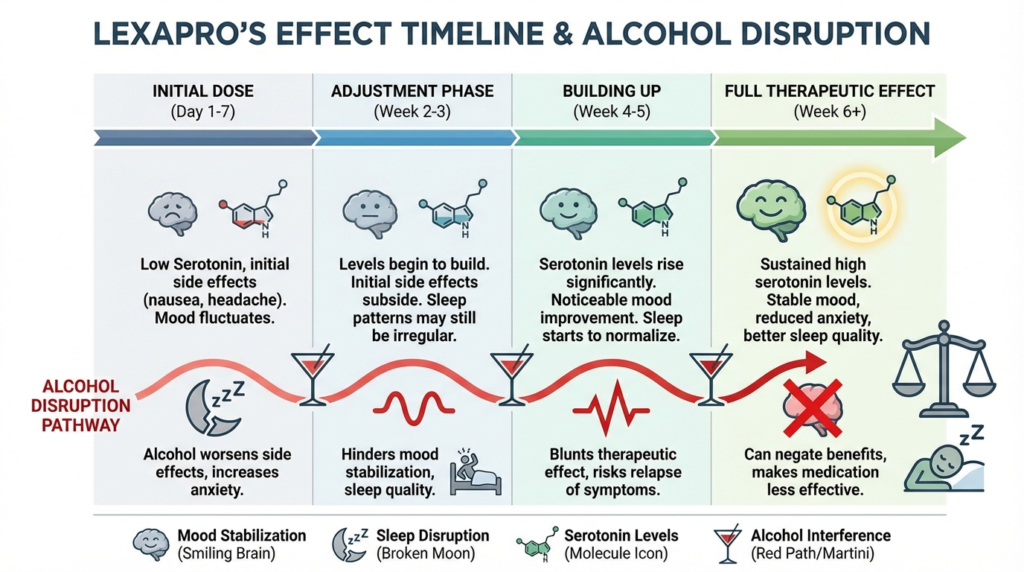
It works by blocking serotonin reuptake in the brain, which gradually improves mood and reduces anxiety over several weeks of consistent daily use.
The FDA-linked prescribing information is direct on the alcohol question. One patient instruction document states plainly: “Do not drink alcohol while using Escitalopram Tablets.”
The full Lexapro prescribing information adds that although Lexapro did not potentiate the cognitive and motor effects of alcohol in a clinical trial, use of alcohol by patients taking Lexapro is still not recommended.
That last point confuses a lot of people. If a study showed no potentiation, why does the warning still stand? The answer is that the trial tested healthy volunteers on specific cognitive and motor tasks.
It did not test people with active depression or anxiety, and it did not measure whether alcohol worsens the underlying condition, disrupts sleep, or makes it harder to tell whether the medication is working. The regulatory position reflects the full clinical picture, not just one lab result.
WebMD’s review captures this well: despite the trial finding, the FDA still recommends not mixing the two because drinking while on escitalopram can increase side effects such as drowsiness, reduced alertness, and impaired coordination, and can keep the antidepressant from working effectively.
The Real Risks of Mixing Lexapro and Alcohol
The most important risks are not dramatic toxicology events in every person. They are functional, psychiatric, and treatment-related. Here is what the strongest evidence actually supports.
Increased Drowsiness, Dizziness, and Impaired Coordination
This is the most consistently reported effect across reliable sources. Alcohol can make a person feel drowsy, less alert, and less coordinated while taking escitalopram, even if they do not feel unusually intoxicated.
That matters practically for driving, operating machinery, caring for children, and making decisions under pressure.
Worsened Depression and Anxiety
Alcohol is a central nervous system depressant that can worsen the very conditions Lexapro is meant to treat. Healthline notes that alcohol can increase anxiety and worsen depression in people taking Lexapro. This is not a minor side note.
If someone drinks regularly while on an antidepressant, they may feel worse and wrongly conclude the medication is not working, when alcohol is the actual problem.
Impaired Judgment
WebMD explicitly flags that judgment may be affected, potentially leading to unwise or dangerous decisions. This concern is heightened in people with depression, anxiety, panic symptoms, or any history of impulsivity.
Interference With Treatment Assessment
One of the most clinically significant but underappreciated risks is that alcohol makes it harder to evaluate whether Lexapro is helping. Alcohol temporarily alters mood, disrupts sleep, and worsens next-day anxiety.
If someone is drinking during the first weeks of treatment or around a dose change, they may not be able to tell whether the medication is working, causing side effects, or simply being undermined by alcohol.
Suicidality Risk in Vulnerable People
Lexapro carries a boxed warning about clinical worsening and suicidality, especially during the initial months of therapy or at times of dose changes. Alcohol lowers inhibitions and can worsen mood, which raises concern in anyone already being monitored closely.
Healthline notes that because alcohol can worsen depression, it can also increase suicide risk, especially in younger individuals and during early treatment.
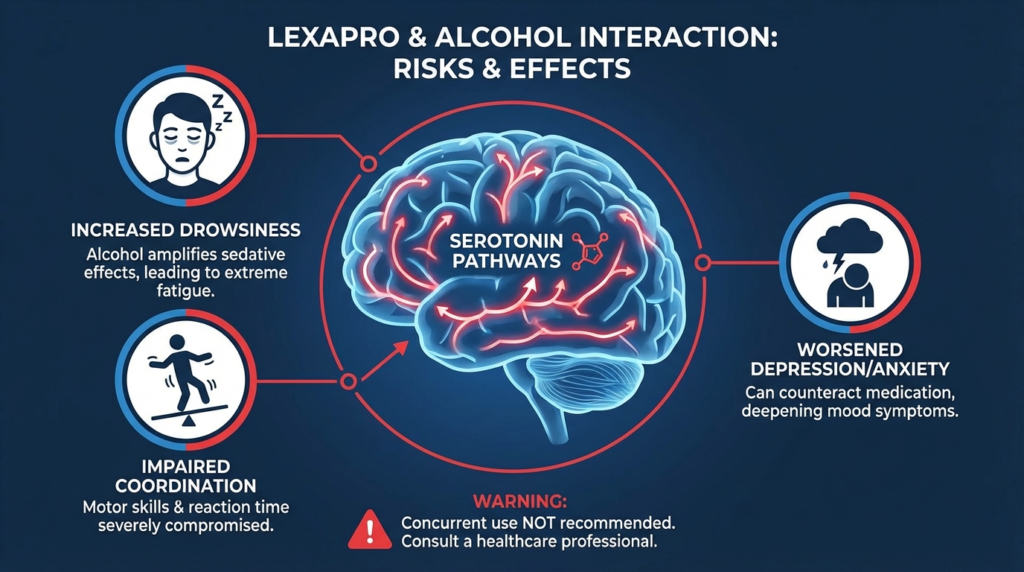
Lexapro and Alcohol Side Effects: A Summary
The following are the best-supported concerns when combining Lexapro and alcohol, drawn from official prescribing information and medically reviewed sources:
- Drowsiness and sedation, even without feeling unusually drunk
- Reduced alertness relevant to driving and safety-sensitive tasks
- Impaired coordination and increased risk of falls or accidents
- Impaired judgment and potential for poor decisions
- Worsening of anxiety or depression symptoms
- Difficulty evaluating whether Lexapro is working as intended
- Disrupted sleep, which can worsen both depression and anxiety the following day
Can You Skip a Dose of Lexapro to Drink?
No! This is one of the clearest practical points in the evidence, and it is worth stating directly.
WebMD states explicitly: “Never temporarily stop taking an antidepressant so you can drink alcohol. You need to take these drugs consistently for them to be effective. Stopping and starting could make your anxiety or depression symptoms worse.”
The pharmacokinetics make the logic of skipping even weaker. Escitalopram has a half-life of about 27 to 32 hours, meaning roughly half of the drug may still be in your body the day after a missed dose. Full clearance can take up to a week.
Skipping one dose does not make you medication-free. It does not reliably remove the alcohol interaction risk. What it does do is introduce new problems.
Missing a dose can trigger discontinuation-type symptoms in sensitive individuals, including dizziness, nausea, headache, irritability, and anxiety.
These symptoms overlap directly with alcohol side effects, making it harder to know what is causing what. MedlinePlus warns that suddenly stopping escitalopram may produce mood changes, agitation, nausea, dizziness, and confusion, among other effects.
The bottom line: skipping Lexapro to drink is a poor trade. It may not prevent alcohol-related risks, and it adds new ones.
Can You OD on Lexapro and Alcohol?
Severe outcomes from combining Lexapro and alcohol are possible, though the evidence does not support the claim that every single drink causes a medical emergency. The more realistic concern is a spectrum of harm.
At the serious end, combining alcohol with escitalopram in large amounts can increase the risk of dangerous impairment, severe confusion, and mood destabilization.
In people with bipolar vulnerability, prescribing information notes that escitalopram may precipitate a manic or hypomanic episode, and alcohol can worsen sleep and judgment in ways that increase that risk.
Seek urgent medical help if you or someone else experiences severe confusion, inability to stay awake, fainting, chest pain, uncontrollable vomiting, seizure, or any thoughts of self-harm after combining Lexapro and alcohol.
Who Should Be Especially Careful?
While complete alcohol avoidance is the best default for anyone on Lexapro, some groups face higher risk and should be especially firm about avoiding it:
- People who just started Lexapro or recently changed their dose
- Anyone who already feels drowsy, dizzy, or foggy on the medication
- People whose depression or anxiety is not yet well controlled
- Young adults or anyone under closer monitoring for suicidality
- People taking other sedating medications such as benzodiazepines or sleep aids
- Anyone with liver disease, since escitalopram clearance is reduced in hepatic impairment
- People with a history of alcohol misuse or difficulty controlling drinking
What to Do If You Already Drank While on Lexapro?
If you drank while taking Lexapro, the most important steps are practical. Stop drinking further.
Do not drive or do anything that requires sharp coordination or judgment. Stay with someone if you feel impaired. Monitor your mood and mental state over the next day or two.
Do not double your next Lexapro dose to compensate. NAMI advises that if a dose is missed, patients should take it when remembered unless it is close to the next scheduled dose, and should never double up.
If symptoms are severe or you have any thoughts of self-harm, seek urgent medical care.
The Nuance Worth Knowing
The evidence does not support the claim that every person who has one drink on Lexapro will suffer a dangerous medical emergency.
Some clinicians acknowledge that a small subset of stable, low-risk adults may tolerate rare light drinking without obvious acute harm.
WebMD notes that some doctors think moderate drinking may be acceptable for some SSRI users, but stresses that patients should first know how escitalopram affects them, drink slowly and with food, and always talk to their doctor before drinking while on an antidepressant.
That nuance does not change the general recommendation. The fact that some people may tolerate occasional light drinking does not make it advisable as a default. Official guidance says alcohol is not recommended, and the safest, most treatment-consistent choice is to avoid it completely.
If alcohol matters to your lifestyle and you want an honest conversation about your individual risk, that discussion belongs with your prescribing clinician, not in a self-experiment during early treatment or a dose change.
Why This Matters for Your Recovery?
Lexapro is a maintenance medication. It depends on consistent daily use to maintain stable serotonin levels and deliver its therapeutic benefit. Alcohol works against that stability in multiple ways: it worsens the conditions being treated, disrupts sleep, impairs judgment, and makes it harder to assess whether treatment is working.
The most evidence-based recommendation is straightforward. Avoid alcohol completely while taking Lexapro. If you are struggling with alcohol use alongside depression or anxiety, that combination deserves proper clinical attention, not a workaround.
If alcohol and mental health are both part of the picture for you or someone you care about, speaking with a specialist at The Summit Wellness Group can help you find a path that addresses both at once. So, reach out to us and find your path to recovery today!