Many people with ADHD wonder whether marijuana might help their symptoms or if it’s safe to use alongside their medications.
The reality is more complicated than most expect. Research shows that marijuana use, especially during adolescence, is linked to significantly higher rates of mental health problems, including worsening ADHD symptoms and increased risk of psychotic and mood disorders.
While some individuals report feeling calmer after using cannabis, studies consistently find that it does not improve attention, executive function, or core ADHD impairments, and may actually make them worse.
This article explains what the science says about marijuana and ADHD, the risks of combining cannabis with ADHD medications, and what treatment approaches actually work.
Why People With ADHD Are More Likely to Use Marijuana?
ADHD is not just a childhood disorder. Research tracking children with ADHD into adulthood found that roughly 90% showed fluctuating symptoms and impairment patterns, with only about 9% achieving sustained remission into young adulthood.
This persistence matters because ADHD-related impulsivity, emotional dysregulation, and self-regulation deficits can increase vulnerability to substance use across adolescence and early adulthood.
The connection between ADHD and cannabis is particularly strong. One study reported that individuals with ADHD had an odds ratio of 7.9 for lifetime cannabis use compared to peers without ADHD.
Longitudinal data from the Multimodal Treatment Study of ADHD showed that by adulthood, those with childhood ADHD had weekly marijuana use rates of 32.8% versus 21.3% in the comparison group, and cannabis use disorder rates of 18.9% versus 11.3%.
Importantly, ADHD does not equally elevate risk for all substances. The same research found higher rates of marijuana and cigarette use in adults with childhood ADHD, but not clear increases in heavy alcohol use, cocaine, or other street drugs.
This specificity suggests that cannabis and nicotine warrant special attention in ADHD populations.
Earlier Initiation and Faster Escalation
People with ADHD tend to start using substances earlier and progress to regular use faster than their peers. In the MTA cohort, children with ADHD were more likely to be early substance users in adolescence—57.6% versus 40.3%, with younger first use of alcohol, cigarettes, marijuana, and illicit drugs.
Early adolescent initiation predicted faster escalation and more adult substance use in both ADHD and comparison groups, suggesting that early exposure is a key pathway by which ADHD increases later cannabis-related problems.
The Self-Medication Myth: Does Marijuana Help ADHD Symptoms?
Many people with ADHD report using cannabis to manage restlessness, anxiety, insomnia, or emotional distress. Some describe feeling calmer or less hyperactive after using marijuana. However, subjective relief is not the same as objective cognitive improvement.
The largest randomized controlled trial review of medicinal cannabis for mental health screened 5,774 studies and included 54 RCTs with 2,477 participants. The conclusion was clear: there is no convincing evidence that cannabis works as a primary treatment for depression, anxiety, PTSD, or most other mental disorders.
What the Research Actually Shows?
A systematic review and meta-analysis of cannabinoids for mental disorders found that pharmaceutical THC with or without CBD showed no significant effect on depression symptoms.
For anxiety, the evidence was rated very low quality, with only a small reduction in anxiety symptoms, and those findings came mostly from patients whose anxiety was secondary to another medical condition, not from people with primary anxiety disorders.
Chronic cannabis use is associated with deficits in the same cognitive domains that define ADHD: attention, working memory, executive functioning, and motivation.
Reviews warn that while cannabis may reduce the appearance of psychomotor activation, it can compound inattention and cognitive inefficiency, especially with ongoing use.
This creates a dangerous gap: patients may feel calmer or less distressed while their functioning in planning, memory, sustained attention, and task completion worsens or fails to improve.
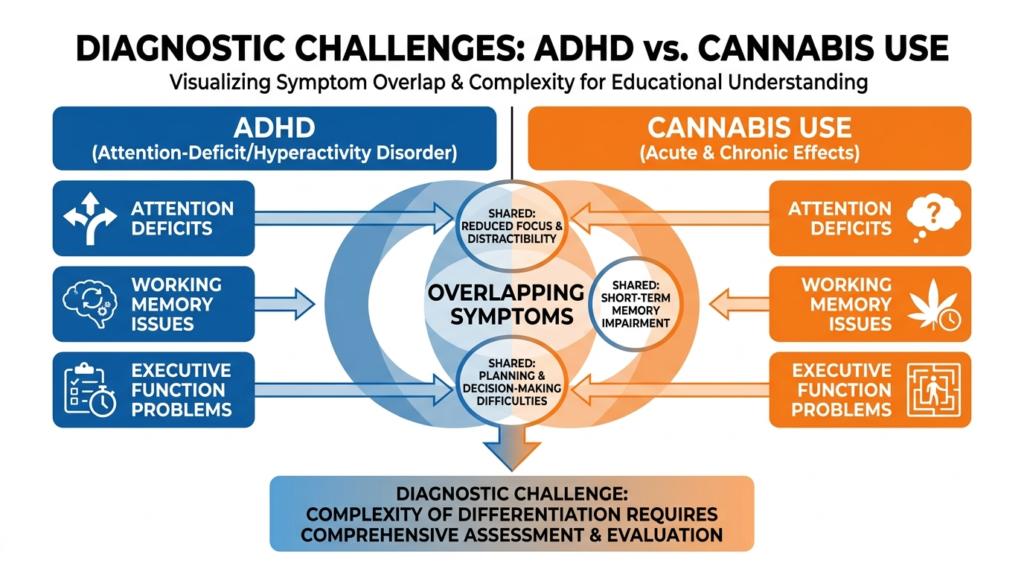
Overlapping Symptoms: Why Diagnosis is So Difficult?
One of the biggest challenges in treating people with both ADHD and cannabis use is that the two conditions can look remarkably similar. Both affect:
- Attention and concentration
- Working memory
- Executive function
- Response inhibition
- Motivation and goal-directed behavior
Clinicians must determine whether neurocognitive deficits are cannabis-induced, true ADHD, or both. This is not a minor issue. Since both conditions affect executive function, screening tools alone are especially vulnerable to false positives in active cannabis users.
Cannabis Withdrawal Adds Another Layer of Confusion
In adults with comorbid ADHD and cannabis dependence, 96% reported at least one withdrawal symptom and 30% met DSM-5 criteria for cannabis withdrawal syndrome.
Symptoms include concentration problems, irritability, restlessness, and sleep disturbance, all of which overlap with ADHD symptoms.
This means that during early abstinence, these symptoms should not be overinterpreted as proof of ADHD persistence or worsening. They may simply reflect ordinary cannabis withdrawal.
How to Diagnose ADHD When Cannabis Use is Present?
Proper diagnosis of ADHD in the context of cannabis use requires much more than a positive screening questionnaire. The evidence strongly rejects a shortcut approach.
Essential Diagnostic Components
Childhood onset is non-negotiable. ADHD diagnosis in adults requires evidence that symptoms were present before age 12.
This criterion is particularly valuable when cannabis use is involved because cannabis-related attention problems usually emerge after initiation, whereas ADHD is developmental.
When patients do not recall childhood symptoms well, clinicians should gather:
- A careful developmental history
- School or report card data if available
- Parent or caregiver history
- Partner input
- Old records documenting inattentiveness, impulsivity, disorganization, or behavioral concerns
Screening is not diagnosis. A positive Adult ADHD Self-Report Scale or other screener does not diagnose ADHD, especially in patients with substance use disorder or chronic cannabis use. The Adult ADHD Assessment Quality Assurance Standard recommends a full diagnostic interview by a trained specialist, using structured interviews such as DIVA, CAADID, or ACE+.
Collateral information improves accuracy. Self-report may be distorted by recall bias, limited insight, intoxication effects, withdrawal, or self-medication narratives. Partner completion of rating scales and input from family or close friends can significantly improve diagnostic accuracy.
Neuropsychological testing can inform but not replace clinical diagnosis. A comprehensive adult ADHD evaluation may include cognitive testing of attention, memory, and executive function, along with performance-based tests. However, cannabis use can depress performance in the same cognitive domains, so testing must be interpreted within developmental context, cannabis use history, and collateral history.
Marijuana and ADHD Medications: A Dangerous Combination
One of the most common questions is whether it’s safe to use marijuana while taking ADHD medications like stimulants or non-stimulants.
The short answer is that combining cannabis with ADHD medications introduces multiple risks and can undermine treatment effectiveness.
What the Evidence Shows About Treatment Outcomes?
A meta-analysis of 13 randomized placebo-controlled trials in patients with concurrent ADHD and substance use disorder found a small pooled benefit for ADHD symptoms overall, with significant symptom reduction for methylphenidate and atomoxetine. However, no medication significantly increased substance abstinence.
This is one of the most important findings in the research: ADHD medications do help ADHD symptoms to a modest degree in co-occurring substance use disorder, but they are not stand-alone anti-addiction treatments.
In adolescents with ADHD and predominantly cannabis-related substance use disorder, a trial of methylphenidate-SODAS found significant improvement in ADHD symptoms and global functioning versus placebo, but no reduction in substance use. The sample was 93.8% cannabis-dependent.
The Adolescent Brain: Why Early Cannabis Use is Especially Risky?
Adolescence is not just an earlier version of adulthood. It is a period of active neurodevelopment that may increase vulnerability to substance-related psychiatric harms.
Adolescent cannabis exposure is linked in the literature to susceptibility to psychiatric illness, altered brain connectivity, and greater vulnerability during neurodevelopment.
The Largest Study on Adolescent Cannabis and Mental Health
The most important risk study in recent years followed 463,396 adolescents aged 13 to 17 in Northern California, universally screened for past-year cannabis use and followed through age 25 or 26 using electronic health records for clinician-diagnosed psychiatric disorders.
At baseline, 26,345 adolescents reported past-year cannabis use. Compared with non-users, past-year cannabis use was associated with increased risk of later:
- Psychotic disorder: 2.19 times higher risk
- Bipolar disorder: 2.01 times higher risk
- Depressive disorder: 1.34 times higher risk
- Anxiety disorder: 1.24 times higher risk
After additional adjustment for past psychiatric conditions, associations remained substantial. Exposure preceded diagnosis by an average of roughly 1.7 to 2.3 years.
Importantly, risk elevations appeared even when exposure was defined as any past-year use, not only heavy use or cannabis use disorder. This undermines the common reassurance that mental health risk is relevant only for very heavy users.
Why These Findings Matter for ADHD?
This study is particularly relevant for people with ADHD because:
1. ADHD increases the likelihood of early cannabis exposure
2. Early exposure is associated with faster escalation to regular use
3. Regular adolescent use is linked to substantially increased risk of serious mental health disorders
4. The strongest associations were for psychosis and bipolar disorder, which are severe, recurrent, and life-disruptive
The combination of ADHD-related vulnerability and adolescent cannabis exposure creates a particularly high-risk developmental pathway.
Psychosis and Bipolar Disorder: The Strongest Risk Signals
Among all mental health outcomes, the psychosis association is the most consistent across research branches.
A systematic review concluded that high-THC cannabis is linked to a significantly higher risk of schizophrenia and psychosis, especially with regular adolescent use and in individuals with family vulnerability to psychotic disorders.
The review also concluded that THC may worsen the course of established schizophrenia, including positive symptoms, negative symptoms, and cognitive disturbances.
Why the Psychosis Evidence is So Strong?
The psychosis literature benefits from several converging forms of evidence:
- Temporal evidence: adolescent use precedes diagnosis
- Dose and potency evidence: higher THC and regular use increase risk
- Mechanistic evidence: THC acts on CB1 receptors in mesolimbic pathways, producing dopaminergic effects linked to hallucinations and delusions
- Clinical course evidence: THC worsens symptoms in established psychotic illness
- Vulnerability evidence: risk appears amplified in those with genetic or familial susceptibility
This multi-branch convergence is notably stronger than what exists for depression or anxiety benefits.
Bipolar Disorder: An Underappreciated Risk
Public discussions often focus on psychosis and schizophrenia, but the evidence indicates that bipolar disorder is nearly as important.
In the large adolescent cohort, past-year cannabis use was associated with about a two-fold increase in later bipolar disorder diagnosis. After additional adjustment for past psychiatric conditions, the risk remained substantial at 1.73.
The paper notes that these results are similar to a meta-analysis showing 2.63 times greater odds of emergence of bipolar disorder associated with cannabis use.
How Cannabis Affects ADHD Medication Efficacy?
Research indicates that ongoing substance use can blunt the therapeutic benefit of ADHD medications.
A review of treatment strategies for co-occurring ADHD and substance use disorders found that stimulant medications can be used safely under monitored conditions in patients with substance use disorder and may be effective for ADHD symptoms, but ongoing substance use can reduce effectiveness.
This makes clinical sense. If cannabis is impairing the same cognitive functions that ADHD medication is trying to improve, attention, working memory, executive control, then the medication is working against an active opposing force.
Cardiovascular and Psychiatric Risks
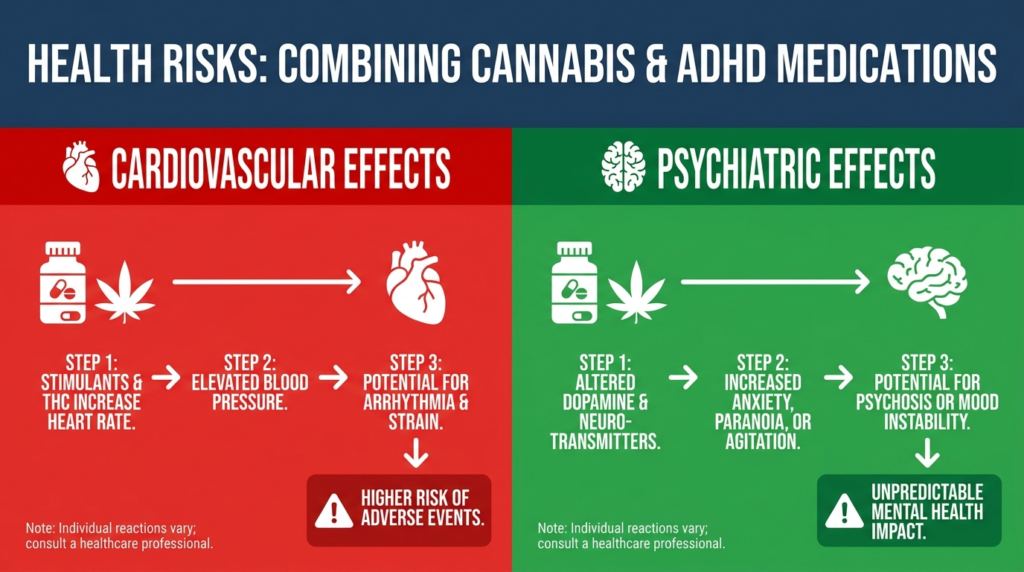
Both stimulant medications and cannabis can affect heart rate and blood pressure. Cannabis use has been associated with acute cardiovascular symptoms, and combining it with stimulants may amplify these risks, particularly in people with underlying heart conditions.
More concerning are the psychiatric risks. Cannabis use, especially high-THC products, is linked to increased risk of psychotic symptoms, paranoia, and severe anxiety.
Stimulant medications can also, in rare cases, trigger psychiatric symptoms. Using both together may increase the likelihood of acute psychological distress, panic attacks, or psychotic-like experiences.
Cognitive Effects: Beyond Diagnosable Disorders
Mental health outcomes do not only involve diagnosable disorders. Cognitive function and neurodevelopment are also part of mental health risk.
A review on cannabis effects on brain structure, function, and cognition concluded that THC acutely impairs cognition, executive function, inhibitory control, mood, and psychosis-related outcomes, with dose-dependent effects across laboratory studies.
It also noted that heavy or long-term cannabis use is associated with neurocognitive deficits, and meta-analytic evidence suggests that some residual neurocognitive effects may persist after prolonged abstinence.
Why This Matters for ADHD?
Cognitive impairment is not a side issue. Executive dysfunction, altered attention, poorer inhibitory control, and memory problems can:
- Worsen school performance
- Reduce treatment adherence
- Increase impulsivity and accident risk
- Compound psychiatric vulnerability
- Mimic or exacerbate anxiety, depression, and psychosis symptoms
Even in cases where cannabis does not trigger a formal diagnosis, it may still degrade functioning in ways that are psychologically and socially important, especially for people already struggling with ADHD-related executive dysfunction.
Modern Cannabis Products: Stronger Than Ever Before
One of the most important developments in recent years is the dramatic increase in cannabis potency. Global mean THC potency was approximately 1 to 2% a few decades ago, whereas cannabis flower containing 20% THC or more now represents a serious public health concern.
The average cannabis flower THC content in Northern California exceeds 20%, and concentrates may exceed 60%, 90%, or even 95% THC depending on product type and market.
This potency shift matters for several reasons:
- Older reassurance studies may not generalize well to current products
- Dose-response harms are more plausible when products are much stronger
- Unexpected intoxication is more likely with edibles and concentrates
- Psychiatric risk may be amplified when high THC is paired with frequent use or adolescent exposure
The public health literature is explicit that legalization without potency controls can create a market environment that increases exposure to higher-risk products.
Edibles and Concentrates: Special Concerns
Edibles are especially problematic because of delayed onset, consumer confusion, and frequent over-ingestion. Concentrates are concerning because of extreme THC potency and limited controlled research on their acute psychiatric effects.
Acute intoxication can precipitate panic, paranoia, transient psychosis-like symptoms, severe anxiety, behavioral dyscontrol, and dangerous decision-making.
Even when these episodes do not become chronic psychiatric illness, they can produce emergency presentations, trauma, accidental injury, and destabilization of vulnerable individuals.
What Actually Works: Evidence-Based Treatment for ADHD and Cannabis Use
The emerging standard of care is concurrent, integrated treatment of ADHD and cannabis-related problems, not deferring ADHD medication until prolonged abstinence.
Current clinical guidance favors treating ADHD and problematic cannabis use concurrently rather than requiring abstinence first, and identifies co-management as the emerging standard.
Why Concurrent Treatment Makes Sense?
Untreated ADHD can impair the very capacities needed to reduce cannabis use and maintain recovery:
- Attendance and organization
- Impulse control
- Emotional regulation
- Sustained engagement in therapy
- Compliance with treatment plans
- Ability to tolerate boredom and delay
If clinicians require lengthy abstinence before treating ADHD, they may be asking patients to achieve recovery with untreated deficits in the executive functions recovery requires.
Medication Strategies
When ADHD medication is indicated in people with co-occurring cannabis use, the evidence supports:
- Prefer long-acting formulations when stimulants are chosen
- Avoid PRN stimulant use in high-risk populations
- Consider non-stimulants first when diversion risk is high
- Monitor adherence, diversion, symptom response, and cannabis outcomes
A review of treatment strategies recommends beginning with non-stimulant pharmacotherapy when misuse or diversion risk is high, while acknowledging that non-stimulants may not match stimulants in ADHD efficacy.
Importantly, stimulant treatment in childhood does not appear to cause later substance problems. A meta-analysis of 15 longitudinal studies found that children with ADHD treated with stimulant medication were generally equivalent to untreated ADHD children regarding later alcohol, cocaine, marijuana, nicotine, and nonspecific drug outcomes.
Psychotherapy is Essential, Not Optional
Because ADHD medication has limited direct effect on abstinence, psychosocial treatment remains central. A multidisciplinary approach combining therapy and medication is recommended, with psychoeducation, motivational interviewing, and cognitive behavioral therapy as especially useful.
The broader adolescent cannabis use disorder treatment literature shows the strongest support for:
- Individual CBT
- Motivational enhancement therapy combined with CBT
- Family-based interventions
- Contingency management
- Assertive continuing care
These findings connect meaningfully to ADHD populations because ADHD-related executive dysfunction, family conflict, and motivational inconsistency are often exactly the mechanisms such treatments target.
Practical Integrated Treatment Components
A coherent ADHD and cannabis use treatment plan often includes:
- Psychoeducation about overlap and risks
- Motivational interviewing to address ambivalence
- CBT for coping skills, planning, and relapse prevention
- Family or systems involvement when appropriate
- ADHD pharmacotherapy when impairment is significant
- Monitoring for diversion and misuse
- Scheduled follow-up of both ADHD symptoms and cannabis use
- Coordination across psychiatry, therapy, primary care, and school or work supports
Who is at Highest Risk?
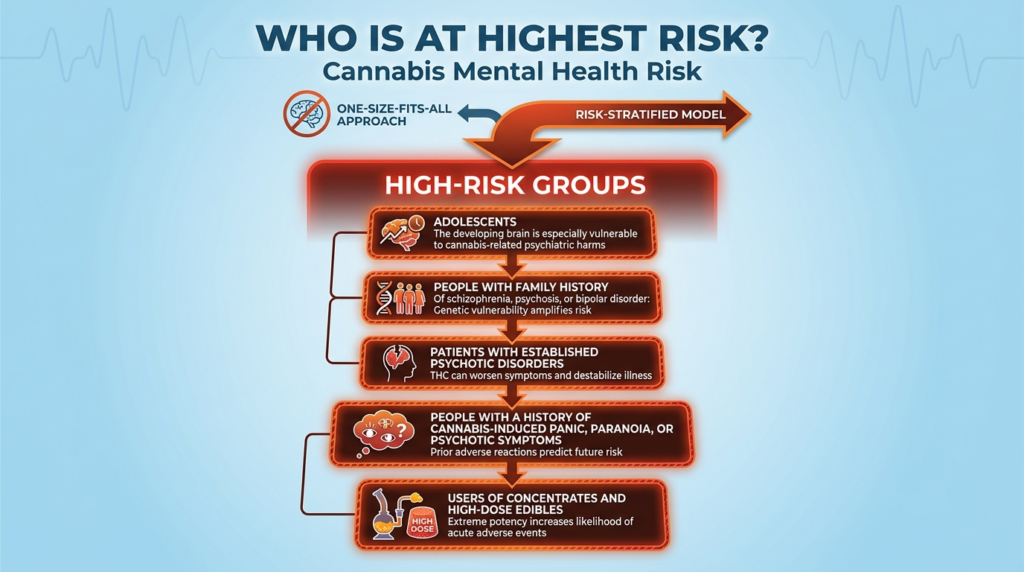
Cannabis mental health risk is not evenly distributed. The evidence strongly supports a risk-stratified model rather than a one-size-fits-all approach.
High-Risk Groups
Particular caution is warranted for:
- Adolescents: The developing brain is especially vulnerable to cannabis-related psychiatric harms
- People with family history of schizophrenia, psychosis, or bipolar disorder: Genetic vulnerability amplifies risk
- Patients with established psychotic disorders: THC can worsen symptoms and destabilize illness
- People with a history of cannabis-induced panic, paranoia, or psychotic symptoms: Prior adverse reactions predict future risk
- Users of concentrates and high-dose edibles: Extreme potency increases likelihood of acute adverse events
Genetic Factors
Research has identified greater risk among genetically vulnerable youth, including those with COMT Val158Met and AKT1 polymorphisms. Family vulnerability to psychotic disorders is an important modifier of risk.
This helps reconcile seemingly contradictory findings: most users do not develop psychosis, yet some subgroups face sharply elevated risk. Population-wide averages can therefore look modest even while subgroup harms are substantial.
Clinical Recommendations
For Clinicians
- Routinely screen adolescents for cannabis use
- Ask specifically about potency, frequency, product type, and age at onset
- Treat cannabis use as clinically relevant in patients with psychosis, mania, severe anxiety, or cognitive complaints
- Do not assume cannabis is benign because it is legal or “medical”
- Be cautious with patient-reported self-medication narratives; they may coexist with harm
- Use full diagnostic interviews, not just screening tools, when ADHD and cannabis use coexist
- Establish childhood onset and gather collateral information before diagnosing ADHD in active cannabis users
For Patients and Families
The evidence supports a simple prevention message: delaying or avoiding adolescent cannabis exposure is likely to reduce psychiatric risk. This is not a moral claim; it is a developmental risk-reduction claim.
For people already using cannabis and struggling with ADHD:
- Be honest with your treatment team about cannabis use
- Understand that cannabis is not treating your ADHD, even if it feels calming
- Know that combining cannabis with ADHD medications can reduce medication effectiveness and increase risks
- Seek integrated treatment that addresses both conditions concurrently
- Consider that stopping or reducing cannabis use may actually improve your ability to benefit from ADHD treatment
The Bottom Line
The totality of evidence supports a clear practical conclusion: high-THC cannabis should be regarded as a significant psychiatric risk factor, especially in adolescents, people with family history of psychosis or bipolar disorder, genetically vulnerable individuals, and those with established mental health conditions.
Cannabis is not an established treatment for ADHD. It does not improve attention, executive function, or core ADHD symptoms, and may worsen them. ADHD medications can help ADHD symptoms even in people with co-occurring cannabis use, but they work best when combined with psychotherapy and substance-focused interventions.
The most defensible position, based on current evidence, is that clinicians should diagnose carefully, treat both conditions concurrently, prefer structured and monitored care pathways, and avoid equating cannabis-related cognitive impairment with definitive ADHD or, conversely, assuming cannabis use invalidates ADHD treatment.
If you or someone you care about is struggling with ADHD and cannabis use, know that The Summit Wellness Group’s effective help is available. Our integrated treatment addresses both conditions together to offer the best path forward. Reach out to explore our treatment options that can support lasting recovery and improved functioning.