Mixing oxycodone and weed can increase side effects without improving pain relief.
A 2024 randomized trial in fibromyalgia patients found that combining inhaled cannabis with oxycodone led to 31% of participants dropping out within three weeks due to intolerable adverse effects, compared with only 13% on oxycodone alone.
This article explains what happens when these substances interact, the evidence behind combination use, and why the strategy may carry more risk than benefit.
What Happens When You Mix Oxycodone and Weed?
When you combine oxycodone and cannabis, both substances affect your central nervous system and pain pathways. Oxycodone is a prescription opioid that binds to opioid receptors in the brain and spinal cord to reduce pain signals.
Cannabis contains THC and CBD, cannabinoids that interact with the body’s endocannabinoid system and may influence pain perception, mood, and inflammation.
The theory behind mixing them is that cannabinoids and opioids might work together to enhance pain relief while allowing lower opioid doses.
This concept, sometimes called opioid sparing, has attracted attention because it could theoretically reduce opioid related harms such as dependence, overdose risk, and side effects like nausea or constipation.
However, direct evidence from controlled studies tells a different story. The 2024 fibromyalgia trial randomized 81 adults into three groups: oxycodone alone, inhaled cannabis alone, or both together.
Participants self titrated their doses over six weeks. The combination group did not experience better pain control, did not have fewer adverse effects, and actually used the highest total drug load despite reducing oxycodone tablets by about 35%.
Common Side Effects of the Oxycodone and Weed Interaction
The most clinically important finding from the randomized trial was poor tolerability in cannabis containing regimens.
Approximately 31% of patients assigned to cannabis or cannabis plus oxycodone discontinued within two to three weeks because adverse effects were intolerable. In contrast, only 13% of those taking oxycodone alone withdrew early.
The trial measured a composite adverse event score that included ten symptoms:
- Dizziness
- Sleepiness
- Insomnia
- Headache
- Nausea
- Vomiting
- Constipation
- Drug high
- Hallucinations
- Paranoia
Among participants who completed the full six weeks, there were no significant differences in adverse event scores across groups.
This pattern suggests that the most intolerant individuals left early, leaving behind a subset better able to tolerate treatment. The practical takeaway is that combining these substances does not reduce the burden of side effects and may actually worsen early tolerability.
Does Mixing Weed and Oxycodone Improve Pain Relief?
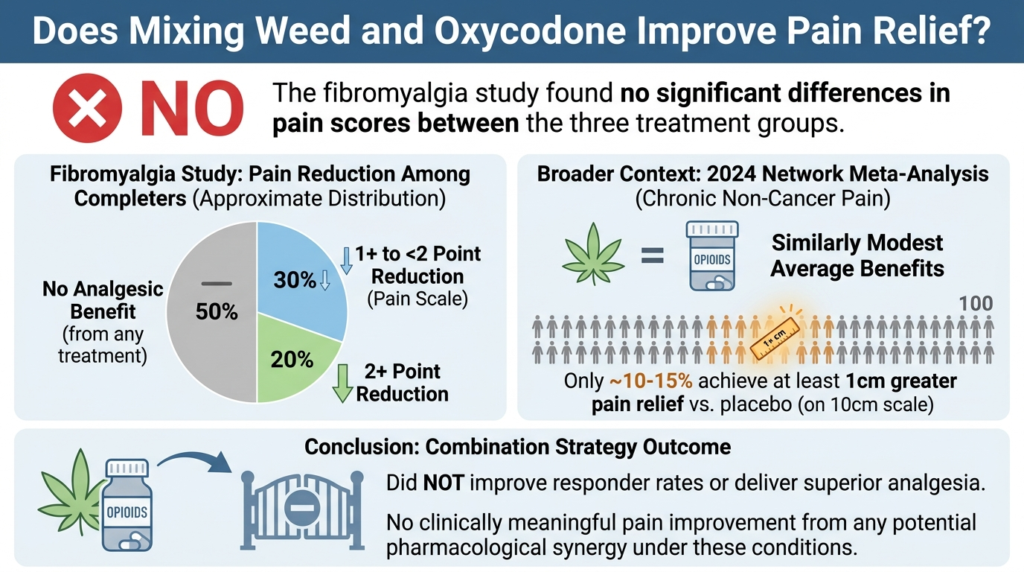
No. The fibromyalgia study found no significant differences in pain scores between the three treatment groups.
Among those who completed the trial, approximately 30% experienced at least a one point reduction on the pain scale but less than two points, about 20% achieved at least a two point reduction, and roughly 50% reported no analgesic benefit from any treatment.
This distribution is consistent with broader chronic pain research, where both opioids and cannabis tend to produce modest average benefits.
A 2024 network meta analysis of 90 randomized trials involving more than 22,000 patients with chronic non cancer pain concluded that cannabis and opioids are similarly modest in effect, with only about 10% to 15% of patients achieving at least one centimeter greater pain relief on a ten centimeter scale compared with placebo.
The combination strategy did not improve responder rates or deliver superior analgesia. If there is any pharmacological synergy between cannabinoids and opioids, it did not translate into clinically meaningful pain improvement under these conditions.
Can You Mix Weed and Oxycodone Safely?
Safety depends on multiple factors including dose, frequency, individual tolerance, and medical supervision. Both substances can cause sedation, dizziness, impaired coordination, and cognitive effects. When combined, these risks may compound.
Oxycodone carries well documented risks including respiratory depression, dependence, overdose, and death. Cannabis does not cause the same respiratory suppression, which is one reason it has been explored as a potential opioid alternative.
However, cannabis itself is not without harms. It can impair driving, worsen anxiety or paranoia in some users, and may contribute to cannabis use disorder with regular use.
The American College of Physicians released 2025 best practice advice recommending that clinicians advise patients against the use of inhaled cannabis for chronic non cancer pain. This guidance reflects concerns about harms outweighing benefits, especially in higher risk groups and with inhaled forms.
If you are considering combining these substances, it is essential to discuss it with a healthcare provider who can assess your individual risk factors, monitor for adverse effects, and help you weigh potential benefits against harms.
Evidence on Opioid Sparing Effects
One of the main arguments for adding cannabis to opioid therapy is that it might allow patients to reduce opioid doses while maintaining pain control. This concept is called opioid sparing. However, systematic reviews have found that opioid sparing effects remain uncertain.
A 2021 meta analysis of randomized and observational studies concluded that evidence for opioid sparing is very low certainty. Among randomized trials in chronic cancer pain, participants were generally instructed to maintain opioid doses, and the effect on opioid use was minimal.
High certainty evidence showed little or no effect on pain relief, and moderate certainty evidence suggested increased nausea and vomiting with cannabis addition.
In the fibromyalgia trial, the combination arm did reduce oxycodone tablet use by about 35%. However, cannabis use did not decrease, and the combination resulted in the highest overall drug load.
This is not true opioid sparing in a clinically useful sense. It represents opioid substitution within an expanded total exposure pattern rather than therapeutic simplification.
Weed and Oxycodone Effects in Fibromyalgia
Fibromyalgia is a chronic pain syndrome characterized by widespread pain, fatigue, sleep disturbance, and other symptoms. It is considered a chronic primary pain condition, meaning pain occurs without a clear underlying structural cause or its impact is disproportionate to observable tissue damage.
Neither opioids nor cannabinoids are generally recommended for fibromyalgia by major clinical guidelines. The 2024 trial authors noted that both drug classes are not recommended for this condition, even though some patients receive them in practice.
The trial used inhaled Bediol cannabis containing 6.3% THC and 8% CBD, with participants allowed up to five inhalation sessions daily. Oxycodone was provided as 5 mg sustained release tablets up to four times daily. Both were self titrated over six weeks.
The results showed that the combination failed on its stated clinical promise. It did not reduce adverse effects, did not improve pain, and increased overall drug exposure.
The investigators concluded that the combination may not offer additional benefit and may even carry a greater risk of harm than monotherapy.
Comparing Cannabis and Opioids for Chronic Pain
Direct head to head comparisons of cannabis and opioids for chronic pain are rare. The 2024 network meta analysis identified only one direct randomized trial, which was the fibromyalgia study discussed here. Most comparative evidence comes from indirect comparisons through placebo controlled trials.
The meta analysis found that cannabis and opioids each provide small improvements versus placebo, with moderate certainty evidence that cannabis probably results in fewer discontinuations due to adverse events than opioids overall.
However, this synthesis largely depended on indirect evidence and excluded inhaled cannabis forms, limiting direct applicability to the fibromyalgia trial’s intervention.
Importantly, the fibromyalgia study used inhaled cannabis, and its tolerability pattern differed from the broader meta analysis. Cannabis containing arms had higher early dropout rates than oxycodone alone in this specific trial.
This highlights why route of administration, product formulation, and patient population matter when interpreting cannabis evidence.
What the Research Shows About Combination Therapy?
The strongest evidence on combining cannabis with oxycodone comes from the 2024 randomized trial in fibromyalgia. Its findings are clear:
- The combination did not improve analgesia
- The combination did not reduce overall adverse effects
- The combination increased total drug load
- Cannabis containing regimens were less tolerable early in treatment
These results align with broader systematic review evidence. A review on opioid sparing effects found that higher quality randomized trials generally did not confirm meaningful opioid sparing, despite recurring signals from observational studies and preclinical work.
The divergence between mechanistic plausibility and randomized evidence is one of the central tensions in this field. Cannabinoids and opioids may interact in pain pathways at a biological level, but that does not guarantee clinical advantage in practice.
Limitations of Current Evidence
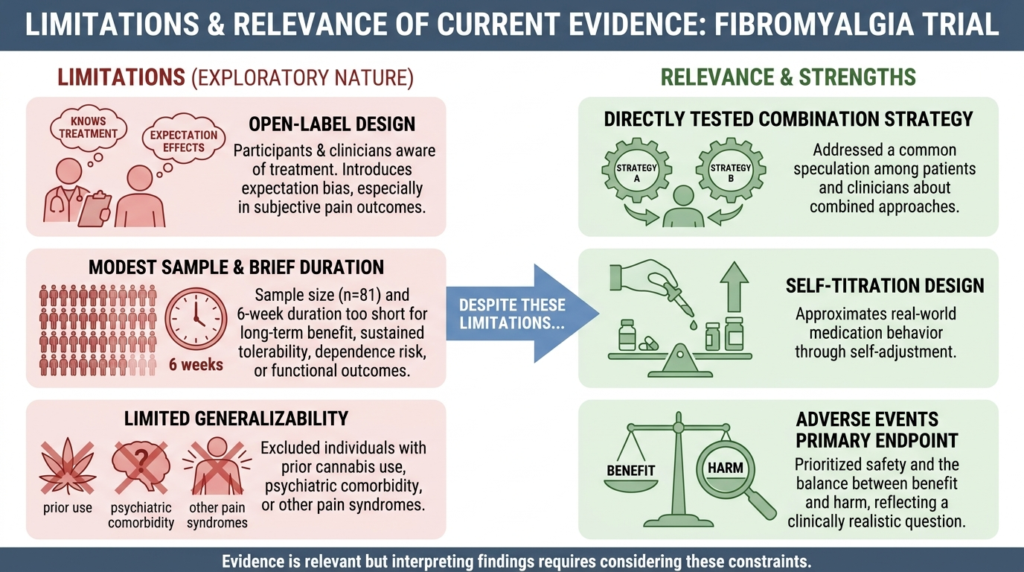
The fibromyalgia trial was exploratory and had several limitations. It was open label, meaning participants and clinicians knew which treatment was assigned. This can introduce expectation effects, especially in pain research where subjective outcomes are prominent.
The sample size was modest at 81 treated patients, and the duration was only six weeks. This is too brief to evaluate long term benefit, sustained tolerability, dependence risk, or functional outcomes. The trial also excluded people with prior cannabis use, psychiatric comorbidity, and other pain syndromes, which limits generalizability.
Despite these limitations, the trial is highly relevant because it directly tested the combination strategy many patients and clinicians speculate about.
It used a self titration design that approximates real world medication behavior, and it prioritized adverse events as the primary endpoint, reflecting a clinically realistic question about the balance between benefit and harm.
Clinical Implications and Guideline Perspectives
Major clinical guidelines remain cautious about both opioids and cannabis for chronic pain, especially in conditions like fibromyalgia.
The National Institute for Health and Care Excellence has published guidance on cannabis based medicinal products and chronic pain management, defining chronic primary pain as pain without a clear underlying cause or pain whose impact is out of proportion to observable injury.
The Centers for Disease Control and Prevention’s 2022 opioid guideline emphasizes balancing benefits and risks, improving function and quality of life, and avoiding harms such as opioid use disorder, overdose, and death. The guideline is voluntary and person centered, not an inflexible standard of care.
The American College of Physicians’ 2025 advice specifically discourages inhaled cannabis for chronic non cancer pain, citing concerns that harms likely outweigh benefits in certain higher risk groups.
These guideline positions reinforce that combining cannabis with oxycodone should not be viewed as a validated therapeutic strategy based on current evidence.
Safer Alternatives for Pain Management
If you are living with chronic pain, there are evidence based approaches that do not carry the same risks as opioid and cannabis combination therapy. Multimodal pain management often includes:
- Physical therapy and exercise
- Cognitive behavioral therapy
- Mindfulness and relaxation techniques
- Non opioid medications such as acetaminophen, NSAIDs, or certain antidepressants
- Interventional procedures when appropriate
For people with co occurring substance use and mental health concerns, integrated treatment that addresses both conditions simultaneously can improve outcomes. Dual diagnosis programs offer coordinated care that recognizes the complex relationship between pain, substance use, and mental health.
When to Seek Professional Help?
If you are currently mixing oxycodone and weed, or if you are considering it, talk with a healthcare provider. They can help you assess your individual risk factors, monitor for adverse effects, and explore safer alternatives.
If you are struggling with opioid dependence, cannabis use disorder, or chronic pain that is affecting your quality of life, professional support can make a meaningful difference. Evidence based treatment programs offer medical detox, medication management, counseling, and holistic therapies tailored to your needs.
Recovery is possible with the right support. Seeking help is a sign of strength, not weakness. If you or someone you care about is facing challenges with substance use or chronic pain, reach out to The Summit Wellness Group because we can provide compassionate, integrated care. Call us today!