Mixing Prozac and marijuana is more common than many people realize, but the combination carries real risks that go beyond a simple “be careful” warning.
Research shows that cannabinoids can alter how fluoxetine is metabolized in the liver, potentially raising drug exposure and intensifying side effects.
This article walks through what the science actually says about prozac and marijuana interactions, who faces the greatest risk, and what warning signs to watch for.
Prozac and Marijuana: What Happens When You Mix Them?
Fluoxetine, sold as Prozac, is a selective serotonin reuptake inhibitor used for depression, OCD, panic disorder, and related conditions. It works by increasing serotonin availability in the brain.
Marijuana contains dozens of cannabinoids, but THC and CBD are the two most relevant when it comes to drug interactions.
The concern with prozac and weed is not just that both substances affect the brain. It operates on two levels at once.
The first is pharmacodynamic: both substances influence mood, anxiety, cognition, and serotonergic signaling, so their effects can overlap and amplify each other.
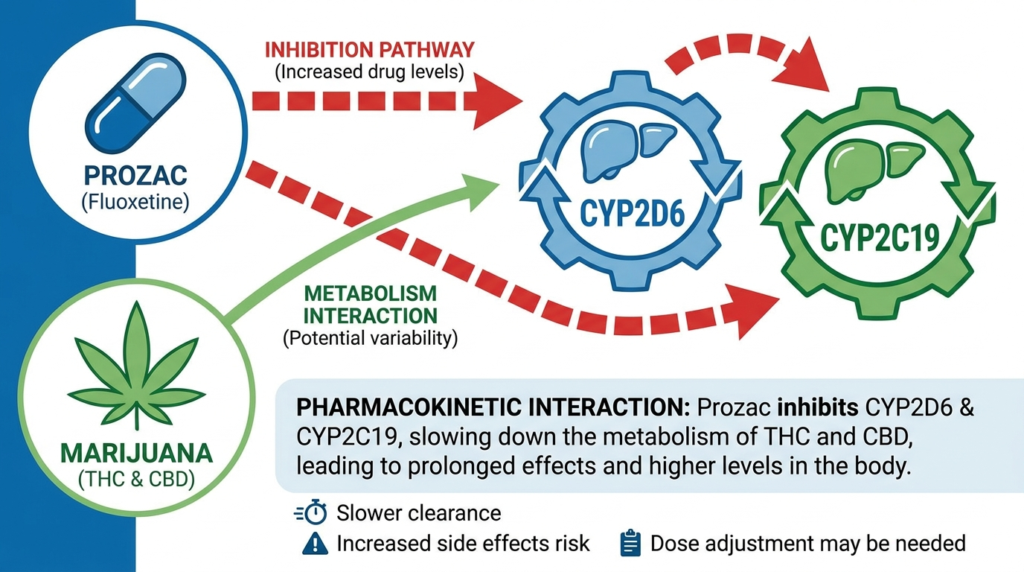
The second is pharmacokinetic: cannabinoids, especially CBD, can inhibit the liver enzymes that break down fluoxetine, which may raise drug levels and prolong its effects in the body.
That dual-layer interaction is why this combination deserves more attention than most people give it.
How Fluoxetine is Metabolized?
Only about 2.5 percent of a fluoxetine dose leaves the body unchanged in urine. The rest is processed by liver enzymes, primarily CYP2D6, with secondary roles for CYP2C19 and CYP2C9. This metabolism converts fluoxetine into norfluoxetine, an active metabolite with an even longer half-life.
A 2025 real-world pharmacogenomic study confirmed that CYP2D6 genotype is the single most significant predictor of the fluoxetine-to-norfluoxetine ratio, meaning genetic differences in this enzyme meaningfully shape how much drug a person carries in their system at any given time.
Fluoxetine also inhibits CYP2D6 itself. So when cannabinoids add further inhibition to the same enzyme system, the result can be a compounding effect that slows drug clearance more than either substance would alone.
What Cannabinoids Do to Those Enzymes?
A review published in Frontiers in Psychiatry found that cannabinoids can inhibit major CYP enzymes including CYP2C19 and CYP2D6, creating a plausible pathway for pharmacokinetic drug interactions with antidepressants.
CBD appears to be the stronger inhibitor in this context, which is one reason CBD-containing products may carry more metabolic interaction risk than smoked THC-dominant cannabis.
A published case report described a probable drug-gene-drug interaction involving CBD, the CYP2D6*4 genetic variant, and fluoxetine, suggesting that genetic susceptibility can convert a modest interaction into a clinically important one.
Does Marijuana Reduce Prozac’s Effectiveness?
This is one of the most practically important questions, and the answer is nuanced. Cannabis does not simply “turn off” fluoxetine. But it can make treatment less stable in several ways.
Cannabis can worsen anxiety, motivation, sleep, and mood independently of any drug interaction. Those effects directly undermine what Prozac is trying to do.
At the same time, if cannabinoid-related enzyme inhibition raises fluoxetine exposure, the result may be more side effects without better antidepressant benefit. Higher drug levels do not automatically mean better outcomes.
The net result for many patients is that their symptom trajectory becomes noisy and harder to interpret.
They may feel like Prozac has stopped working when what is actually happening is that repeated cannabis use is introducing emotional variability that masks or counteracts any improvement.
Prozac and Weed Interactions: Serious Risks
Beyond the common side effects, there are less frequent but more serious risks that deserve clear attention.
Mania and Hypomania
Hypomania has been reported following simultaneous use of marijuana with fluoxetine.
An older published case report also documented mania as a direct result of the fluoxetine-marijuana combination. SSRIs can trigger activation or mood elevation in susceptible individuals, and THC can independently destabilize mood.
Together, the risk is amplified, especially for anyone with a bipolar-spectrum history.
Serotonin Syndrome
Serotonin syndrome is rare but serious. A 2023 case report found that cannabis was present on every occasion where serotonin syndrome emerged in a patient on serotonergic medication, and on multiple occasions cannabis was used immediately before symptoms appeared.
The authors concluded that cannabis use history should be taken before prescribing serotonergic medications.
Symptoms of serotonin syndrome include high fever, rapid heartbeat, high blood pressure, muscle rigidity, tremor, confusion, and agitation. In severe cases it can be fatal.
The risk is not common with ordinary cannabis use, but it becomes more credible with high-THC products, concentrated vape oils, or when other serotonergic drugs are already in the regimen.
Cardiovascular Effects
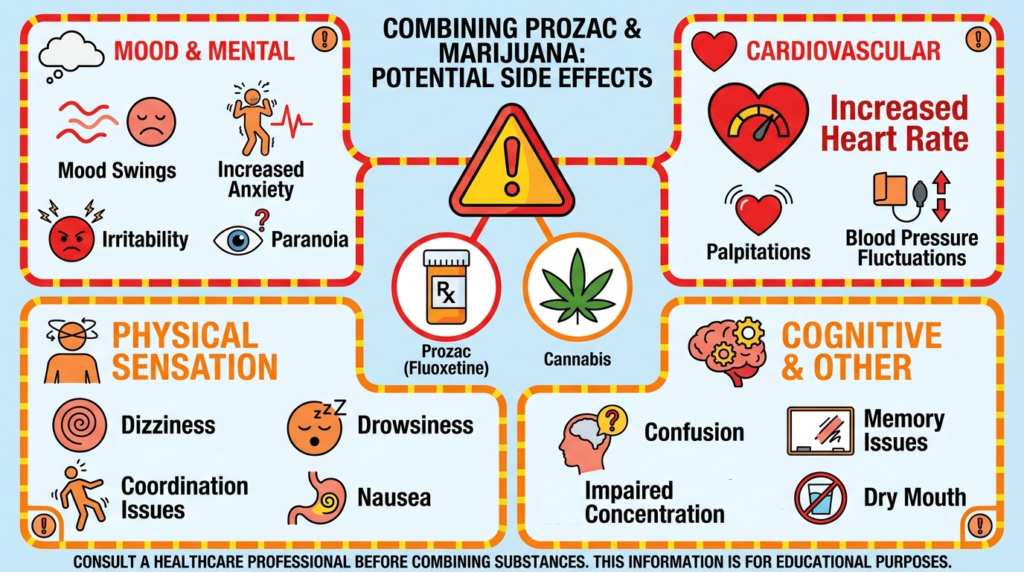
Cannabis raises heart rate on its own. Combined with the autonomic effects of SSRIs and the anxiety or paranoia that high-THC products can trigger, the result can be pronounced tachycardia and a cycle of physical overstimulation that is especially difficult for people with panic disorder or cardiovascular sensitivity.
Common Side Effects of Weed and Prozac Together
The most frequently reported side effects when combining weed and prozac fall into several overlapping clusters. These are not rare or theoretical. They are the effects most likely to show up in everyday use.
- Drowsiness, fatigue, and dizziness
- Impaired concentration, slower reaction time, and confusion
- Mood swings, anxiety, paranoia, and agitation
- Nausea and dry mouth
- Increased heart rate and palpitations
- Worsened depression or emotional instability
- Insomnia or disrupted sleep
Many of these effects appear in both substances independently. When combined, they tend to be stronger and last longer, particularly because fluoxetine already has a long half-life and norfluoxetine extends that further.
If CBD slows the enzymes that clear fluoxetine, the side-effect window stretches even longer.
A pediatric interaction review identified a probable fluoxetine and CBD oil interaction in a 17-year-old that produced insomnia, increased agitation, hyperactivity, vocal yelling, and worsening OCD symptoms.
The interaction was rated probable on the Drug Interaction Probability Scale, and symptoms resolved when the CBD was stopped.
Who Faces the Greatest Risk?
The risks of marijuana and prozac interactions are not equal across all users. Several factors raise the danger significantly.
Adolescents and young adults face greater developmental vulnerability. A review of marijuana and antidepressant treatment in adolescents found that cannabinoids altered serotonergic transmission and were linked to adverse effects including dizziness and fatigue in younger patients. People under 25 are already a special-risk group with antidepressants because of potential worsening depression or suicidality early in treatment.
People with bipolar-spectrum vulnerability face elevated risk of mania or hypomania from the combination of SSRI activation and THC-related mood destabilization.
People using CBD products may not realize they are taking something that interacts with Prozac. Many patients do not regard CBD as a drug, yet it may materially slow the enzymes that clear fluoxetine from the body.
People on multiple serotonergic medications face the greatest risk of serotonin syndrome. The FDA fluoxetine labeling already warns about combining fluoxetine with other serotonergic agents. Adding cannabis to a regimen that already includes other antidepressants, tramadol, triptans, or stimulants creates a more complex and potentially unsafe pharmacologic environment.
People with CYP2D6 genetic variants may experience stronger metabolic interactions, particularly when CBD is involved.
Smoking Weed on Prozac: Is It Safer Than Other Forms?
A common assumption is that smoking is the “safer” route compared to edibles or CBD oils. The reality is more complicated.
Smoked cannabis delivers THC rapidly, with effects peaking in about 30 minutes compared to roughly 2 hours for edibles. That fast delivery can intensify acute pharmacodynamic overlap: sedation, dizziness, anxiety, tachycardia, and confusion all hit at once rather than building gradually.
CBD oils and oral CBD products may carry stronger enzyme-mediated interaction concerns because of their sustained effect on CYP metabolism. But smoked high-THC cannabis carries stronger immediate psychiatric and cardiovascular risks.
So smoking weed while taking Prozac is not safer overall. It is a different risk profile, not a lower one. The route changes which risks dominate, not whether risks exist.
What the Evidence Does Not Support?
Some older studies found that fluoxetine treatment was associated with reduced marijuana use in specific comorbid populations, such as depressed patients with alcohol use disorder. Those findings are real but narrow.
They do not mean Prozac and marijuana are safe together, and they have not translated into any approved treatment.
A broad review of cannabis use disorder treatments concluded that no pharmacotherapy is approved for cannabis use disorder and that antidepressants overall have been largely unsuccessful for cannabis-related outcomes.
The older positive findings came from small, specific populations using lower-potency cannabis products that bear little resemblance to many modern formulations.
Warning Signs That Need Urgent Attention
If you use Prozac and marijuana together and notice any of the following, seek medical care promptly.
High fever, severe agitation, confusion, muscle rigidity or twitching, rapid or irregular heartbeat, very high blood pressure, or hallucinations may indicate serotonin syndrome.
Extreme energy, decreased need for sleep, impulsivity, or pressured speech may indicate a manic episode. Both are medical emergencies.
More common warning signs that still warrant a conversation with your prescriber include worsening anxiety or panic, new or increased paranoia, significant mood swings, persistent drowsiness that affects daily function, or the sense that your antidepressant has stopped working.
The Bottom Line on Prozac and Marijuana
The evidence does not support describing this combination as safe. For most people, mixing Prozac and marijuana most commonly produces fatigue, dizziness, cognitive clouding, mood instability, and less reliable antidepressant response.
For some, it escalates into clinically significant psychiatric or cardiovascular complications.
CBD-containing products deserve special caution because they carry stronger metabolic interaction risk than many users expect. High-THC products, concentrates, and vaping devices carry stronger acute psychiatric and cardiovascular risks. Neither category is low-risk when combined with fluoxetine.
The most evidence-supported practical guidance is to disclose all cannabis and CBD use to your prescriber, avoid initiating or increasing cannabis use during Prozac dose changes, and treat any new or worsening psychiatric symptoms as a signal to reassess the combination.
If you or someone you care about is struggling to manage cannabis use alongside mental health treatment, speaking with our specialist can make a real difference.
The Summit Wellness Group offers dual diagnosis treatment that addresses both substance use and underlying psychiatric conditions together. So, reach out to our professionals today and take the next step to your recovery!