Mixing Xanax and cocaine creates a dangerous chemical collision in your brain and body. When you combine a powerful stimulant with a sedative, you don’t cancel out the risks, you multiply them.
This article explains the specific dangers of cocaine and Xanax co-use, the physiological interactions that make this combination so hazardous, and what the latest research reveals about patterns of polysubstance use that increase overdose risk.
Why Do People Mix Xanax and Cocaine?
Understanding why people take Xanax and cocaine together is essential to addressing the real-world risks. A 2025 qualitative study of 48 people who co-used sedatives and stimulants identified two major motivational branches: functional and experiential.
Functional motivations include using Xanax to manage the comedown from cocaine, reduce anxiety during or after stimulant use, help with sleep after a cocaine binge, or simply to feel normal enough to function.
Experiential motivations center on achieving specific subjective states like a “buzz,” “glow,” or “oblivion.” Some users report that combining stimulants and sedatives creates a fluctuating state they describe as “gouching,” where they ebb between comfort and dissociation.
These motivations are not irrational from the user’s perspective. They reflect attempts to self-regulate intolerable states like anxiety, insomnia, withdrawal, or trauma-related distress.
However, the fact that co-use serves a purpose does not make it safe. The motivations underlying co-use study concluded that assessing why people mix drugs should be a routine part of harm reduction and treatment to reduce mortality risk.
The Pharmacological Collision: What Happens When You Mix Xanax and Cocaine?
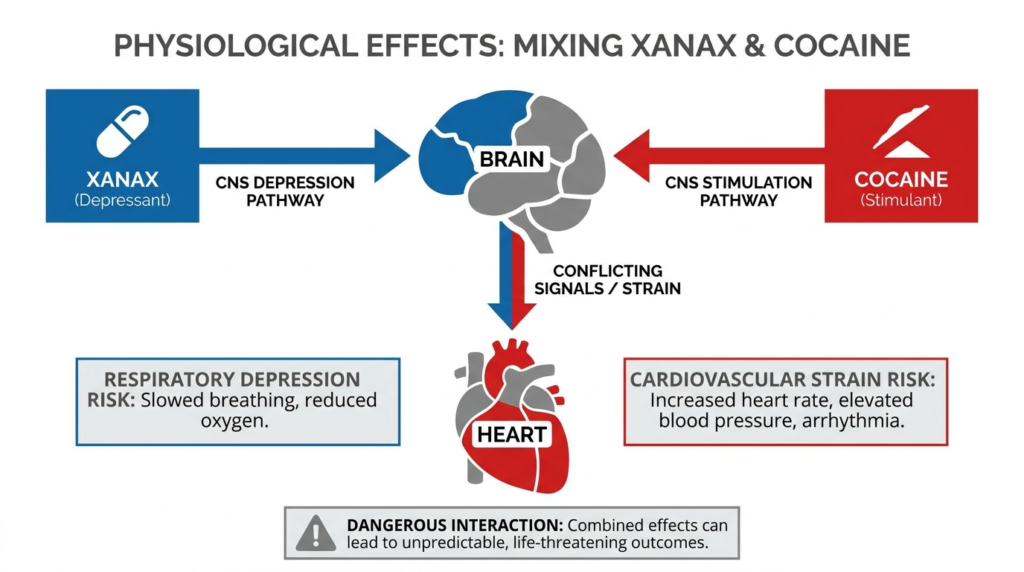
Cocaine is a powerful central nervous system stimulant that floods the brain with dopamine, increases heart rate and blood pressure, and creates intense feelings of euphoria and alertness.
Xanax (alprazolam) is a benzodiazepine that enhances the calming neurotransmitter GABA, producing sedation, muscle relaxation, and reduced anxiety.
When you take cocaine and Xanax together, you are not simply balancing one drug against the other. Instead, you create overlapping and unpredictable effects on multiple body systems.
Cardiovascular Stress
Cocaine causes acute cardiovascular complications including elevated blood pressure, arrhythmia, electrocardiographic abnormalities, and acute myocardial infarction.
Even in controlled laboratory settings with carefully screened participants, cocaine produces dose-related increases in heart rate and blood pressure.
Adding Xanax does not protect the heart. While benzodiazepines may reduce some subjective anxiety, they do not reverse cocaine’s direct cardiotoxic effects.
In fact, the sedative properties of Xanax can mask warning signs like racing heart or chest discomfort, leading users to take more cocaine than they otherwise would.
Respiratory Depression Risk
Although cocaine is a stimulant, mixing it with Xanax introduces serious respiratory risks. Benzodiazepines affect neural systems involved in breathing.
When combined with other depressants or in the context of polysubstance use, benzodiazepines can contribute to synergistic respiratory depression. This risk becomes especially dangerous if opioids are also present, a scenario that is increasingly common in real-world drug use.
Impaired Judgment Without Awareness
One of the most insidious dangers of mixing Xanax and cocaine is that Xanax can impair psychomotor performance, memory, and judgment without the user feeling impaired.
A controlled study of alprazolam found dose-related impairments across multiple behavioral tasks, yet participants reported no subjective awareness of being affected on visual analog drug-effect scales.
This means you can be objectively impaired while feeling alert and confident due to cocaine’s stimulant effects. That combination creates a perfect storm for dangerous behavior, including driving, taking additional drugs, or engaging in risky activities.
Patterns of Xanax and Cocaine Co-Use
Not all co-use looks the same. A 2025 UK study identified six distinct patterns of benzodiazepine and stimulant co-use, ranging from relatively controlled routines to chaotic, high-risk behaviors.
More Controlled Patterns
Some people use Xanax specifically to aid sleep or manage the comedown after cocaine use. Others follow structured routines, taking benzodiazepines at predictable morning and evening times while using stimulants throughout the day.
A particularly notable pattern involved people stabilized on medication-assisted treatment who used benzodiazepines in a highly curated way to achieve specific effects like confidence or reduced social anxiety.
These patterns may appear more controlled, but they are not safe. The 2025 pattern study emphasized that even when drugs are separated in time, their long-lasting effects can still interact dangerously. Timing separation does not eliminate co-use risk.
Less Controlled Patterns
The majority of participants in the study—70% followed less controlled patterns. These included intermittent high-dose binges, sustained all-day co-use, and continuous benzodiazepine use throughout the day even while stabilized on treatment. Non-fatal overdoses were mostly reported among people with these less controlled patterns.
Binge use may be especially dangerous because tolerance to the drugs’ effects remains relatively low between episodes. All-day co-use creates sustained overlap between stimulant and sedative effects, often in the context of extensive polysubstance use involving alcohol, opioids, or other drugs.
Can You Take Xanax and Cocaine Safely?
No. There is no safe way to mix Xanax and cocaine. The combination creates unpredictable cardiovascular stress, impairs judgment without subjective awareness, and increases the risk of overdose, especially when other substances are involved.
The question is not whether the combination is dangerous, it is! The question is how to reduce harm for people who are already mixing these drugs or at risk of doing so.
The Broader Context: Polysubstance Use and Overdose Risk
Cocaine use rarely occurs in isolation. A study of people who use street drugs found that daily powdered cocaine use was associated with more than three times the odds of daily benzodiazepine and opioid co-use. This means cocaine use can mark heightened risk for dangerous sedative-opioid combinations, not just stimulant toxicity.
Emergency department data from 2025 found that among patients with confirmed opioid overdose, 29% had detectable benzodiazepines. Novel benzodiazepines, substances not typically detected by routine drug screens, were associated with significantly greater odds of mechanical ventilation, indicating more severe overdose.
These findings have major implications. If you or someone you know uses cocaine, the real danger may not be the cocaine alone. It may be the hidden or unrecognized co-exposure to benzodiazepines, opioids, or other sedatives that dramatically increases overdose severity.
Mental Health, Trauma, and the Drive to Co-Use
The 2025 motivations study found that the majority of participants reported at least one overdose experience and poor mental health, including anxiety, depression, PTSD, and trauma.
Many described using drugs to manage unbearable emotional states, to leave the house, to sleep, or simply to feel normal for a little while.
This context matters because it shows that co-use is often not reckless hedonism. It is often a constrained survival strategy in the absence of adequate mental health care, trauma treatment, or social support.
The NIHR summary of the research program framed the overdose crisis as driven by trauma, inadequate mental health support, and lack of individualized treatment options.
Overdose prevention that ignores these realities will fail. People do not ignore risk because they do not understand it. They make constrained decisions under conditions of emotional crisis, structural exclusion, or service failure.
Cocaine’s Long-Term Effects on the Brain
Chronic cocaine use is not just about repeated intoxication. It involves persistent adaptations in brain reward and compulsion circuits. Research identifies dopamine-related mechanisms, reinstatement circuitry, and long-term molecular regulators such as CREB and ΔFosB in the persistence of addictive behavior.
Advanced neuroimaging shows that chronic cocaine dependence is associated with altered brain connectivity, especially in cortico-striatal, cortico-amygdala, hippocampal, insular, and interhemispheric networks. These disrupted connections are not abstract findings. They are linked to relapse risk, impulsivity, and treatment outcomes.
A 2025 meta-analysis found that cocaine users show significantly worse cognitive inhibition than controls, with a moderate-to-large effect size. This deficit was consistent across sex, age, years of use, and abstinence duration. The review recommended testing inhibitory-control training as an adjunct to first-line treatment.
The practical implication is clear: cocaine use disorder involves measurable deficits in executive inhibition. These deficits likely reflect altered brain network functioning. Treatment should not focus solely on detoxification or motivation. Cognitive remediation and inhibitory training deserve serious investigation.
Detection and Testing Challenges
Routine drug screens often fail to detect the full scope of polysubstance exposure. Traditional immunoassay-based tests are vulnerable to false positives, false negatives, and limited analyte coverage.
A forensic toxicology study found that reliance on immunoassay alone missed 26% of cocaine metabolite-positive specimens, 33% of lorazepam-positive specimens, and 60% of oxymorphone-positive specimens.
Modern toxicology increasingly relies on liquid chromatography-tandem mass spectrometry (LC-MS/MS), which offers higher sensitivity, higher specificity, and broader coverage.
A validated LC-MS/MS urine screening panel for 52 drugs and metabolites found limits of detection equal to or lower than immunoassay cutoffs, fewer interferences, and reduced screening cost per specimen by about 70% compared to ELISA.
This matters because incomplete testing can produce dangerously incomplete interpretation. If clinicians or forensic laboratories assess cocaine alone using narrow immunoassay menus, they will miss relevant benzodiazepine and opioid exposures, potentially misclassify overdose severity, and underestimate the real risk environment.
Harm Reduction and Treatment Implications
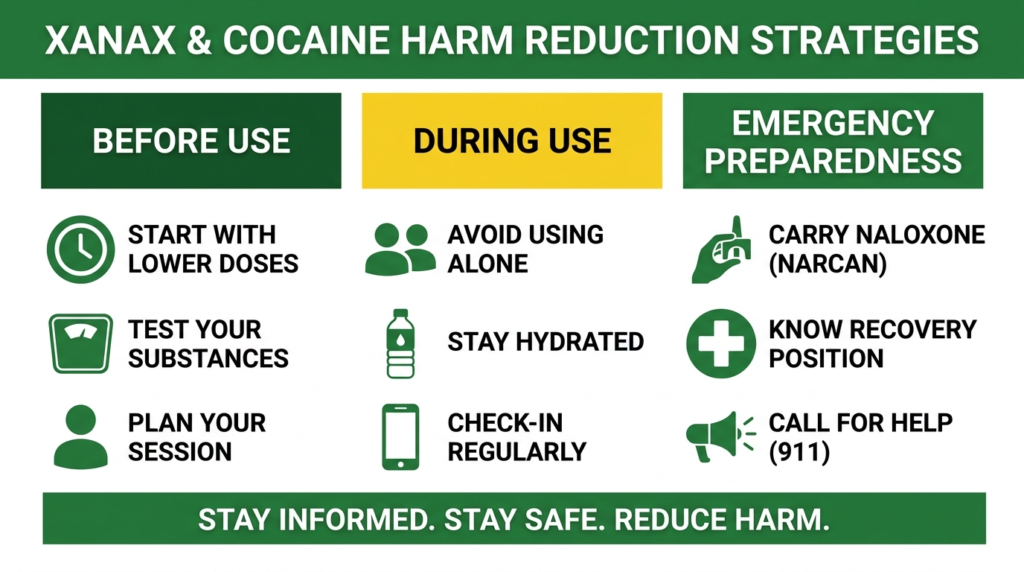
The strongest practical conclusion from recent research is that harm reduction should be tailored to specific patterns of dosing, timing, route, and purpose of co-use rather than delivered as generic “don’t mix” messaging.
Pattern-Specific Advice
Advice should differ for people who use Xanax only for sleep or comedown, those who follow structured morning and evening routines, those who binge intermittently, and those who use both drugs throughout the day. The risks, decision points, and practical interventions differ across these groups.
Motivation-Sensitive Assessment
Routine care should assess why co-use occurs. Is it for anxiety relief, sleep, stimulant comedown, confidence, withdrawal management, or escape?
https://pubmed.ncbi.nlm.nih.gov/41024026/The 2025 motivations paper explicitly concluded that assessing motivations should be routinely recognized as part of harm reduction and medication-assisted treatments to reduce mortality risk.
Trauma-Informed Mental Health Support
Both the pattern and motivation studies repeatedly identified untreated mental health symptoms and trauma as key drivers. Overdose prevention that does not improve access to mental health care is likely to remain partial and ineffective.
Prescribing Flexibility with Monitoring
Translational recommendations from the research program include flexible, tailored benzodiazepine prescribing for dependent people, structured detox plans, improved staff training, better guidance on interactions, and shared-risk approaches rather than rigid exclusion.
Blanket refusal to engage with benzodiazepine dependence is not an evidence-based neutral position. It is an active policy choice that may leave people in higher-risk illicit markets.
Overdose-Prevention Advice Grounded in Real Routines
Practical advice should address long half-lives and overlap, reduced tolerance after breaks, heightened risk during medication changes, extra danger from alcohol and other sedatives, and the limitations of simply spacing drugs apart.
Laboratory experiments confirmed that even when drugs are taken at different times of day, their long-lasting effects can still interact dangerously.
What to Do If You or Someone You Know Mixes Xanax and Cocaine?
If you are currently mixing Xanax and cocaine, or know someone who is, the most important step is to seek professional support. The combination is dangerous, but judgment and shame do not reduce risk. Honest, tailored care does.
Key steps include:
- Seek medical evaluation. Cardiovascular and neurological effects may be present even without obvious symptoms.
- Disclose all substances. Incomplete information leads to incomplete care. Clinicians need to know about cocaine, Xanax, alcohol, opioids, and any other drugs.
- Ask about medication-assisted treatment. For people with opioid or alcohol dependence, medications like buprenorphine, naltrexone, or acamprosate can reduce cravings and support recovery.
- Request trauma-informed mental health care. If co-use is driven by anxiety, PTSD, depression, or trauma, addressing those root causes is essential.
- Explore structured treatment programs. Partial hospitalization, intensive outpatient, and outpatient programs offer varying levels of support customized to individual needs.
Your Recovery Matters To Us! Call Today.
The dangers of mixing Xanax and cocaine are not theoretical. They are documented in emergency departments, forensic toxicology labs, and the lived experiences of people who have survived overdoses or lost loved ones.
The combination creates cardiovascular stress, impairs judgment without awareness, and increases overdose risk, especially in the context of polysubstance use.
But the evidence also shows that risk is not uniform. It is pattern-specific, motivation-sensitive, and inseparable from trauma, mental health burden, and polysubstance contexts. Generic abstinence-oriented messaging is inadequate.
Personalized, pattern-specific harm reduction, flexible prescribing, systematic assessment of motivations and routines, and better access to trauma-informed mental health care are more strongly supported by the evidence than rigid prohibitionist approaches.
If you or someone you care about is struggling with cocaine and Xanax use, know that Summit’s help is available. Recovery is possible, and it begins with our honest conversation, compassionate care, and evidence-based treatment that meets you where you are.
Reach out today to explore The Summit Wellness Group’s addiction treatment options that address the full complexity of polysubstance use and co-occurring mental health needs.