Mixing Zoloft and alcohol is something many people on sertraline wonder about, especially in social situations.
The short answer is that you should not mix them!
The official drug guidance states that alcohol can worsen sertraline’s side effects, and Pfizer’s own medication guide says plainly, “Do not drink alcohol while you take ZOLOFT.”
This article explains exactly why, what happens when you mix them, and who faces the greatest risk.
Zoloft and Alcohol: Why the Combination is a Problem?
Zoloft is the brand name for sertraline, a selective serotonin reuptake inhibitor prescribed for depression, anxiety, OCD, PTSD, panic disorder, social anxiety disorder, and premenstrual dysphoric disorder.
It works by increasing serotonin availability in the brain to help stabilize mood and reduce anxiety over time.
Alcohol is a central nervous system depressant. It slows brain activity, impairs judgment, disrupts coordination, and affects mood. Both substances act on the brain, and that overlap is exactly where the trouble starts.
The Pfizer medication guide for Zoloft does not hedge on this point. It tells patients not to drink alcohol while taking the medication.
The FDA-approved prescribing information echoes the same instruction in patient counseling materials. These are not vague cautions; they are direct instructions grounded in clinical safety evidence.
What Sertraline Does in the Body?
Sertraline takes time to work. Most patients need several weeks before they feel meaningful benefit, and the early weeks of treatment can bring side effects like nausea, dizziness, fatigue, and sleep changes.
During that adjustment period, the brain is particularly sensitive, and adding alcohol creates extra unpredictability.
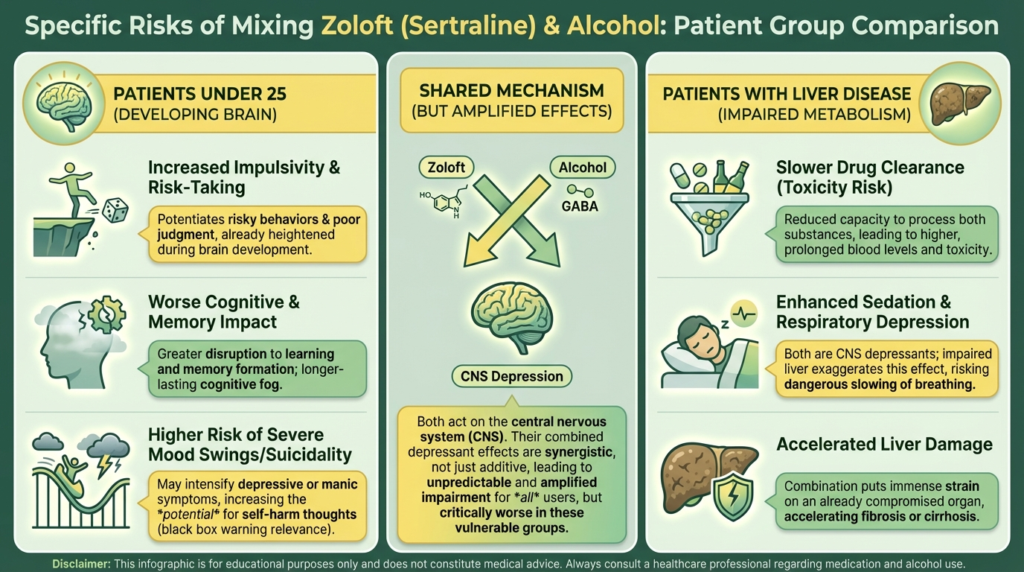
DailyMed prescribing information confirms that sertraline is extensively metabolized by the liver. Patients with liver problems already face higher drug exposure because the body clears sertraline more slowly.
Alcohol burdens the same organ, which makes the combination especially risky for anyone with liver disease.
Zoloft and Alcohol Side Effects You Should Know
The most consistently reported problem when mixing Zoloft and alcohol is additive sedation. Patient.info describes the two substances as having an additive effect that enhances each other’s sedative properties.
That means more drowsiness, more dizziness, worse coordination, slower reaction time, and poorer judgment than either substance would cause alone.
Here is a summary of the key effects:
- Increased drowsiness and fatigue
- Dizziness and loss of balance
- Impaired coordination and motor control
- Slowed reaction time, raising accident and driving risk
- Poorer judgment and more impulsive decisions
- Worsened depression and anxiety symptoms
- Disrupted sleep, including rebound anxiety the next day
- Greater danger of suicidal thinking becoming suicidal action in vulnerable individuals
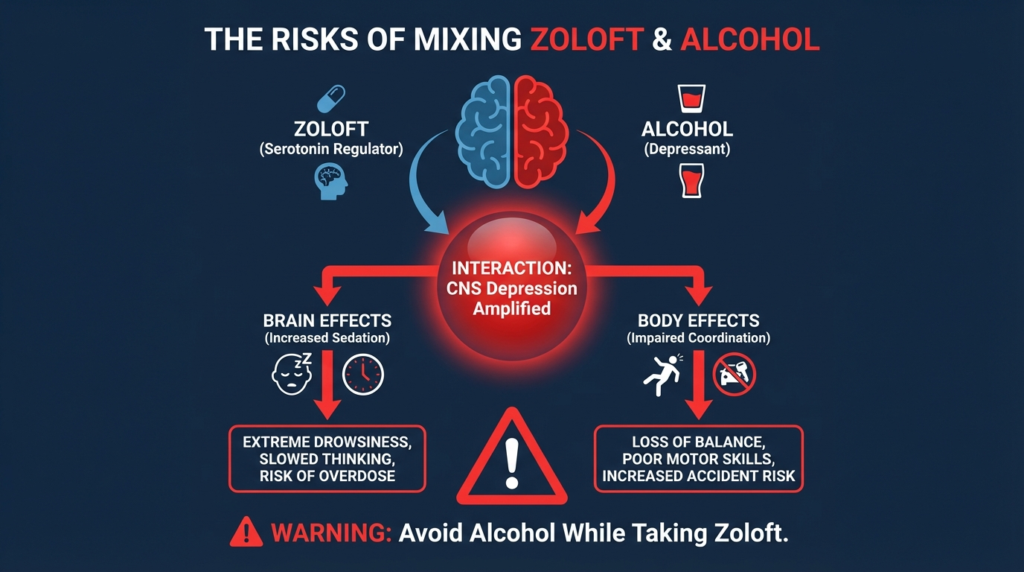
These are not rare edge cases. They are the expected result of combining two substances that both affect the brain, and they matter in everyday life: driving, working, making decisions, and managing emotional stability.
Alcohol Can Undermine Your Treatment
One of the most underappreciated risks is not a dramatic side effect but a quiet one. Alcohol can stop sertraline from working as intended. Sertraline aims to stabilize mood and reduce anxiety over weeks of consistent use.
Alcohol causes short-term sedation followed by rebound low mood, poor sleep, and next-day anxiety. If you drink regularly while taking sertraline, you may conclude the medication is not helping when alcohol is actually the reason your symptoms keep returning.
This matters most in the first weeks of treatment, when the medication has not yet reached full effect and when the brain is still adjusting.
Clinically reviewed guidance specifically advises avoiding alcohol when you first start sertraline or after a dose increase, because those are the periods of greatest vulnerability.
Can You Mix Zoloft and Alcohol Safely? The Honest Answer!
No. There is no established safe amount of alcohol for people taking sertraline. Medical News Today notes that no universally safe amount exists because metabolism varies between individuals.
Body size, age, sex, liver function, dose, other medications, and individual sensitivity all affect how strongly the combination hits any one person.
Some people point to a note in FDA labeling that says sertraline did not potentiate the acute cognitive and psychomotor effects of alcohol in healthy volunteers under controlled conditions. That finding sounds reassuring, but it is narrow.
It describes a short-term experiment in healthy adults, not patients with depression, panic disorder, PTSD, suicidal thoughts, liver disease, or other real-world factors. The broader regulatory and clinical evidence still says do not drink.
The Suicidality Risk is Especially Serious
Sertraline carries a boxed warning, the strongest warning the FDA issues, about increased suicidal thoughts and behaviors in people aged 24 and younger, particularly during the first months of treatment and after dose changes.
All patients on antidepressants should be monitored for worsening mood or emerging suicidal thinking during those windows.
Alcohol impairs judgment and lowers inhibition. Even if alcohol does not directly cause suicidal thoughts, it can increase the chance that distress or impulsive thinking leads to action. Patient.info directly notes the possible increased risk of suicidal thoughts when alcohol is consumed alongside sertraline.
That combination of a boxed warning period plus alcohol-impaired judgment is one of the clearest reasons to avoid drinking entirely while on this medication.
Who Faces the Highest Risk When Mixing Zoloft and Alcohol?
Risk is not the same for every patient. Some situations make the combination significantly more dangerous.
| Situation | Why the risk is higher |
|---|---|
| First weeks of treatment | Side effects peak and suicidality monitoring is most critical |
| After a dose increase | Mood instability and side effects may worsen temporarily |
| Under age 25 | Boxed warning for suicidal thoughts applies most strongly |
| Liver disease | Sertraline clears more slowly, raising drug exposure |
| Bipolar disorder history | Alcohol destabilizes mood and may trigger mania or hypomania |
| Seizure history | Both alcohol and sertraline affect seizure threshold |
| Taking other sedating medications | CNS depression compounds further |
| Alcohol use disorder | SSRIs may not help and can worsen drinking in some people |
The Frontiers in Psychiatry research on comorbid anxiety and alcohol dependence found that SSRIs should be used with caution in patients who are actively drinking, because the combination can lead to increased alcohol consumption in some subgroups. That is a more serious concern than most patients realize.
Serotonin Syndrome: Real but Often Overstated
Many sources warn that mixing Zoloft and alcohol raises the risk of serotonin syndrome, a potentially serious condition caused by too much serotonergic activity in the brain.
Symptoms range from mild agitation and tremor to severe confusion, high fever, rapid heart rate, muscle rigidity, and seizures.
Serotonin syndrome is a genuine risk with sertraline, but it is most commonly triggered by combining multiple serotonergic drugs, such as SSRIs with MAOIs, triptans, tramadol, or lithium.
Alcohol is not listed in official labeling as a classic serotonergic interaction partner the way those drugs are. The Cleveland Clinic describes serotonin syndrome as most likely after starting a new serotonergic medication, increasing a dose, or combining high-risk agents.
So serotonin syndrome is worth knowing about, but it is not the main everyday hazard of having a drink on Zoloft. The more common and immediate problems are sedation, impaired judgment, and worsened mood.
If you ever experience severe agitation, high fever, rapid heartbeat, muscle stiffness, or confusion after mixing these substances, seek emergency care immediately.
A Note on the Oral Solution Formulation
Most patients take sertraline as a tablet, but the oral solution form contains 12 percent alcohol. StatPearls notes that the oral solution is contraindicated with disulfiram because of this alcohol content.
This is a separate issue from social drinking, but it shows that alcohol-related prescribing considerations are built into sertraline’s formulation details and are not an afterthought.
What to Do If You Are Struggling With Alcohol While on Zoloft?
If you find it hard to stop drinking while taking sertraline, or if you are using alcohol to cope with the symptoms sertraline is supposed to treat, that pattern deserves attention.
A 2025 Therapeutics Initiative review found that serotonergic antidepressants often do not improve psychological symptoms in people with alcohol use disorder and may worsen drinking in some patients.
Simply increasing the Zoloft dose is unlikely to solve the problem if alcohol is driving the symptoms.
Warning signs that alcohol may be interfering with your treatment include:
- Feeling much more drowsy or dizzy than expected after small amounts of alcohol
- Worsening depression or anxiety after drinking
- Skipping doses to drink
- Using alcohol to manage anxiety or low mood
- No improvement in symptoms after several weeks of otherwise consistent treatment
If any of these apply to you, talk to your prescribing clinician. Do not stop sertraline abruptly to make room for drinking.
Official labeling is clear that sertraline should be tapered gradually rather than stopped suddenly, because discontinuation symptoms can occur.
The Bottom Line on Zoloft and Alcohol Interactions
Mixing Zoloft and alcohol is not recommended, and the evidence behind that recommendation is strong.
The main risks are additive sedation, impaired coordination and judgment, worsened depression and anxiety, and greater danger during the vulnerable early weeks of treatment. In overdose or co-ingestion situations, alcohol also appears in FDA labeling as a factor that can complicate toxicity.
There is no reliable safe amount of alcohol for people taking sertraline. The safest choice is to avoid it entirely, especially when starting treatment, after dose changes, or if you are under 25 or have any of the higher-risk conditions described above.
If you do choose to drink despite the guidance, keep it to a very small amount, drink slowly with food, and never drive afterward.
The deeper issue is that alcohol and sertraline are working against each other. One is trying to stabilize your mood and anxiety over time. The other is a depressant that disrupts sleep, lowers mood, and impairs the judgment you need to stay safe and consistent with treatment.
If alcohol use is making it harder to get the most from your mental health treatment, speaking with a specialist can help.
So, reach out to The Summit Wellness Group to learn about dual diagnosis treatment options that address both substance use and mental health together.