Tennessee’s new kratom ban is the clearest warning yet for states still debating whether to regulate or prohibit the substance. As of July 1, 2026, Tennessee treats kratom possession as a criminal offense, making it one of eight states to fully ban kratom. This article breaks down what Tennessee’s law actually says, how Georgia’s current rules compare, and what the future of kratom regulation could look like for consumers, retailers, and clinicians across the country.
Tennessee’s Kratom Ban and What It Means for Georgia
Georgia has not banned kratom. As of July 2026, kratom remains legal for adults 21 and older in Georgia under a tightened regulatory framework. But Tennessee’s decision to criminalize possession and sale shows exactly what Georgia’s legislative landscape could look like if a future prohibition bill gains enough support.
The contrast between the two states is sharp. Georgia regulates kratom as a consumer product. Tennessee now treats it as a controlled substance. Understanding that gap matters for anyone who uses kratom daily, sells it, or works in addiction medicine.
How Tennessee’s Ban Became Law
Tennessee’s Matthew Davenport’s Law, formally HB1649/SB1656, was signed by Governor Bill Lee on May 7, 2026, and took effect July 1, 2026. The law makes Tennessee the eighth U.S. state to fully ban kratom.
The penalties under the enacted law are significant:
- Knowing possession of kratom: Class A misdemeanor, up to 11 months and 29 days in jail and up to a $2,500 fine
- Manufacture, delivery, sale, or possession with intent: Class C felony, 3 to 15 years and up to a $10,000 fine
- Sale or delivery to a minor by an adult who knew the person was a minor: Class B felony, 8 to 30 years and up to a $25,000 fine
It is worth noting that the original introduced version of the Tennessee bill was harsher. The initial HB1647/SB1655 proposed Class D felony possession and Class A felony sale to a minor. The final enacted version reduced each tier by one class before passage. That kind of amendment is common, but the core policy choice, moving from regulation to prohibition, stayed intact throughout the process.
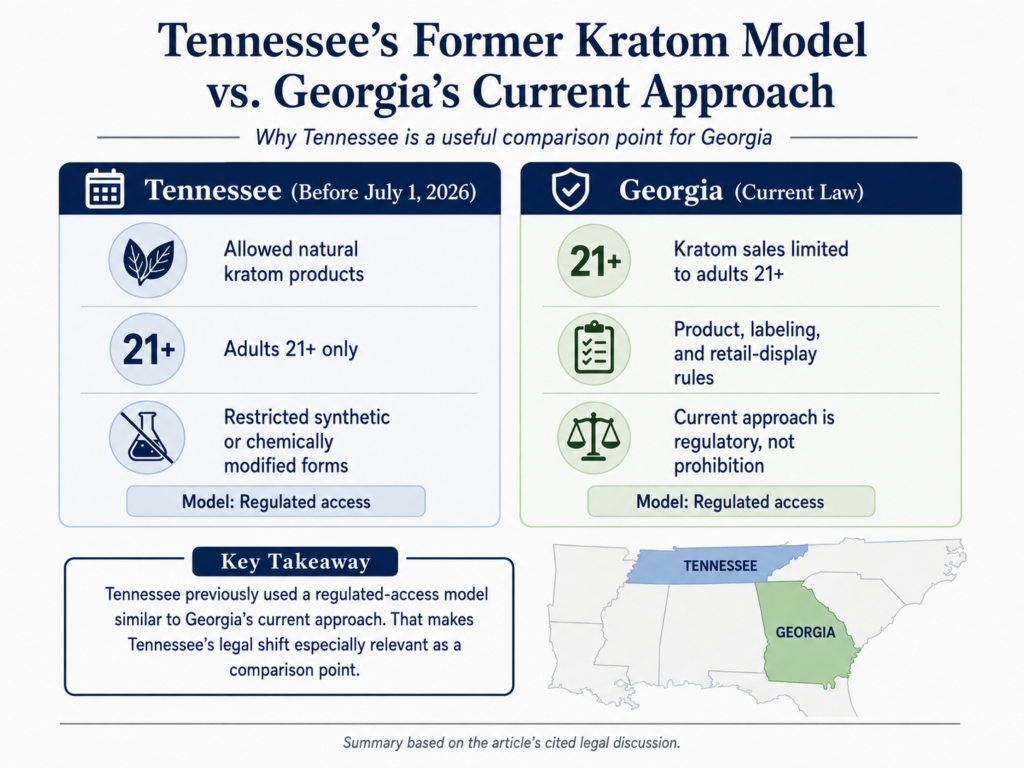
Before July 1, 2026, Tennessee allowed natural kratom products for adults 21 and older under Tennessee Code § 39-17-452, while restricting synthetic or chemically modified forms. In other words, Tennessee previously had a regulated-access model, not unlike Georgia’s current approach. That makes the shift especially relevant as a comparison point.
What Happened to Retailers After the Ban
The practical effect on Tennessee’s retail market was immediate. Compliant retailers stopped shipping kratom into the state because sale or delivery became a felony under the new law. Products that were legal one day became contraband the next. That is the real-world outcome of moving from a regulated-access model to a prohibition model, and it is the scenario Georgia consumers and retailers should understand clearly.

Georgia Kratom Laws: Regulated but Still Legal
Georgia’s current approach is best described as regulated but legal. Adults 21 and older can still buy and possess compliant kratom products. Retailers and processors must follow age-verification, behind-counter display, labeling, testing, alkaloid-content, and anti-adulteration rules created or strengthened by Georgia’s Kratom Consumer Protection Act framework and HB181, which took effect January 1, 2025.
Georgia HB181, signed by Governor Brian Kemp on May 2, 2024, made several concrete changes to how kratom is sold and accessed in the state:
- Raised the minimum purchase age from 18 to 21
- Required kratom products to be kept behind a display counter or in a secured display accessible only with employee assistance
- Added labeling requirements including mitragynine and 7-OH content, serving size, batch or lot number, expiration date, and a visible 21-plus warning
- Capped 7-hydroxymitragynine at 2 percent of total alkaloid content
- Prohibited synthetic alkaloid additives and adulteration with non-kratom substances
- Banned ingestion through vaping or similar devices
These are not minor adjustments. Georgia is not simply asking retailers to card customers. The state is trying to standardize product safety, reduce youth access, and address the concentrated 7-OH products that have drawn the most regulatory concern nationally.
What the 7-OH Cap Actually Does
The 2 percent cap on 7-hydroxymitragynine is one of the most important parts of Georgia’s current rules. Much of the recent push for outright bans, in Tennessee and elsewhere, has been driven not by traditional kratom leaf but by concentrated or synthetic 7-OH products that can produce stronger opioid-like effects. Georgia’s cap targets that specific risk without eliminating adult access to compliant products.
A product marketed primarily as 7-OH, or one with synthetic alkaloid additives, may not comply with Georgia standards even if kratom itself remains legal in the state. Consumers purchasing kratom online should compare the product’s label and disclosed alkaloid content with the requirements in Georgia Code § 16-13-122, rather than relying only on a seller’s general claim that kratom is legal in Georgia. Georgia does not appear to maintain a public registry of approved kratom products, so the required labeling is the primary product-level source of compliance information.
Georgia HB968: The Prohibition Bill That Died
Georgia HB968 was introduced January 14, 2026, moved to committee March 6, 2026, and was listed as dead on April 2, 2026, according to BillTrack50.
The source of most confusion about Georgia’s kratom status is HB968, introduced in the 2026 legislative session. The bill proposed classifying both mitragynine and 7-hydroxymitragynine as Schedule I controlled substances under Georgia law. If enacted, it would have replaced Georgia’s product-regulation model with criminal prohibition, making possession, sale, manufacture, and distribution criminal offenses rather than retail compliance issues.
That said, HB968 matters politically. Georgia lawmakers heard hours of testimony on the bill in February 2026, including testimony from families who lost loved ones and from Georgia’s poison center, which reportedly logged a 66 percent increase in kratom-related exposure calls since 2022. The bill shows that the prohibition model has entered Georgia’s legislative agenda, even if it failed this session.
The core legal shift HB968 would have made is worth understanding clearly. Under current Georgia law, kratom is a regulated product. Under HB968, kratom’s primary alkaloids would become Schedule I substances. That moves the question from “did the retailer follow consumer-protection rules?” to “did the person possess a controlled substance?” Those are very different legal frameworks with very different consequences for daily users.
Kratom Laws by State: The Broader Picture
As of July 2026, the national map shows two dominant models. More than thirty states regulate kratom under some form of Kratom Consumer Protection Act framework. Eight states have fully banned it: Alabama, Arkansas, Indiana, Louisiana, Vermont, Wisconsin, Connecticut, and now Tennessee.
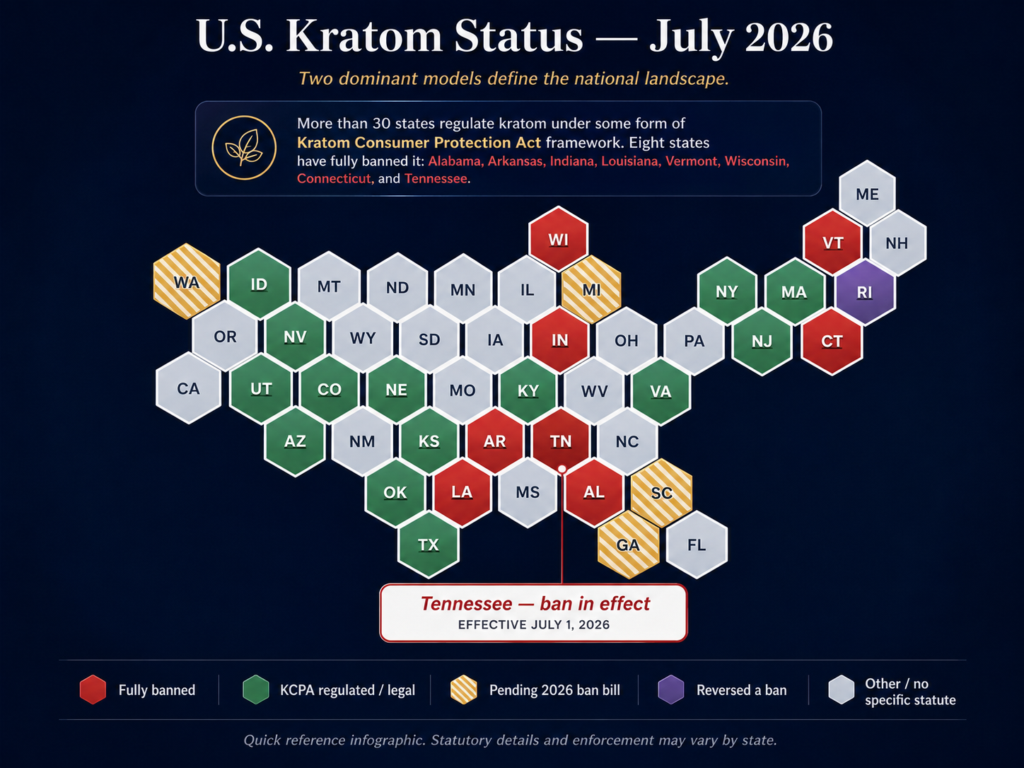
The trend is not entirely one-directional. Rhode Island reportedly reversed a ban and moved to a regulated framework effective April 1, 2026, showing that states can move from prohibition back to regulation. But Tennessee’s 2026 ban and Georgia’s HB968 proposal suggest that prohibition bills have real momentum in some legislatures, particularly in the South.
The table below shows where Georgia and Tennessee stand right now:
| Issue | Georgia (July 2026) | Tennessee (July 2026) |
| Overall status | Legal for adults 21+ under regulation | Fully banned statewide |
| Adult possession | Legal if product is compliant | Class A misdemeanor |
| Sale | Legal only if compliant with all rules | Class C felony |
| 7-OH products | Legal within regulatory limits, capped at 2% | Covered by statewide ban |
| Retail display | Behind counter or secured display required | No lawful retail sales |
| Vaping products | Prohibited | Covered by ban |
| Pending ban? | HB968 proposed Schedule I but was not enacted | Ban already in effect |
The Kratom Ban 2026 Debate: Regulation vs. Prohibition
The strongest case for Georgia’s current model is that it addresses the highest-risk market features without criminalizing adult users. Age restrictions reduce youth access. Labeling and testing reduce unknown potency and contamination. The 7-OH cap addresses concentrated products. Behind-counter display reduces casual access. Anti-adulteration rules target synthetic or dangerous additives.
The strongest case for Tennessee’s approach is that lawmakers concluded regulation was not enough. Supporters cited overdose concerns, dependence, inconsistent product strength, and the wide availability of products in convenience stores and smoke shops. Local reporting described kratom as widely available and noted supporters’ concerns about health risks and overdose links.
There is a real tradeoff here that often gets lost in the debate. Regulation tries to make the market safer. Prohibition tries to eliminate the market. But prohibition may push some use into informal channels where labeling and testing are less likely. That is a practical concern for dependent users, people managing chronic pain, and anyone using kratom to avoid illicit opioids. Sudden access changes can trigger withdrawal, anxiety, sleep problems, or a return to prescription or illicit opioids if people lack support.
Georgia’s regulatory model will only stay credible if it is actively enforced. If retailers ignore labeling, age checks, display rules, and the 7-OH cap, prohibition advocates will have stronger arguments in future sessions. In that sense, Georgia’s best defense against a ban is serious enforcement of the rules already on the books.

What Georgia Users and Retailers Should Know Right Now
For daily users in Georgia, the correct practical message is not panic but compliance and awareness. A few specific points matter most.
If you are 21 or older and buy compliant, labeled kratom products from a retailer following Georgia’s display and age-verification rules, you are operating within the law as it stands today. If you use concentrated 7-OH products or buy online without checking whether products meet Georgia’s concentration and labeling standards, your legal exposure is less clear.
If you drive into Tennessee with kratom after July 1, 2026, you face serious risk. A product that is legal in Georgia becomes a Class A misdemeanor the moment you cross the state line. That is not a hypothetical. It is the current law.
For retailers, Georgia’s rules require behind-counter or secured display, age verification, compliant labeling, and product testing. Open-shelf access is not the legal model in Georgia, and retailers who treat kratom like an ordinary supplement are not in compliance with HB181’s requirements.
For clinicians, the 7-OH issue deserves specific attention. Concentrated 7-OH products can produce opioid-like withdrawal and may meet criteria for opioid use disorder in some patients. Patients may not volunteer that they use these products, especially if they view them as supplements. Asking directly about kratom, kratom shots, extracts, and 7-OH products is worth adding to standard screening.
Why Tennessee’s Experience Matters Beyond Its Borders
Tennessee is not just a cautionary tale for Georgia. It is a data point for every state still debating the regulation-versus-prohibition question. The state had a regulated-access model, heard the same arguments Georgia is hearing now, and chose prohibition. The result is a criminal penalty structure for possession and a felony charge for sale, with no lawful adult consumer market remaining.
Georgia is not there yet. HB968 failed. The regulated-but-legal framework is still in place. But the political conditions that produced Tennessee’s ban, rising poison-center reports, concentrated 7-OH products in gas stations, and families testifying about losses, are present in Georgia too. The next legislative session could bring another prohibition bill, and the next one after that.
The most honest summary of where things stand is this: Georgia is a regulated-legal state under real political pressure toward prohibition. Daily users, retailers, and clinicians should treat that pressure as ongoing, not resolved.
If you or someone you care about is struggling with daily kratom or 7-OH use and wants to understand treatment options in Georgia, the team at Summit Wellness Group offers evidence-based addiction treatment programs, including medication-assisted treatment, at accredited facilities in Atlanta and Roswell.