How much a partial hospitalization program costs depends mainly on your insurance plan’s allowed amount for each treatment day, not the facility’s posted price. Insured patients often pay $135 to $545 a day in coinsurance once the deductible is met, while someone without coverage might pay $300 to $800 a day. This guide covers what drives partial hospitalization program cost, how insurance changes what you owe, and how to build a realistic estimate before treatment.
What Shapes Partial Hospitalization Program Cost
A lot of people ask how much does PHP cost and expect one clean number. There isn’t one. Partial Hospitalization Programs are usually billed as a bundled per diem, meaning one payment covers a full day of care rather than each group session, medication check, or therapy hour separately. Many commercial insurers treat the per diem payment as inclusive of facility, professional, and other services delivered that day, so you generally cannot add up separate session fees to guess your bill.
What actually moves the number is a short list of variables. Here are the ones that matter most:
- Your plan’s allowed amount for the day, not the facility’s billed charge
- Whether the facility and its billing entity are in your network
- How much of your deductible is left
- Your coinsurance percentage after the deductible
- How many days your insurer authorizes at a time
- Which services are bundled into the daily rate versus billed apart
Get these six answers and you have a real PHP cost estimate. Skip them and you’re guessing.
Typical Per Diem Rates And Billing Codes
Common Codes You Might See On A Bill
Facilities usually bill PHP using one of two HCPCS codes, H0035 or S0201, paired with a revenue code such as 0912 or 0913. Billing guidance describes S0201 as per diem partial hospitalization care furnished in less than 24 hours, and notes that a program should not bill both codes for the same day. Which code your insurer accepts is a contract question, not a rule of thumb. Some commercial plans reimburse H0035 for mental health PHP, and others require S0201, so a code that works for one payer may get denied by another.
The dollar amount tied to these codes varies a great deal too. One Colorado commercial fee schedule lists H0035 at about $271 per day for certain clinician types, while other markets show very different figures for the same code. This is exactly why a national average is a starting point for conversation, not a quote you can rely on for your own bill.
How Much Does PHP Cost With Insurance
Deductible, Coinsurance, And Your Out Of Pocket Max
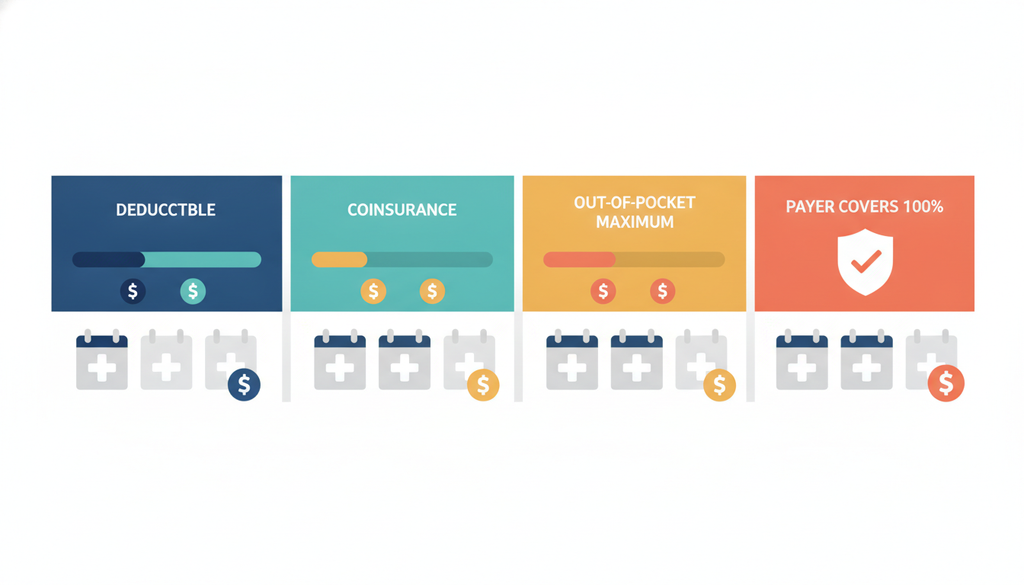
If you’re asking how much does partial hospitalization cost with insurance, the honest answer is that it depends on three moving parts working together. First comes your deductible. If you haven’t met it yet, you generally pay the full allowed amount for each PHP day until the deductible is used up. Once that happens, coinsurance kicks in, so you pay a set percentage of the allowed amount for each additional day. Finally, your out of pocket maximum acts as a ceiling. Once you hit it, covered in network care is generally paid in full for the rest of your plan year.
The order matters. A plan that says “30 percent coinsurance” tells you almost nothing on its own if you still have $1,000 of deductible left, because that portion gets paid in full before coinsurance even starts.
A Real World Example
Say your plan’s allowed amount is $500 a day, your remaining deductible is $1,000, your coinsurance is 30 percent, and your insurer authorizes five days to start. You’d pay the full $500 for day one and day two, since that covers your remaining deductible. From day three onward, you’d owe 30 percent of $500, or $150 a day. Add it up: $500 plus $500 plus $150 plus $150 plus $150 equals $1,450 for that five day block. A shortcut estimate of 30 percent times $2,500 total charges would have wrongly suggested $750, missing the deductible entirely.
Now picture a patient whose deductible is already met. At an allowed amount of $424 a day and 40 percent coinsurance, ten days of treatment works out to $169.60 per day, or $1,696 total. Same treatment length, very different math, because the deductible status changed everything.
Typical Price Ranges You Might See
Without insurance, a single day of PHP is often quoted somewhere between $300 and $800, and the cost of PHP can climb higher depending on the facility, location, and program intensity. With insurance, the picture looks different because you’re paying a share of the allowed amount rather than the sticker price. Real world transparency data shows negotiated PHP rates ranging from about $209 to $545 a day depending on the code, revenue code, and region, which explains why two patients at two different facilities can have wildly different bills for what looks like the same level of care.
Plan design adds another layer. Many commercial policies treat PHP and IOP as mutually exclusive services on the same date, so you generally shouldn’t expect to be billed for both types of programming on one day. Coinsurance percentages themselves vary by plan too. One published Wisconsin marketplace schedule lists 30 percent coinsurance after deductible for PHP, while a similar plan from the same insurer lists 40 percent. That ten point difference alone can change your bill by a third at the same daily rate.
Why Authorization Changes Your PHP Cost
Cost and coverage don’t mean much if your insurer hasn’t approved the days you’re attending. Most commercial plans require prior authorization before PHP starts, and then approve care in blocks rather than for the whole expected stay at once. Industry billing guidance commonly describes an initial authorization period of about five to ten days, followed by ongoing review if treatment needs to continue.
That number is a common pattern, not a promise. Your actual authorization letter is the only document that tells you how many days are approved, the start and end dates, the level of care, and the deadline for your treatment team to request more days. A gap between authorization periods, caused by a late or incomplete review request, is one of the most avoidable ways patients end up owing for unauthorized days even though their care was appropriate the whole time.
How To Estimate Partial Hospitalization Program Cost
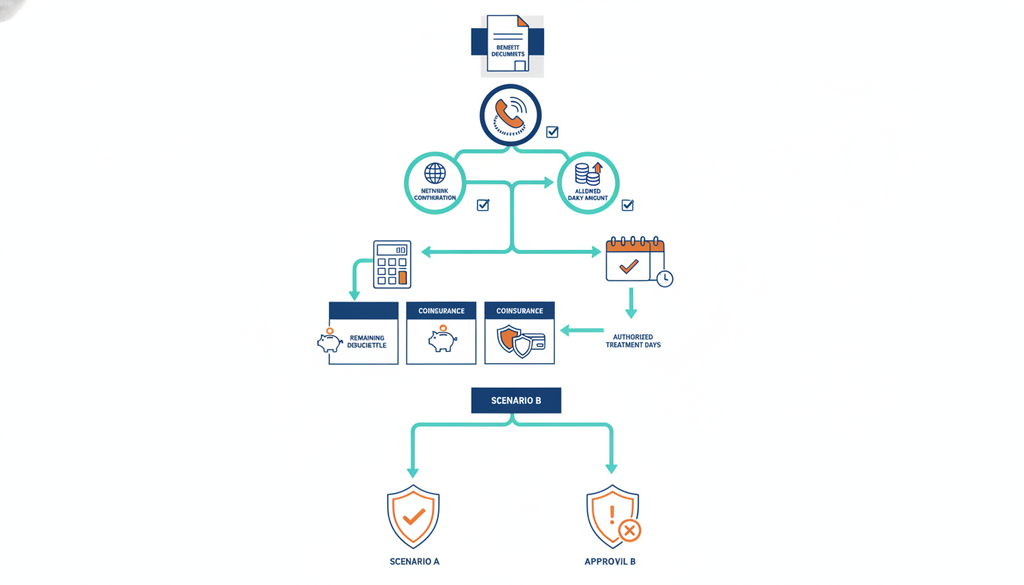
A trustworthy partial hospitalization program cost estimate isn’t a single dollar figure pulled from a brochure. It’s a range built from five specific facts:
- The in network allowed amount for your facility’s PHP day
- Your remaining deductible as of today
- Your coinsurance or copay rule after deductible
- Your remaining annual out of pocket maximum
- The number of days currently authorized
You’re entitled to ask your insurer for each of these numbers directly, and you can also request a full copy of your plan’s coverage certificate at no charge if the summary you have on hand doesn’t spell out PHP benefits clearly. A benefits call that only produces a coinsurance percentage, with no mention of the allowed amount or deductible status, hasn’t actually answered the question you asked.
Once you have those five numbers, build two scenarios rather than one. The first covers the days already authorized. The second covers what happens if treatment continues beyond that, capped by whatever remains of your out of pocket maximum for the year. That second cap matters more than people expect. If you’re close to your maximum already, several more PHP days might cost you very little, because the plan starts covering the full allowed amount once you cross that line.
Why This Matters
Getting a real number before admission protects you from two different kinds of surprise. The first is a bill based on the facility’s full charge rather than your plan’s actual allowed amount, which can be several times higher. The second is a gap in coverage caused by an authorization that expired without anyone noticing. Both are avoidable with the same basic homework: confirm network status, get the allowed amount, check your deductible and out of pocket numbers, and keep track of your authorized days as treatment goes on.
PHP can be a genuinely useful level of care for someone who needs more support than weekly therapy but doesn’t need round the clock hospitalization. Knowing what it will actually cost you, rather than guessing from a general price range, makes it much easier to say yes to that care with confidence instead of worry.
If you’re weighing your options and want to talk through what treatment could look like for you or someone you love, you can explore treatment programs at Summit Wellness Group and get real answers about the next step.