Sober curious means questioning your relationship with alcohol without committing to full abstinence, and a short break often starts that process. A common test is a 30 day break like Dry January, where about 70 percent of official registrants stay completely dry for the month, though many notice cravings or trouble keeping their own limits along the way. This article covers the sober curious meaning behind that test, what those reactions can mean, and when they call for real support.
Sober Curious Meaning and Why People Ask the Question
Sober curious meaning is simpler than it sounds. It describes someone who questions how alcohol fits their life, tries stretches of time without it, and pays attention to what changes rather than promising to quit forever. The term covers people who just want clearer mornings and people who might be dealing with something more serious, so it works better as a starting point for noticing your habits than as a diagnosis.
That distinction matters because an alcohol use disorder diagnosis depends on a specific pattern, not vague unease. The clinical criteria look for signs of impaired control, harm to relationships or work, risky use, and physical signs like tolerance or withdrawal, with at least two showing up in the same year before anyone considers a diagnosis. Being sober curious does not require meeting any of those criteria. It just requires curiosity about your own drinking.
What Does Sober Curious Mean During a Real Break
So what does sober curious mean once you actually stop drinking for a while? In practice, it means paying attention to your own reactions without assuming the worst about yourself. Some people move through a month with mild boredom and little else. Others notice cravings, restless nights, or short tempers in the first week and wonder what that says about them.
Most of these reactions are ordinary adjustment, not a medical event. But sleep trouble paired with tremor, sweating, nausea, or a racing pulse in the first day after cutting back can point to early alcohol withdrawal, which can occasionally become dangerous. Hallucinations, seizures, or confusion are not something to wait out at home. Those signs need urgent medical attention, not another day of toughing it out.
The Sober Curious Movement Behind Dry Months
The sober curious movement grew alongside campaigns like Dry January, which frame a month off alcohol as a chance to reset habits rather than a punishment. Alcohol Change UK promotes the challenge with daily support and a tracking app, and it directly warns people who may be dependent on alcohol against quitting abruptly on their own, since sudden stopping can carry real risk for that group.
Numbers from one tracked cohort explain why the movement caught on, and why it is not a fix for everyone. About 70 percent of official registrants finished the month, compared with roughly 36 percent of people who attempted it on their own. Six months later, 59 percent of registrants who completed the month still showed a meaningful drop in their drinking scores, against 36 percent of people who never attempted a dry month at all. A month can open a door. It rarely walks you all the way through on its own.
What a Break Actually Tests
A break tests something more specific than willpower. It tests whether you can hold a limit you set for yourself. If you plan two drinks on a Saturday and repeatedly end up with six, or you promise weekdays off and keep sliding into a Wednesday drink, that pattern maps onto a real criterion, drinking more or longer than you meant to, plus a second one covering unsuccessful attempts to cut back. Two of those showing up over a year, alongside real distress or disruption, can already meet the bar for mild alcohol use disorder.
One skipped day or one abandoned attempt proves none of that by itself. Life happens, plans slip, and a single lapse is just a lapse. What matters is whether the pattern repeats, month after month, rule after rule.
Craving, Sleep Trouble, and Ending Early
A handful of experiences show up again and again during a break, and each one carries a slightly different weight.
- Craving is a recognized symptom on its own, but it does not confirm anything by itself unless it repeats and drives loss of control
- Restless sleep or mild anxiety in the first days is often just adjustment, not a medical event
- Repeatedly breaking your own rules on allowed drinking days points toward impaired control rather than bad luck
- Ending the break early once is a lapse, but ending it early again and again suggests real trouble regaining control
- Drinking more once the break ends can reveal a rebound pattern that needs a plan, not just willpower
None of these settle the question of alcohol use disorder on their own. Together, especially the last three, they build a picture worth talking through with someone trained to read it.
Screening Scores and What They Really Mean
A short screening tool is not a diagnosis. It asks how often you drink, how much on a typical day, and how often you have six or more drinks at once, with scores running from 0 to 12. A common positive result sits at 4 or higher for men and 3 or higher for women, while VA and DoD guidance uses a single cutoff of 5 or higher for everyone.
A high score does not mean you have alcohol use disorder. A low score does not clear you either. The number just tells a clinician whether a fuller conversation is worth having, based on your pattern over the past year, not just the month you happened to take off.
When a Break Points to Something More
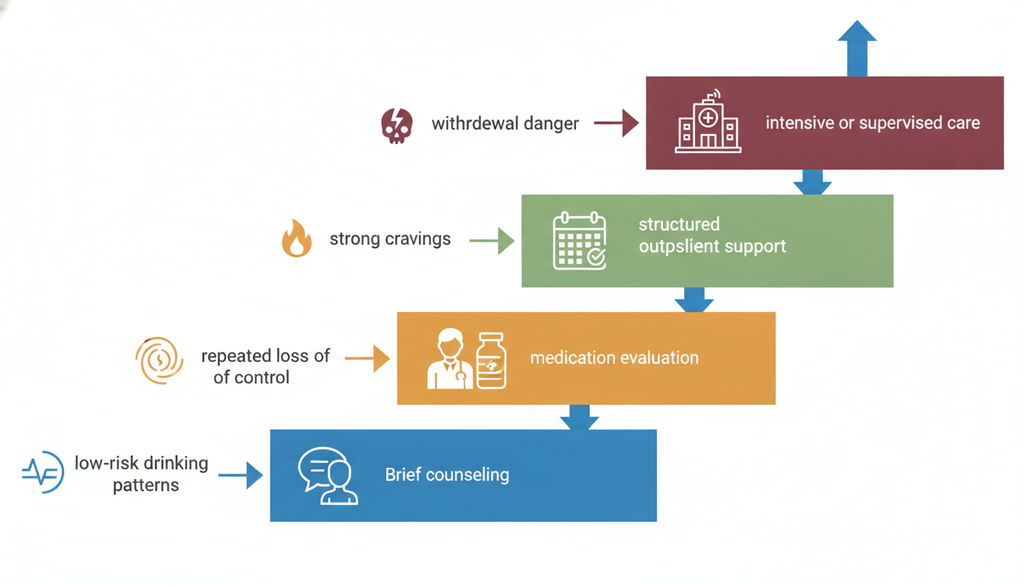
For most people with a positive screen and no signs of withdrawal risk, brief counseling and a follow up conversation are a reasonable next step. National screening guidance supports exactly that approach for adults with risky drinking patterns.
But repeated failed attempts to cut down, strong cravings that drive loss of control, or any withdrawal symptoms during the break call for a different response. Addiction medicine guidance recommends matching care to actual risk, which sometimes means structured outpatient care or medically supervised support rather than another solo attempt at the same month. Trying the identical 30 day challenge again and again without changing the plan rarely changes the outcome.
Why This Distinction Matters
Knowing what does sober curious mean for your own life comes down to paying attention rather than judging yourself. A break can be genuinely useful information. It can also be the moment you notice a pattern that needs more than a calendar reminder and a bit of willpower.
The goal is not to pass or fail 30 days. It is to notice whether alcohol controls your choices more than you would like, and to get real support if it does.
If your break revealed more than curiosity, you do not have to sort out the next step by yourself. Talk to a counselor at The Summit Wellness Group and figure out a plan that actually fits what you need.