Kratom and 7-hydroxymitragynine are often discussed as if they are the same thing, but that assumption can be dangerously misleading.
Traditional kratom leaf contains mostly mitragynine with only trace amounts of 7-hydroxymitragynine, while many modern products sold as “kratom” deliver concentrated or semi-synthetic 7-hydroxymitragynine at levels far above what occurs naturally.
The difference matters because 7-hydroxymitragynine is a much more potent opioid-like compound with substantially higher risks of respiratory depression, dependence, and overdose. This article explains how these substances differ in potency, effects, and safety so you can make informed decisions.
What Are Kratom and 7-Hydroxymitragynine?
Kratom comes from the leaves of *Mitragyna speciosa*, a tropical tree native to Southeast Asia. For generations, people in that region chewed fresh leaves or brewed them as tea for pain relief, energy, and help with opioid withdrawal. Traditional kratom is a whole-leaf botanical preparation containing a mix of alkaloids, with mitragynine as the dominant compound.
7-Hydroxymitragynine, often shortened to 7-OH, is both a minor natural alkaloid in kratom leaves and an active metabolite that forms when your body breaks down mitragynine. In natural leaf, 7-OH appears only in trace amounts, typically less than 2% of total alkaloids.
That low baseline exposure is important because it helps explain why traditional kratom leaf behaves differently than concentrated 7-OH products.
The U.S. market has changed dramatically in recent years. What started as powders and teas now includes gummies, liquid shots, tablets, and products labeled as “kratom extract” that contain chemically enriched or semi-synthetic 7-OH at concentrations hundreds of times higher than natural leaf.
Some products marketed as kratom are actually closer to engineered opioid-active alkaloid formulations than to plant material.
How 7-Hydroxymitragynine and Kratom Differ in Potency?
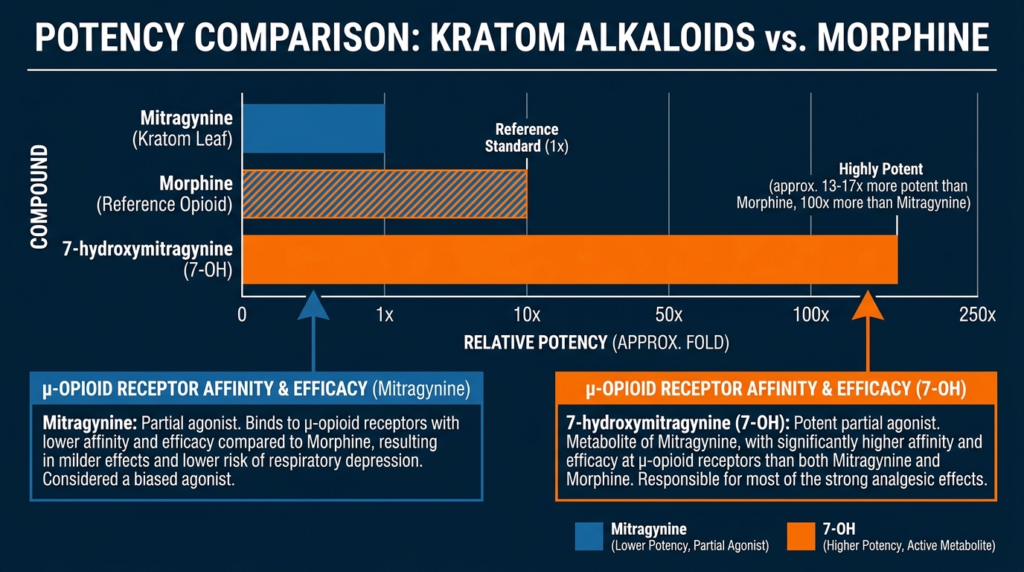
The most consistent finding across recent research is that 7-hydroxymitragynine is substantially more potent than mitragynine. While mitragynine acts as a partial μ-opioid receptor agonist with a broader pharmacologic profile, 7-OH binds more tightly to opioid receptors and produces stronger opioid-like effects.
Studies report that 7-OH has nanomolar affinity at the μ-opioid receptor and may be 13 to 22 times more potent than morphine in some experimental systems.
One mechanistic study found 7-OH was 22-fold more potent than mitragynine as a μ-opioid receptor agonist and 13-fold more potent than morphine in a guinea pig ileum assay. These numbers vary by assay design, but the qualitative direction is clear: 7-OH is a high-potency opioid-like compound, not a weak botanical trace constituent.
The potency difference becomes even more pronounced when you compare traditional kratom tea to a concentrated 7-OH gummy or shot.
Traditional kratom delivers mostly mitragynine and depends partly on your body’s metabolism to convert some of that mitragynine into 7-OH. Concentrated 7-OH products bypass that natural moderating step and deliver the potent active compound directly, often in highly enriched form.
Potency Comparison Table
| Comparison | Evidence-Based Conclusion |
|---|---|
| 7-OH vs. mitragynine | 7-OH is substantially more potent and has higher efficacy at μ-opioid receptors |
| 7-OH vs. morphine | 7-OH often exceeds morphine in functional potency in preclinical systems |
| Concentrated 7-OH vs. traditional kratom | Concentrated 7-OH can be dramatically more opioid-like because it directly delivers the potent active constituent rather than relying on limited metabolic formation |
How They Work: Mechanism of Action
Both mitragynine and 7-OH interact with opioid receptors in your brain, especially the μ-opioid receptor responsible for pain relief, euphoria, and respiratory depression. But they do not interact equally.
Mitragynine has lower μ-opioid receptor affinity and efficacy. It also appears to affect adrenergic and serotonergic systems, giving it a more complex pharmacologic profile.
At lower doses, kratom can feel stimulating or energizing. At higher doses, it produces more sedative and opioid-like effects. Much of kratom’s opioid activity depends on your liver converting mitragynine into 7-OH through an enzyme called CYP3A4.
7-Hydroxymitragynine, by contrast, is a stronger and more selective μ-opioid receptor agonist. It has higher receptor affinity, greater efficacy, and produces more clearly opioid-like effects including analgesia, sedation, respiratory depression, tolerance, dependence, and withdrawal.
When you take concentrated 7-OH directly, you bypass the need for metabolic conversion and can experience much higher and faster exposure to this potent compound.
Some research suggests kratom alkaloids may produce different receptor signaling patterns than classical opioids like morphine, a property called biased agonism. This has led to speculation that kratom might offer opioid-like pain relief with fewer side effects.
However, newer toxicology evidence shows that concentrated 7-OH still produces the core toxicodynamic liabilities of opioids, including respiratory depression and dependence, despite any signaling differences at the molecular level.
Effects of Traditional Kratom Leaf
Traditional kratom has historically been used for pain relief, mood enhancement, fatigue reduction, and relief of opioid withdrawal symptoms.
Its effects are often described as dose-dependent and mixed, with lower doses sometimes associated with more stimulant-like or activating properties and higher doses with more opioid-like sedation and analgesia.
Commonly reported effects of traditional kratom include:
- Pain relief
- Increased energy at lower doses
- Sedation and relaxation at higher doses
- Mood elevation
- Reduced opioid withdrawal symptoms
- Improved focus and motivation
One of the most important recent pieces of evidence is a 2025 randomized trial of dried kratom leaf powder in healthy volunteers. This study reported no serious adverse events, no deaths, and common treatment-emergent adverse events that included dizziness, nausea, relaxation, headache, feeling hot, and increased liver enzyme levels in multiple-dosing phases.
The researchers found no evidence of meaningful abuse potential or withdrawal in the dose ranges tested and concluded the tested product was safe and well tolerated at the studied doses.
This trial is significant because it provides controlled human data on a well-characterized leaf product, not a mislabeled extract. It supports the view that traditional or authentic dried leaf kratom can have a risk profile that is significantly milder than concentrated 7-OH products.
However, the study does not prove kratom is universally safe. It was conducted under controlled conditions with healthy volunteers, a specific product, and bounded dose ranges.
Effects of Concentrated 7-Hydroxymitragynine
Concentrated 7-OH produces a much sharper opioid-like effect profile than leaf kratom. Because it acts strongly at μ-opioid receptors, its effects align more closely with classical opioids.
Reported effects of concentrated 7-OH include:
- Strong pain relief
- Sedation and drowsiness
- Euphoria or mood elevation
- Relaxation
- Slowed breathing
- Confusion or altered mental state
- Nausea and vomiting
Animal experiments summarized in a 2025 review demonstrated robust antinociception, respiratory depression, tolerance, dependence, and reinforcing properties.
These are classic opioid toxicology signals. The review concluded that concentrated 7-OH products are pharmacologically and toxicologically distinct from kratom leaf and pose significant risks of morbidity and mortality.
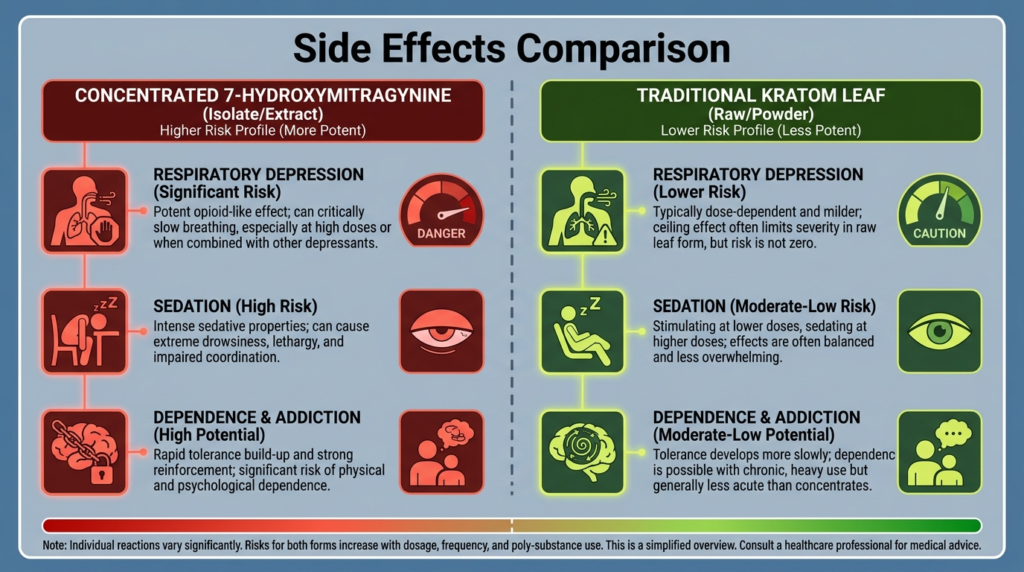
The most important acute safety difference between 7-OH and ordinary leaf kratom is respiratory depression. Because 7-OH acts strongly at opioid receptors, it can slow or stop breathing, especially when mixed with alcohol, sedatives, or other opioids.
Public health agencies explicitly warn of overdose risk and note that naloxone may reverse opioid effects, though reversal may be incomplete when multiple substances are involved.
Side Effects of Kratom Leaf
Traditional kratom is not without risks. Commonly described adverse effects include:
- Nausea
- Dizziness
- Headache
- Feeling hot
- Sedation or relaxation
- Gastrointestinal effects
- Elevated liver enzymes in some cases
- Dependence and withdrawal in frequent or heavy users
- Seizure and liver injury concerns in some reports
- Possible cardiotoxicity in emerging case literature
Kratom can be habit-forming and can produce dependence and withdrawal, though the severity may vary and may be less severe than with many classical opioids in some cases. Withdrawal symptoms can include restlessness, body aches, fatigue, irritability, and cold sweats.
Kratom-related liver toxicity is a recurrent concern. A 2026 systematic review concluded that further research is needed to better characterize kratom’s mechanisms of liver injury and to inform clinical decision-making.
A 2025 systematic review also examined seizures associated with kratom use, reflecting that seizure risk remains part of the adverse-event landscape, especially in uncontrolled real-world contexts.
Leaf products can also be unsafe due to heavy metals, bacterial contamination, salmonella outbreaks, adulterants, and inaccurate alkaloid labeling. These are not necessarily intrinsic to kratom pharmacology, but they matter to real-world safety.
Side Effects of 7-Hydroxymitragynine
The evidence base consistently presents concentrated 7-OH as having a much sharper opioid-like side-effect profile than leaf kratom. Reported or inferred adverse effects include:
- Respiratory depression
- Sedation and loss of consciousness
- Nausea and vomiting
- Agitation or confusion
- Sweating
- Rapid heart rate
- High blood pressure
- Seizures
- Tolerance
- Dependence
- Withdrawal symptoms
- Overdose
- Possible death, especially with co-use or high-potency products
Dependence risk is one of the most consistently emphasized hazards of 7-OH. The Kansas Department of Health and Environment reported the FDA had received harmful-effect reports including addiction and withdrawal symptoms such as restlessness, body aches, fatigue, irritability, and cold sweats.
Because 7-OH acts strongly at opioid receptors, it can cause respiratory depression, and public health agencies explicitly warn of overdose, especially when mixed with alcohol or sedatives. America’s Poison Centers listed trouble breathing, sleepiness, loss of consciousness, and seizures among reported 7-OH symptoms.
Among patients reporting exposure to 7-OH alone, 35% had serious health problems and 67% were treated at a healthcare facility.
Which is Safer: Kratom or 7-Hydroxymitragynine?
Based on the evidence, traditional kratom leaf is safer than concentrated 7-hydroxymitragynine by a substantial margin, although it is not fully safe or benign. That conclusion is supported by multiple independent research branches including chemistry, pharmacology, toxicology, human data, surveillance, and regulatory actions.
Traditional kratom leaf contains only trace 7-OH, while concentrated products do not. 7-OH is far more potent and more opioid-like than mitragynine. 7-OH shows respiratory depression, dependence, and reinforcement more typical of opioids.
A controlled dried-leaf trial found tolerability within tested ranges, while no comparable reassuring human dataset exists for concentrated 7-OH. Poison centers, state health agencies, and FDA-related actions are increasingly focused on 7-OH, not ordinary leaf alone. FDA’s reported 2025 scheduling recommendation specifically distinguished concentrated 7-OH from natural kratom leaf.
Safety Comparison Table
| Feature | Traditional Kratom Leaf | Concentrated 7-OH Products |
|---|---|---|
| Primary composition | Mixed alkaloid botanical product, mitragynine dominant | High-potency 7-OH, often isolated, enriched, or semi-synthetic |
| Natural 7-OH level | Trace / minimal | Far above natural leaf levels |
| Main pharmacologic concern | Dose-dependent stimulant/opioid-like effects, variability, contamination, dependence in some users | Strong opioid-like effects, respiratory depression, overdose, dependence, withdrawal |
| μ-opioid activity | Present but more complex and generally lower potency | Stronger and more selective |
| Abuse liability | Present but heterogeneous and unresolved | Higher and more clearly opioid-like |
| Respiratory depression risk | Lower in traditional leaf context, though not absent | Significantly higher |
| Overdose potential | Increased with extracts, adulterants, or polysubstance use | High concern, especially in concentrated products |
| Overall relative safety | Safer than concentrated 7-OH, but not risk-free | Less safe; highest concern among kratom-related product types |
Public Health Surveillance and Rising Harm Signals
The CDC analyzed National Poison Data System reports from 2015 to 2025 and found approximately a 1,200% increase in kratom-related exposure reports, from 258 in 2015 to 3,434 in 2025. Multiple-substance exposures were associated with the most severe outcomes. The CDC explicitly notes that the recent shift to high-potency alkaloid extracts, especially 7-OH products marketed as kratom, has raised safety concerns.
America’s Poison Centers reported 1,690 reports of exposure cases involving kratom from January 1 to July 31, 2025, already surpassing all of 2024. They also reported 165 reports of exposures to 7-OH in 2025. Among patients reporting exposure to 7-OH alone, 35% had serious health problems and 67% were treated at a healthcare facility.
State health departments have amplified similar concerns. Kansas warned that 7-OH products are typically synthetic, more concentrated, more addictive, and can cause respiratory depression and overdose. Pennsylvania reported increasing call volume related to kratom and 7-OH, highlighting significant harm risk from unregulated products sold online, in smoke shops, and at gas stations.
San Francisco described kratom and its alkaloids as an increasing clinical and public health concern, with heightened toxicity concerns due to adulteration with synthetic 7-OH and co-use with other substances.
Product Misbranding and Marketplace Risks
One of the biggest safety issues is that the word “kratom” on a label is no longer enough to infer traditional leaf-like risk. Evidence shows that products are being sold with artificially elevated 7-OH levels.
A 2016 toxicology study found multiple marketed kratom products contained 7-OH concentrations substantially above natural leaf levels, with some levels exceeding naturally occurring material by up to 500%, strongly suggesting adulteration or artificial enrichment.
A newer study on products misbranded as kratom described “kratom extract” products composed of high concentrations of 7-OH, again reinforcing that some retail products labeled as kratom are not representative of authentic leaf chemistry.
Misbranding creates several overlapping risks. Consumers may think they are taking a mild botanical product when they are taking a highly potent opioid-like alkaloid. Direct 7-OH exposure is more likely to produce respiratory depression and overdose-like effects.
Repeated use of high-potency products can produce tolerance and withdrawal more rapidly. Cases get coded as “kratom” when the actual toxic agent may be concentrated 7-OH. Providers may underestimate opioid-like toxicity if they hear “herbal supplement” rather than “potent μ-opioid receptor agonist.”
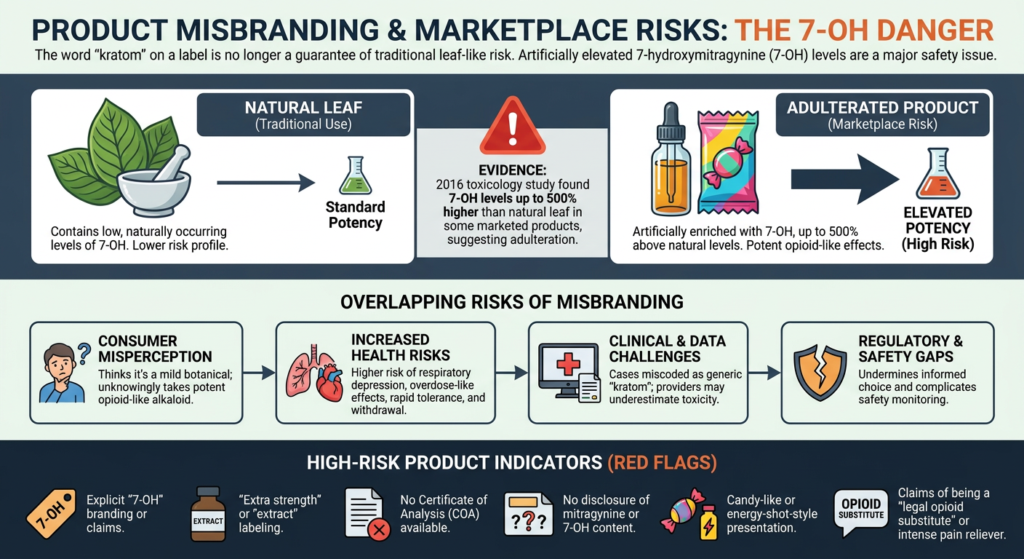
High-risk product indicators include:
- Explicit “7-OH” branding
- “Extra strength” or “extract” labeling
- Products with no certificate of analysis
- No disclosure of mitragynine or 7-OH content
- Candy-like or energy-shot-style presentation
- Claims of being a legal opioid substitute or intense pain reliever
Special Populations at Higher Risk
Pregnancy
Available sources consistently warn that kratom and 7-OH act on opioid receptors and may cross the placenta, potentially leading to fetal dependence and neonatal abstinence syndrome. Reported risks include maternal dependence and withdrawal, neonatal abstinence syndrome, low birth weight, premature birth, feeding difficulties, and developmental complications.
Given the opioid-receptor activity and stronger potency of 7-OH, the prudent safety conclusion is that neither kratom nor especially concentrated 7-OH should be considered safe during pregnancy. The concern is particularly strong for 7-OH due to higher potency and potential for greater fetal exposure.
Children and Adolescents
Pediatric vulnerability is heightened due to developmental neurobiology, lack of safeguards, and youth-appealing marketing practices. Products sold as gummies, candies, tablets, and energy-shot-style formulations create accidental ingestion and misuse risks. Health officials specifically advise residents to keep 7-OH products away from children and pets and to read labels carefully when buying candies or supplements.
Role of Polysubstance Use
A recurrent theme across surveillance and forensic literature is that polysubstance use amplifies risk. Commonly implicated co-exposures include alcohol, sedatives, opioids, antidepressants, stimulants, and cannabinoids. The CDC found multiple-substance exposure reports were linked to the most severe clinical outcomes.
Combining kratom or 7-OH with other central nervous system-active substances can significantly worsen outcomes, especially for respiratory depression and altered mental status. Some people may underestimate risk when a product is marketed as “herbal” or “natural,” but in reality, these combinations can be dangerous.
Regulatory Actions Targeting 7-Hydroxymitragynine
In 2025, the FDA took steps specifically targeting concentrated 7-OH products, including warning letters and a recommendation that the DEA classify concentrated 7-OH products under the Controlled Substances Act. Crucially, this recommendation reportedly did not apply to kratom leaf.
The FDA also stated that there are no FDA-approved 7-OH drugs and that 7-OH is not lawful in dietary supplements or conventional foods.
The regulatory separation between natural kratom leaf and concentrated 7-OH is not arbitrary. It reflects the same evidence pattern summarized throughout this article: low natural leaf 7-OH, direct opioid activity of 7-OH, stronger toxicity and abuse liability when concentrated, rapidly growing retail availability, and worsening surveillance signals.
What to Do If You or Someone Else Experiences Adverse Effects?
Because 7-OH acts on opioid receptors, naloxone should be used if opioid overdose is suspected, and emergency services should be contacted immediately. Naloxone may not fully reverse mixed-substance toxicity, but it remains appropriate first-line overdose action.
Signs of a serious reaction include:
- Trouble breathing or slow breathing
- Loss of consciousness or extreme drowsiness
- Confusion or agitation
- Seizures
- Rapid heart rate
- Sweating and cold sweats
If you or someone you know is struggling with kratom or 7-OH use, dependence, or withdrawal, professional help is available. Treatment approaches may include medications for opioid use disorder such as buprenorphine, behavioral therapies, and supportive care tailored to individual needs.
Key Takeaways
The most important health message is not merely that kratom has risks, but that the modern marketplace increasingly contains products labeled as kratom that are pharmacologically closer to potent opioid formulations than to botanical leaf. Product type matters more than the label “kratom.”
If a product contains concentrated or stand-alone 7-OH, it should be approached as a substantially higher-risk opioid-like substance, not as a conventional botanical supplement.
Traditional kratom leaf is safer than concentrated 7-hydroxymitragynine, but neither is fully safe. The greatest health risk today is not only kratom itself, but the increasing sale of concentrated 7-OH products under the kratom umbrella. For consumers, clinicians, and regulators, the practical implication is straightforward: product type matters more than the label “kratom.”
If you are concerned about substance use or need support for yourself or a loved one, reach out to Summit’s addiction treatment professionals who can provide evidence-based care personalized to your situation.