Outpatient vs inpatient rehab comes down to one question: can you stay safe and keep progressing while living at home, or do you need round the clock support? Inpatient care is the safer bet if you have had withdrawal seizures or delirium before, since a prior history of delirium tremens nearly triples the odds of severe withdrawal happening again. This guide breaks down the medical and home factors that separate outpatient and inpatient treatment, so you can choose with confidence.
Outpatient vs Inpatient Rehab: What Sets Them Apart
At the most basic level, outpatient care means you live at home and attend treatment for a set number of hours each week. Inpatient or residential care means you stay at a facility where staff can watch and support you around the clock.
Clinicians rarely decide based on a diagnosis alone. Most use a framework called the ASAM Criteria to weigh several areas of your health and life at once, including withdrawal risk, medical conditions, mental health, ongoing substance use risk, your home environment, and your own preferences and barriers. Two people with the exact same diagnosis can land in different settings because their risk in these other areas looks nothing alike.
Outpatient treatment itself covers a wide range of intensity. Standard outpatient care might mean a few hours a week. A step up from there, intensive outpatient programs generally run 9 to 19 hours weekly, and partial hospitalization adds even more daytime treatment without an overnight stay. Inpatient and residential programs, by contrast, provide staffing at every hour, which matters most during the window when withdrawal symptoms can suddenly get worse.
The real difference between inpatient and outpatient rehab is not the label on the building or how comfortable the facility looks. It is whether your current risks can be managed safely while you sleep in your own bed each night, and whether help is close enough if something changes at 2 a.m.
Medical Signs That Point to Inpatient Care
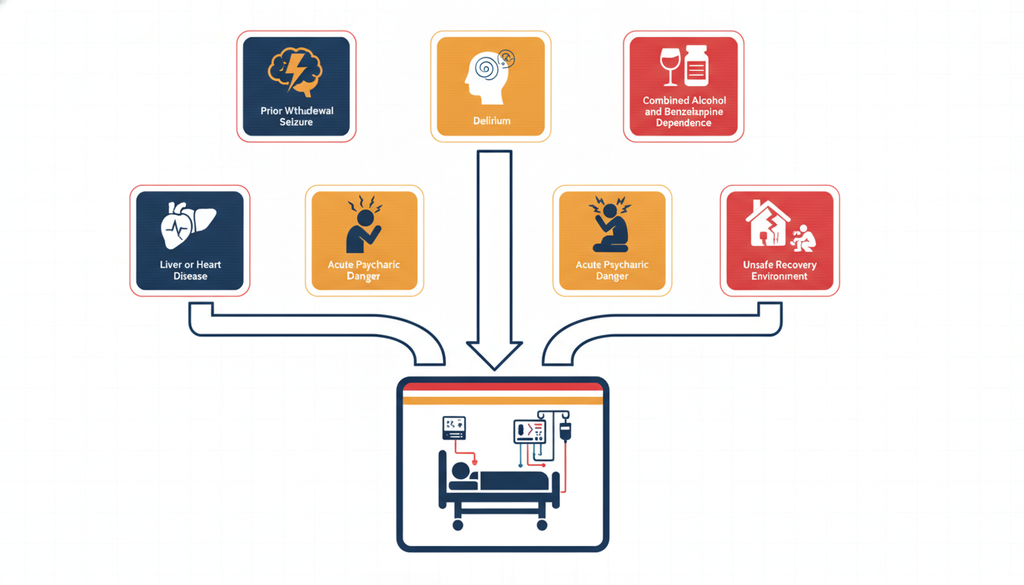
Some findings shift the balance strongly toward inpatient or medically managed care. A past withdrawal seizure or episode of delirium tremens is one of the clearest. Research shows a delirium tremens history meaningfully raises the risk of severe withdrawal happening again, even years later and even if the person feels fine at the moment they ask for help.
Why one bad night matters more than it seems
Withdrawal is not a fixed event. Someone can look mild and steady during an early check in, then get much worse hours later as alcohol clears their system. That is one reason clinicians look hard at how many times someone has gone through withdrawal before, not just how it looks right now. Repeated withdrawal episodes can sensitize the nervous system over time, sometimes called kindling, which can lower the seizure threshold with each new cycle.
Combining alcohol with benzodiazepines or other sedatives adds another layer of danger. Both substances calm the same part of the brain, so stopping them together at home can trigger more severe withdrawal than either substance alone would cause. Serious medical conditions such as liver disease, heart disease, or a recent head injury raise the stakes further, since withdrawal symptoms can mask or worsen an existing illness that needs its own care. Older age matters here too, since the body often has less reserve to absorb a rough few days.
Mental health carries just as much weight as physical health. Active suicidal thoughts, psychosis, or severe confusion call for a setting built to manage that risk at every hour, not a weekly appointment with a gap in between.
Signs that often call for inpatient or medically managed care include:
- A past withdrawal seizure or episode of delirium tremens
- Heavy alcohol use combined with benzodiazepine or sedative dependence
- Serious medical conditions like liver disease or heart disease
- Active suicidal thoughts or an inability to stay safe alone
- No sober, stable place to recover once a program day ends
- Repeated outpatient attempts that have not held so far
No single item on that list automatically means you need inpatient rehab. ASAM’s own guidance notes that several risks together carry more weight than any one risk alone, which is why two people can share a diagnosis and still need two very different plans. A mild tremor by itself rarely tips the scale. That same tremor next to a prior seizure, daily benzodiazepine use, and an empty house at night tips it fast.
Home Life Factors That Support Outpatient Care
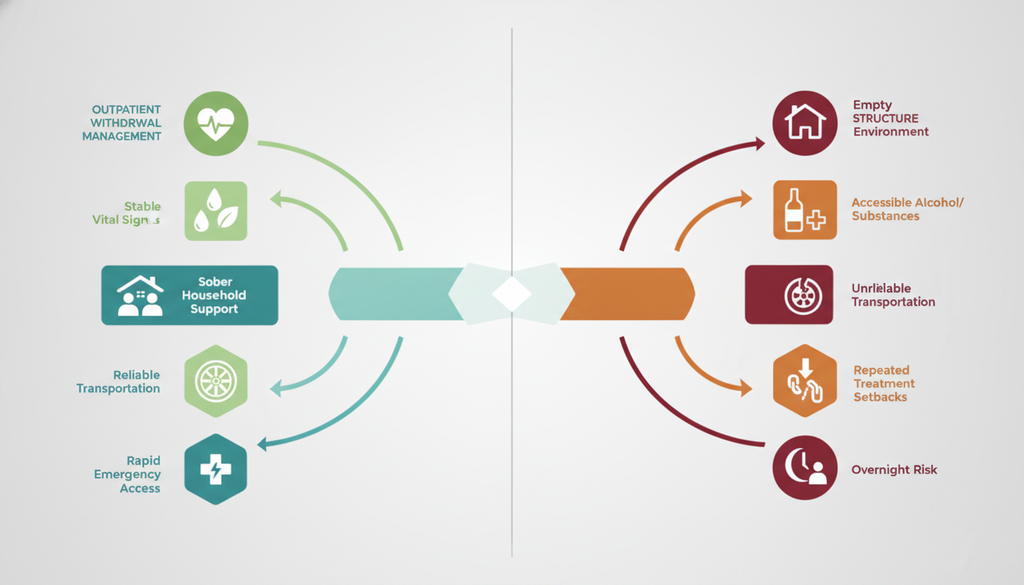
Outpatient treatment tends to work well when the picture looks different from what was described above. Stable vital signs, no history of seizures or delirium, and manageable current symptoms are a good starting point. From there, your home life carries real weight in the decision.
A safe household without easy access to alcohol or drugs, a sober person who can check in on you, reliable transportation, and the ability to reach help quickly all support outpatient care. Clinicians sometimes describe this as after hours oversight: if no one can watch for warning signs once the clinic closes for the day, that gap alone can push the decision toward residential care, even when the medical picture looks fairly mild. The reverse is also true. A steady partner, a phone that works, and a short drive to the emergency room can make outpatient treatment a genuinely safe choice for someone whose withdrawal risk is otherwise low.
Work, school, and caregiving responsibilities are legitimate parts of this decision too, not distractions from it. A parent with no childcare backup, or an employee who would lose a job over a month long absence, has real constraints worth naming out loud to a treatment team. Outpatient and intensive outpatient programs let people keep those responsibilities running while still getting meaningful treatment hours during the day or evening.
Consider someone with several months of daily drinking, mild shakiness, stable vitals, no history of seizures, a partner who does not drink, and a car. That combination often supports outpatient or intensive outpatient care with close monitoring in the first week. Change just one detail, say the partner also drinks heavily, and the same person may need a more structured setting instead.
How Insurance Decisions Shape Your Level of Care
Most commercial insurers lean on similar clinical thinking when deciding what they will pay for. They generally ask whether a lower level of care could meet your needs just as safely, using what is sometimes called the least intensive standard for coverage decisions. That standard is meant to prevent both under treatment and over treatment, though it does not always land the same way in practice.
Insurance approval is often not a one time decision either. Many plans use something called concurrent review, checking in every few days to decide whether continued residential care is still needed. A person who has stabilized inside a structured program can look calm and compliant, which sometimes leads an insurer to push for a quicker step down than the person’s actual home situation can support. Documentation that spells out what specifically would still go wrong outside that structure tends to hold up better than a general request for more time.
Federal parity rules add another layer of protection. Under federal parity rules, a plan generally cannot apply stricter approval rules to addiction treatment than it applies to comparable medical care within the same type of benefit.
If your plan denies a request for inpatient or residential treatment, you have the right to push back. A detailed clinical picture, not a general request for more time, tends to carry the most weight with reviewers. Providers and patients can appeal a denial and ask the insurer exactly which criteria and clinical tool it used to reach that decision.
Choosing Outpatient vs Inpatient Rehab for You
Weighing outpatient vs inpatient treatment is rarely about picking the option that sounds less disruptive to your week. It is about matching the setting to your actual, current risk, not the risk you had last year or the risk a friend had in a similar situation.
Start with your withdrawal and medical history. Add your mental health status and any recent close calls, including hospital visits or near misses. Then look honestly at your home life: who is there, what substances are within reach, and whether you could get help quickly if things got hard overnight. When several risks stack up together, inpatient vs outpatient rehab stops being a close call and starts looking like an obvious answer either way.
Talk through all of this with a clinician who can walk you through your own specific risk factors rather than a generic checklist. Ask what signs would move you up or down the continuum over time, and what the plan looks like if your situation changes partway through treatment. A good provider should be able to explain their reasoning in plain terms, not just hand you a level number.
Why the Right Level of Care Matters
Getting this decision right protects more than your schedule. Withdrawal management by itself is not a substitute for full treatment of a substance use disorder, whether it happens at home or inside a facility. The setting you choose should connect smoothly into ongoing therapy, medication support, and relapse prevention work, rather than standing alone as a single event with nothing planned afterward.
Choosing too light a setting can leave real risks unmanaged during the exact window when things are most likely to go wrong. Choosing far more structure than you need can drain money, time, and motivation you will want later in recovery. Neither mistake is harmless. The goal is not the most intense option or the most convenient one. It is the setting that keeps you safe right now while still supporting the work you have left to do.
If you are trying to sort out where you or someone you love fits on that spectrum, a team that offers care across the full continuum can help you look at your specific history and home life honestly. Check out a program that treats both ends of that range so you can explore treatment options built around what you actually need, not a one size fits all schedule at The Summit Wellness Group.