Wondering how long to wait after a drink before nursing again is one of the top questions about breastfeeding and drinking alcohol. In short, wait about two hours per standard drink, since a 68 kg parent who has four drinks needs roughly nine hours before milk is alcohol free. This guide covers the real timing rules, what pumping does, and when drinking needs more than a clock.
Breastfeeding and Drinking Alcohol: The Basics
Alcohol moves from your bloodstream into your milk easily, since it is a small molecule that crosses cell membranes without much trouble. As your blood alcohol level rises, the alcohol in your milk rises too, and as your blood alcohol falls, so does the level in your milk. This close match between blood and milk, confirmed by the lactation drug database, explains why timing is what actually clears alcohol from milk, not any home remedy.
Drinking alcohol while breastfeeding on occasion is generally treated as manageable by major pediatric guidance, as long as you give your body time. Alcohol in milk usually peaks somewhere between 30 and 60 minutes after a drink, though eating something can push that peak later and lower it a bit. A study cited in the 2023 clinical protocol found blood and milk alcohol levels moving in step among nursing parents who were tracked closely after drinking.
A lot of people reach for coffee, water, exercise, or a cold shower hoping to speed things along, but none of that changes how fast your liver breaks down alcohol. Food can lower how high your blood alcohol climbs and delay the peak, which is genuinely useful, but it does not create a shortcut to zero. The only thing that reliably brings milk alcohol down is time, and alcohol does not sit trapped in breast tissue waiting to be pumped out later once your blood alcohol has already dropped.
How Long After Drinking Can You Breastfeed
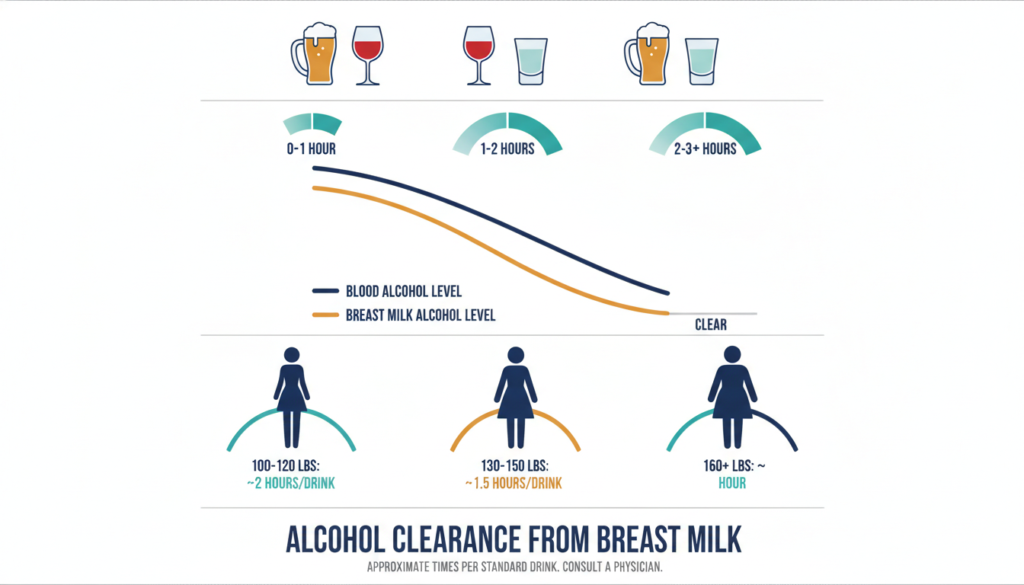
If you are asking how long after drinking can I breastfeed, the two hour rule is the place most parents start. This is not exact science, since body weight, food, and how fast you drink all shift the number a bit, but it is a solid starting point for occasional drinking, one backed by pediatric group guidance on infant feeding after alcohol.
The wait should stack as drinks add up rather than staying fixed at two hours. One drink means about two hours. Two drinks push that closer to four hours. Three drinks call for roughly six hours, and four drinks land near eight hours by the simple math, though your body weight changes that estimate quite a bit.
A More Exact Number
For a sharper figure, the weight based estimates built from actual clearance studies break the timing down by body size for a drink holding about 12 grams of alcohol.
| Body Weight | Time To Clear One Drink | Time To Clear Four Drinks |
| 54 kg (120 lb) | About 2.5 hours | About 10 hours |
| 68 kg (150 lb) | About 2.25 hours | About 9 hours |
| 82 kg (180 lb) | About 2 hours | About 8 hours |
Start the clock when you finish your last drink, not when you took your first sip. If you start a glass of wine at 7:00 and finish at 7:45, the waiting window begins at 7:45. Someone who has two drinks by 8:30 should push the estimate to roughly five hours out using the more precise weight based numbers, landing near 1:30 in the morning rather than assuming a flat four hour rule covers it.
Keep in mind that a standard drink is smaller than most people pour at home. In the United States, one standard drink holds about 14 grams of pure alcohol, which works out to a 12 ounce beer, a 5 ounce glass of wine, or a 1.5 ounce shot of liquor. A big restaurant pour or a cocktail built with two shots often counts as two standard drinks, not one, which is a common reason the two hour rule seems to fail in real life. It has not failed, the count was just off.
Can You Drink While Breastfeeding Without Losing Supply
Can you drink while breastfeeding and still keep your supply steady? Mostly yes with light, occasional drinking, but alcohol is not a supply booster despite the old myth that beer helps letdown. The letdown reflex research summarized by lactation specialists shows alcohol can actually blunt the letdown reflex and reduce how much milk your baby takes in during the hours right after you drink, with five or more drinks capable of disrupting nursing until your levels fall back down.
In small studies, babies who nursed after their parent drank took in less milk over the following few hours, then often made up for it later on. Sleep changed too. Babies had more frequent but shorter stretches of sleep in the roughly four hours after exposure, not the deep restful sleep that alcohol sometimes gets credit for. None of this means one glass of wine will harm a healthy full term baby. It does mean alcohol and breastfeeding do not mix quite as smoothly as some old advice suggests, and it is one more reason the waiting window is worth following rather than skipping.
Rules for Breastfeeding and Drinking Alcohol
The simplest habit that helps almost everyone is to nurse or pump before your first drink rather than right after. This gives you the longest possible stretch before your baby needs to eat again, and it keeps you from feeding during the window when alcohol in your milk is still climbing toward its peak, a point backed by breastfeeding support group guidance for nursing parents.
Counting your drinks honestly matters just as much as watching the clock. A restaurant pour of wine or a cocktail made with two shots is often closer to two standard drinks than one, so the real wait should double even though it looked like a single glass.
When breastfeeding and drinking alcohol both fit into your evening plans, a little prep goes a long way. Pump or nurse before that first drink, keep some alcohol free milk stashed in the freezer for the times your baby eats sooner than expected, and line up a sober adult who can step in if you end up needing more time than planned.
If your baby feeds unpredictably, such as a newborn, a baby in a growth spurt, or one with feeding trouble, timing gets a lot less reliable. In those cases it often makes more sense to skip alcohol that night or lean on milk pumped earlier in the day, especially for babies who were born early or have health issues, since a young liver clears alcohol more slowly than an adult one does.
Drinking Alcohol and Pumping Breastfeeding: What It Changes
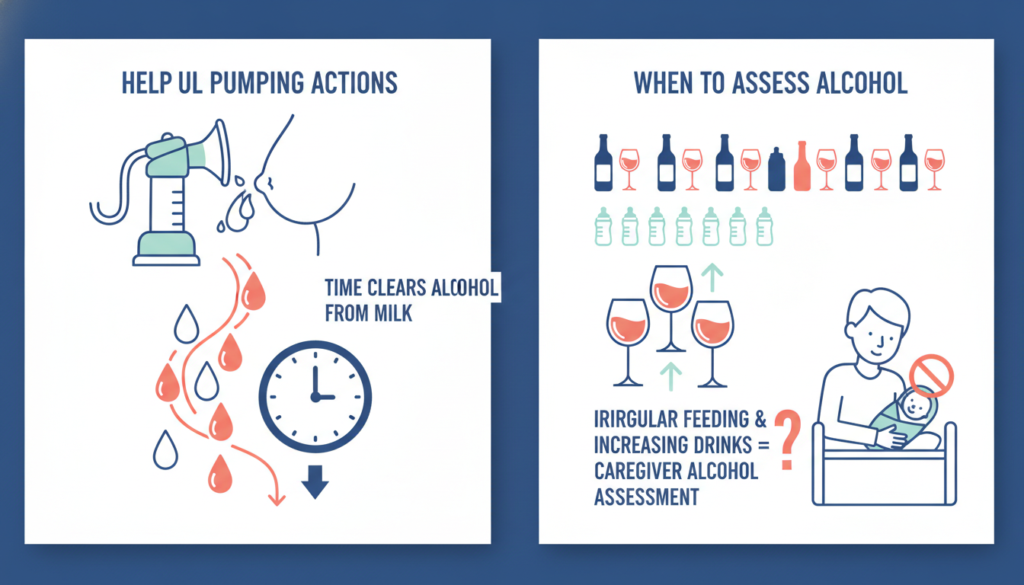
Pump and dump is a phrase that gets tossed around constantly, but it does not speed anything up. Alcohol leaves your milk only as your blood alcohol falls, so pumping out a bottle and tossing it will not make the next bottle alcohol free if your blood alcohol is still elevated, according to postpartum care guidelines covering alcohol use after delivery.
That said, pumping still has a real job to do. It can ease painful fullness, keep your supply steady if a feeding gets pushed back, and lower your risk of clogged ducts while you wait out the clock. If you are weighing drinking alcohol and pumping breastfeeding milk on the same night, the safest split is simple. Milk expressed before you started drinking is fine to store and use later. Milk expressed while alcohol is still active in your system should be dumped if you need relief for comfort, not saved for a feed. Once enough time has passed, go right back to your normal routine without any extra pumping just for the sake of it.
When Timing Alone Is Not Enough
A single drink handled with a two hour wait is one thing. A nightly glass of wine, drinks that pile up night after night, or feeds that get rescheduled again and again to make room for drinking are something else entirely. None of this automatically means a parent has alcohol use disorder, but it does mean the clock has stopped being the main tool that matters, based on postpartum screening guidance used by many clinicians.
Signs Worth a Second Look
A few patterns are worth paying attention to. Drinking most nights, needing more than one drink to feel the same relief, drinking mainly to manage stress or poor sleep, trouble cutting back once you start, and repeatedly pumping and dumping because drinking keeps interfering with feeds are all signals that a conversation with a doctor or lactation consultant would help more than a longer wait time would. A short three question screening tool many clinicians use, often called AUDIT-C, can open that conversation without turning it into an accusation.
Heavy drinking also raises a danger that has nothing to do with what is in your milk. Alcohol dulls how easily you wake up and respond, which matters most overnight. Safe sleep guidance from official safe sleep guidance is clear that babies should sleep alone, on their backs, on a firm flat surface built for infants, never in an adult bed, on a couch, or in a recliner, and that risk climbs sharply if the adult nearby has been drinking. A parent who is intoxicated should not bedshare or attempt overnight care alone, no matter how the milk timing works out.
Why This Matters for You and Your Baby
Getting the timing right protects your baby from a completely avoidable exposure while still letting you enjoy a night out or a glass of wine with dinner now and then. It does not mean occasional drinking makes you a bad parent, and it does not mean every drink is a crisis. What it does mean is that a two hour wait works for what it was built for, which is occasional, honest, single drink situations. It was never meant to manage nightly use, escalating amounts, or drinking that is quietly taking over feeding decisions and nighttime safety.
Knowing the difference between an occasional drink and a pattern that needs help is what keeps both the timing rule and your baby safe. If you are unsure which side of that line you are on, that uncertainty alone is worth bringing to a clinician.
If drinking has started running your feeding schedule instead of the other way around, you deserve support that does not force you to choose between recovery and breastfeeding, and you can explore treatment options built around real evidence and your goals at The Summit Wellness Group.